


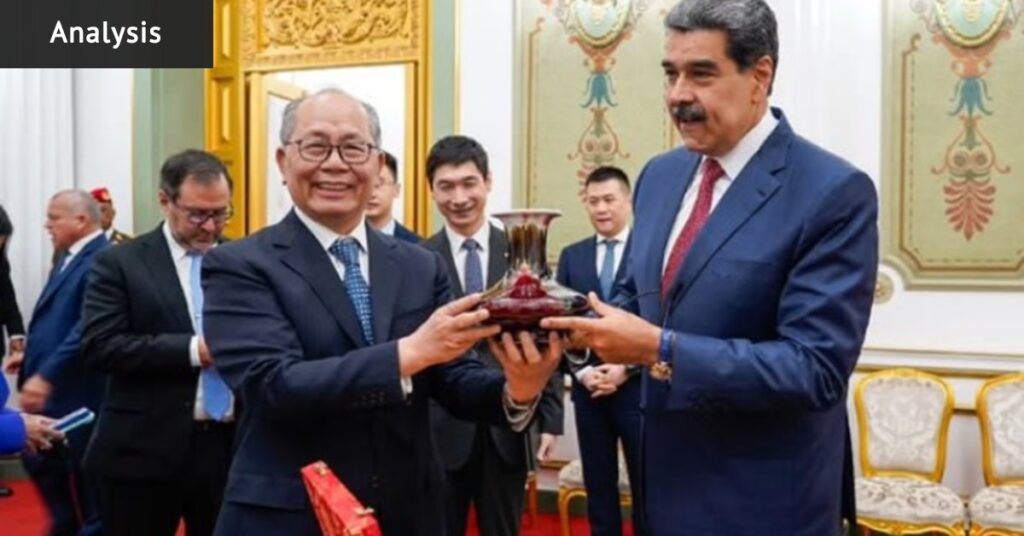
Hours before US forces captured Nicolás Maduro in a dramatic raid in Caracas, the Venezuelan leader was seen hosting Beijing’s special envoy for Latin American affairs at the presidential palace. The meeting, which took place just before the US operation, highlighted the strong ties between Venezuela and China, as Maduro expressed gratitude to Chinese President Xi Jinping, describing him as an “older brother.”
The encounter, documented on Maduro’s social media, has become a source of embarrassment for Beijing, given the timing of the US military action. Shortly after, images circulated by former US President Donald Trump showed Maduro shackled and blindfolded aboard a US warship, en route to face narco-conspiracy charges in New York. Maduro declared himself a “kidnapped president” and a “prisoner of war” during the proceedings.
Beijing’s Reaction and Global Implications
The events have elicited a strong response from Beijing, which has accused Washington of overstepping international norms. Chinese state media have criticized the US, portraying the incident as another instance of American imperialism, where international laws are secondary to US interests. This narrative is bolstered by legal scholars who argue that the US intervention likely breaches international law prohibitions on the use of force.
“We have never believed that any country can act as the world’s police, nor do we accept that any nation can claim to be the world’s judge,” said Chinese Foreign Minister Wang Yi.
Dylan Loh, a Chinese foreign policy expert at Nanyang Technological University in Singapore, notes that while Beijing can use this situation to position itself against US power, it also serves as a stark reminder of American military capabilities.
Economic and Strategic Complications
The removal of Maduro introduces economic challenges for China, Venezuela’s largest oil buyer. Despite the oil trade being a small fraction of China’s total imports, the outstanding $12 billion in loans to Venezuela poses a significant financial concern. The broader implications of this event also touch upon the ongoing US-China rivalry, particularly concerning Taiwan.
As the US’s actions in Venezuela spark discussions, parallels are drawn with the Taiwan situation. The US’s ability to remove a leader it deems illegitimate raises questions about its stance on Taiwan, which China views similarly. However, experts argue that the situations are not directly comparable due to the legitimacy of Taiwan’s democratic elections versus Maduro’s controversial rule.
“This view flips the logic of realism: it implies that if the US were perfectly law-abiding, others would be too, but China’s foreign policy follows its own calculus,” Loh explains. “Trump’s move is not suddenly going to delay or hasten China’s plans.”
Future Prospects and International Dynamics
Bonnie Glaser, an Indo-Pacific expert at the German Marshall Fund, believes the capture of Maduro is not a template for China’s potential actions against Taiwan. Instead, Beijing is likely to continue using non-military tactics to influence Taiwan’s political landscape, confident that time favors its reunification goals without military conflict.
Ryan Hass, former China director on the US National Security Council, suggests that Beijing will use the Venezuela incident to argue for greater latitude in international law, similar to what it perceives the US has taken.
“Privately, I expect Beijing will emphasize to Washington it expects to be given the same latitude for great power exemptions to international law that the US takes for itself,” Hass noted.
As Trump eyes further geopolitical moves, such as his interest in Greenland, the Venezuela strike may signal a shift in how international law is interpreted and enforced, potentially reshaping global order throughout 2026.