




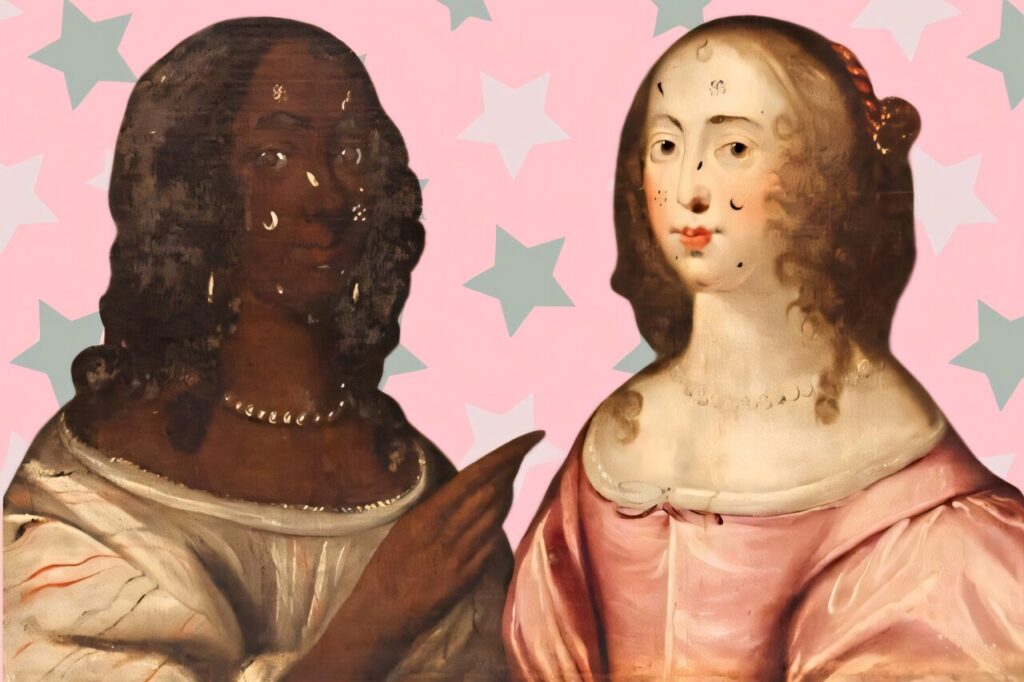
You may have noticed people out and about with little stickers on their faces. Perhaps you’ve seen moons, stars, clouds, or even smiley faces adorning people’s cheeks and chins. Maybe you wear them yourself. While some people do wear them as accessories, these colorful stickers are medicated “pimple patches,” designed to treat spots or acne.
Some of the patches simply contain a gel formula, which keeps the emerging blemish moist to aid healing. Some wearers opt for near-transparent film patches to get the benefit in a more inconspicuous way. Far from a new fad, beauty patches have a long history, tracing back to 17th-century Europe.
The Historical Roots of Beauty Patches
The trend of beauty patches first took off in 17th-century Europe, with patches made from paper, silk, velvet, or even fine leather, cut into lozenge shapes, stars, or crescent moons. These patches were often black, creating a stark contrast to the idealized pale face of western upper-class men and women. This complexion was a status symbol, indicating they did not work outdoors.
Mentions of patches occur regularly in print from the late 16th and early 17th century. Just like today, beauty patches had a dual function. In his 1601 play Jack Drum’s Entertainment, John Marston explains that:
“Black patches are worn, some for pride, some to stay the rheum, and some to hide the scab.”
Some were worn for aesthetic reasons, while others, sometimes medicated, were used to dry up sores or conceal blemishes like scars from diseases such as smallpox or syphilis.
Moral and Social Implications
This latter use of patches was controversial. An anonymous book from 1665 claimed a chaplain of King Charles I had compared beauty patches to the biblical mark of Cain, suggesting they invited plague epidemics:
“black-patches and beauty-spots … were Forerunners of other Spots, and Marks of the Plague.”
Other moralists criticized patches for concealing true appearances, likening them to makeup that presented a false front.
By the 18th century, patches were linked to sexual promiscuity. William Hogarth’s 1731 series A Harlot’s Progress depicted the fall of a country girl, Moll Hackabout, tricked by brothelkeeper Elizabeth Needham, whose face was covered with black patches.
Fashion and Function in the Restoration Era
Civil servant Samuel Pepys frequently mentioned patches in his diary between 1660 and 1669. He noted their use among fashionable women and even sported one himself in 1664. The fashion for patches rose during the Restoration era (1660–1700) as royalist exiles returned from the Commonwealth with French fashions.
English writer Mary Evelyn described the fashionable French term for patches as “mouches” or “flies,” reflecting their popularity. Her poem The Ladies Dressing-Room Unlock’d, published posthumously in 1690, satirized the Francophile fashions of Restoration London.
The Modern Pimple Patch Trend
While today’s pimple patches may not provoke the moral backlash of the past, they are not without their critics. Some corners of the internet mock those who wear visible spot patches in public. Yet, whether they work or not, pimple patches remain a harmless accessory.
From the late 17th century, books began to refer to patch boxes, ornate containers designed to hold patches. Fashionable individuals carried silver boxes for their velvet or silk patches. Perhaps this will be the next development in the modern pimple patch craze.
The enduring appeal of pimple patches, both as a cosmetic and practical tool, underscores a timeless human desire to manage and conceal blemishes. As trends evolve, the historical context of these seemingly simple accessories offers a fascinating glimpse into the intersection of fashion, health, and societal norms.