



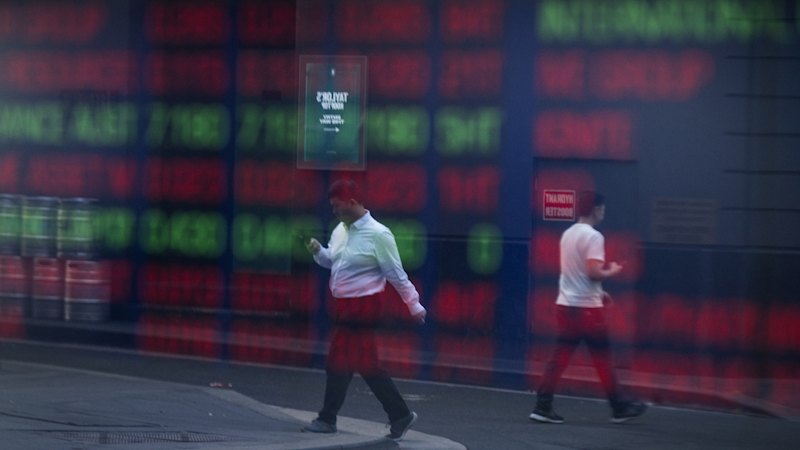
The trend of withdrawing from Australian assets is gaining momentum as investors redirect their capital to more promising global markets. This shift is driven by the pursuit of higher returns, which seem more attainable abroad than within Australia’s own borders.
Prominent financial institutions like MLC Asset Management and JPMorgan Asset Management have expressed expectations for stronger equity returns overseas. Meanwhile, T. Rowe Price anticipates the Reserve Bank of Australia’s (RBA) hawkish monetary policy will lead to a flatter yield curve for bonds.
The Australian market’s lackluster performance is underscored by the S&P/ASX 200 Index’s underperformance in 2025 and declining bond prices as the central bank considers tightening monetary policy. “We’re under-allocated to Australia,” stated Patrick Nicoll, head of asset allocation at MLC, highlighting the challenges in outperforming in 2026. “We’re also short duration in Australia, expecting [bond] yields to rise” as the RBA raises rates.
Investor Concerns and Market Performance
Investor apprehension is largely centered around weak profit growth among major Australian companies. The Commonwealth Bank, which constitutes about 10% of the ASX 200, saw its gains trimmed following a November update that raised concerns over valuation and margin pressures. Biotech giant CSL also faced a challenging year, recording its worst performance in over two decades due to disappointing earnings and a sluggish US vaccine market.
Analysts predict that Australian stocks may see gains of less than 5% over the next year, significantly lower than the projected rally of the MSCI All-Country World Index, which is expected to be three times higher. According to Penny Heard, head of equities at UniSuper, future earnings growth will be driven by cyclical metals and a mining sector recovery, contingent on inflation and interest rate trends. In contrast, sectors focused on domestic markets, such as industrial and consumer discretionary, may face hurdles.
Impact of RBA Policy on Debt and Currency
The RBA’s hawkish stance has significantly impacted the nation’s debt market. Traders anticipate further rate hikes by June, with a one-third probability of an increase as early as February, according to Bloomberg’s swaps data. This anticipation has driven yields on Australia’s 10-year bonds to the highest levels among developed nations. A Bloomberg gauge indicated that debt returns in Australia rose 2.3% in 2025, compared to a 6.8% return from international counterparts.
Despite these challenges, there are some positive aspects. The RBA’s policies have narrowed the three- to 10-year bond gap to approximately 60 basis points, a figure that T. Rowe Price expects to shrink further as rate hike debates continue, according to Scott Solomon, a portfolio manager in London. Additionally, the rate differential with the US, where rates are declining, could elevate the Australian dollar to US70¢ by mid-year, a level last seen in February 2023. As of Monday, the currency was trading just below US67¢.
Shifts in Investment Strategies
The anticipation of higher interest rates has prompted a shift from banking stocks to mining stocks, driven by rising metal prices and a robust currency. The Australian sharemarket continues to offer a dividend yield of around 3.2%, nearly double the 1.8% yield of MSCI’s global gauge.
Nonetheless, despite these relative advantages, Australia is expected to remain a global underperformer as the AI theme dominates North Asian and US stock markets. “Investors have a pretty constructive outlook for Australia relative to where it has been,” noted Kerry Craig, a global market strategist at JPMorgan in Melbourne. “But we would still see international markets doing better.”
As global markets continue to evolve, investors and analysts will closely monitor the interplay between domestic policies and international opportunities, shaping strategies to optimize returns in a dynamic economic landscape.