




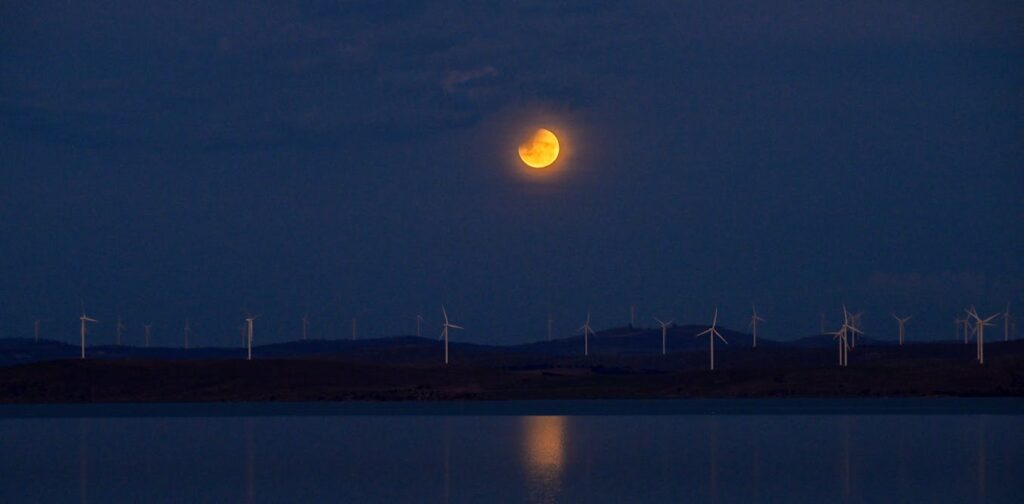
The southern sky in 2026 promises a celestial showcase with a total lunar eclipse, a blue Moon, a supermoon, and a rare planetary alignment. These events, visible to the naked eye even in light-polluted urban areas, offer a feast for skywatchers and photographers alike. This astronomical year will also feature the annual meteor showers and the nightly parade of constellations, best viewed from dark rural locations but still visible from cities.
March, May, and December: Lunar Highlights
On the evening of Tuesday, March 3, a total lunar eclipse will occur, turning the full Moon a striking red or coppery hue. This phenomenon results from Earth’s atmosphere bending sunlight onto the Moon, with the red light being the glow of global sunrises and sunsets. Lunar eclipses are entirely safe to observe with the naked eye and present excellent opportunities for nighttime photography. For optimal results, use a camera or phone capable of timed exposures and stabilize it on a tripod.
From southeastern Australia, totality will occur between 10:04 PM and 11:03 PM local time. In Brisbane, the times will be an hour earlier, while in Perth, they will be three hours earlier. In Aotearoa New Zealand, totality will begin just after midnight.
Another lunar event, a “blue Moon,” will grace the sky on Sunday, May 31. This term refers to the second full Moon in a single calendar month, occurring approximately once every two to three years. The year concludes with a “supermoon” on Christmas Eve, Thursday, December 24. This event happens when a full Moon coincides with the Moon’s closest approach to Earth in its orbit, making it appear slightly larger than usual. The supermoon is most spectacular at moonrise, where an optical illusion magnifies its size when near the horizon.
April, June, and November: Planetary Alignments
Before dawn from April 19 to 22, the planets Mercury, Mars, and Saturn will form a tight grouping in the eastern sky. This rare alignment provides a unique opportunity for early risers to witness a celestial dance of planets.
On the evenings of June 9 and 10, the two brightest planets, Venus and Jupiter, will pass within three moon-widths of each other. This close encounter offers a stunning visual treat for both amateur and professional astronomers.
On November 3, the crescent Moon will occult Jupiter during the day, visible with binoculars. However, caution is advised to avoid pointing binoculars at the Sun, and children should be fully supervised. In Sydney, the Moon will cover Jupiter at 10:40 AM and reveal it again at 11:39 AM.
December: Geminid Meteor Shower
Mid-December presents an excellent opportunity to observe the Geminid meteor shower, one of the year’s most prolific. This shower occurs as Earth passes through a stream of dust left by the asteroid Phaethon. As these particles burn up in the atmosphere, they create brief streaks of light known as meteors.
The peak of the shower is expected in the early morning of Tuesday, December 15. For the best viewing experience, find a dark spot and look towards the north. The meteors will appear to radiate from a point near Castor in the Gemini constellation. This year, the absence of moonlight will enhance visibility.
January and December: Taurus and the Constellations
The constellation Taurus, the Bull, will be a focal point in 2026. To locate Taurus, extend a line downward from Orion’s belt to the bright reddish star Aldebaran, which forms the Bull’s head. This constellation is upside down in the southern hemisphere, as it was named in the north.
Taurus also hosts the Hyades star cluster and the Pleiades, known as the Seven Sisters. While most people can see six stars in the Pleiades with the naked eye, hundreds are visible through a telescope. Recent astronomical studies suggest the Pleiades contain 20 times more stars than previously estimated.
These celestial events in 2026 offer a rare chance to connect with the universe’s wonders, bridging the gap between ancient stargazers and today’s astronomers. Whether you’re a seasoned skywatcher or a curious newcomer, the southern sky promises a year of awe-inspiring spectacles.