


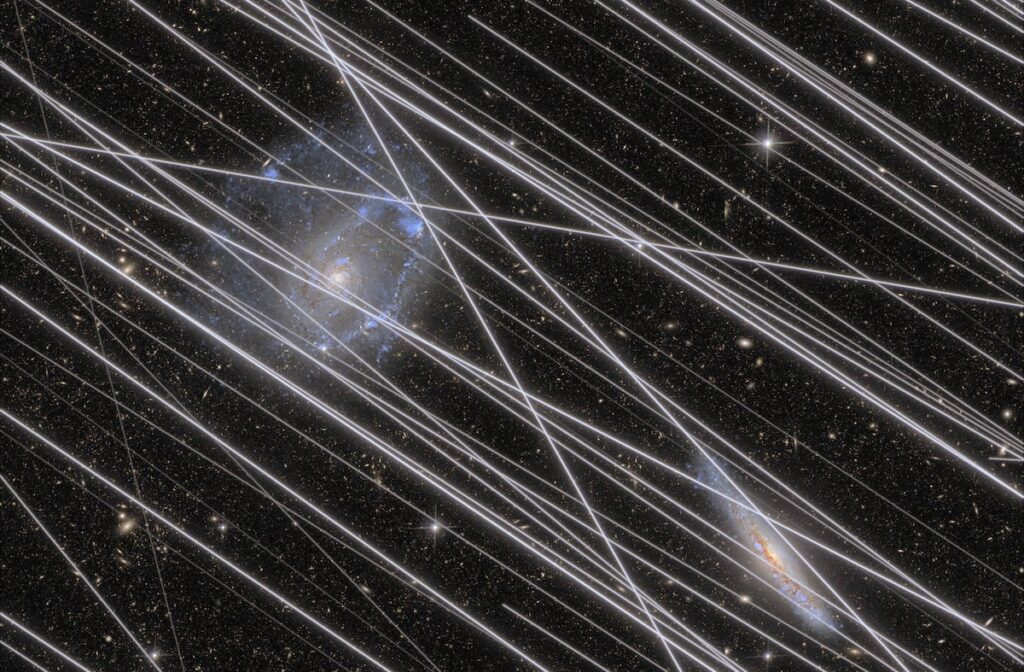
First came the curious lights in the sky after nightfall, surprising astronomy enthusiasts worldwide. These luminous trains, caused by Elon Musk’s Starlink satellite network, initially sparked excitement among stargazers. However, the enthusiasm quickly turned to concern as astronomers observed the satellites’ bright trails disrupting their telescope images, leaving them streaked with intense white lines.
Elon Musk responded to these concerns by promising improvements to minimize the effects. Yet, these changes were never fully implemented. Instead, Musk urged scientists to look beyond ground-based observatories and venture further into space. Now, a new NASA study warns that even space telescopes like the Hubble are not immune to the threats posed by satellite constellations.
Impact on Space Telescopes
The research, led by Spanish astrophysicist Alejandro Serrano Borlaff, reveals that if plans to launch large constellations like Starlink proceed, at least one in three Hubble images will be contaminated by satellite light. These constellations have already sought authorization to launch over 500,000 satellites.
“This is the first scientific study whose main objective is to investigate the effects of light pollution on space telescopes, taking into account these plans announced by the industry,” said Borlaff from NASA’s Ames Research Center in Mountain View, California.
The consequences could be even more severe for the new generation of space telescopes. One such mission is ARRAKIHS, the European Space Agency’s (ESA) first mission scientifically led by Spain. According to Borlaff’s study, published in the journal Nature, satellite streaks could appear in 96% of images from this future European telescope.
Hubble and SPHEREx at Risk
The veteran Hubble Space Telescope and the upcoming SPHEREx, set to launch in 2025, are two NASA telescopes in low Earth orbit, an area now crowded with over 9,000 Starlink satellites. The study predicts that with 560,000 satellites in orbit, nearly 40% of Hubble’s images will contain at least one satellite streak. For SPHEREx, the contamination could reach up to 99%.
Borlaff explains that the impact of these artificial streaks depends on the scientific goals of each investigation. If observations can be repeated or combined, data correction is possible, albeit at a cost. However, if satellite streaks contaminate time-sensitive observations or searches for moving objects like asteroids, the effects could be significant.
“One of the fields that could be most affected is the search for asteroids potentially hazardous to Earth,” Borlaff warns.
ARRAKIHS and the Debate
ARRAKIHS, designed to point toward the zenith to study dark matter, was conceived by scientists from the Institute of Physics of Cantabria in Spain. Rafael Guzmán, the team leader, praises Borlaff’s research but disputes its conclusions regarding ARRAKIHS.
“Unfortunately, Borlaff’s article is wrong about ARRAKIHS. Our binocular camera will be oriented perpendicular to Earth, reducing satellite interference,” Guzmán notes.
Carlos Corral, head of the ARRAKIHS project at ESA, supports Guzmán’s assertion, expressing surprise at Borlaff’s data. “Our estimates indicate a much smaller impact, around 1% of images,” Corral says, emphasizing ARRAKIHS’s robustness against cosmic rays and satellite interference.
Wider Implications
Corral acknowledges the broader implications for other missions, highlighting the growing issue of space debris and potential collisions. “Filling the sky with tens of thousands of satellites is not a good idea,” he concludes, noting that the problem affects both ground-based and space telescopes.
This development follows a growing debate over the balance between technological advancement and its impact on scientific research. As satellite networks expand, the astronomy community faces the challenge of adapting to a new era where the night sky is increasingly crowded.
The move represents a significant shift in the landscape of space exploration and observation. As the debate continues, the scientific community must navigate these challenges to ensure the integrity of astronomical research and the safety of space missions.