




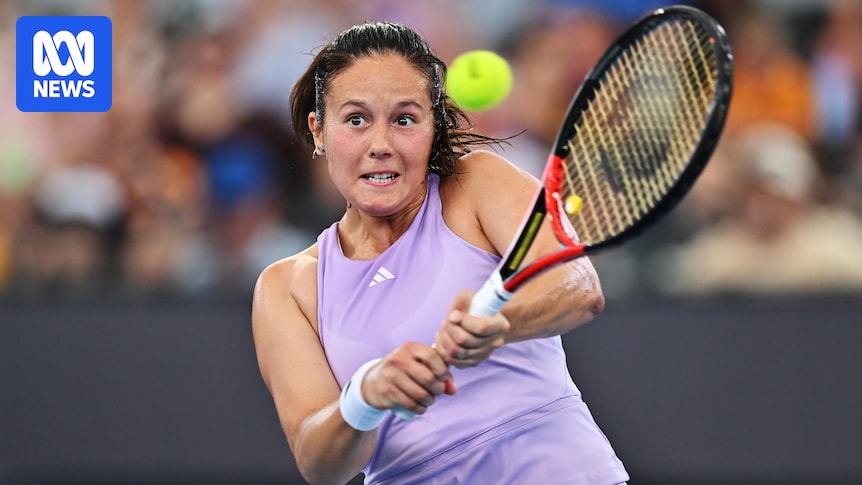
Daria Kasatkina, who recently switched her sporting allegiance from Russia to Australia, faced a challenging return to the Brisbane International, succumbing to a three-set defeat against Anastasia Potapova. The match, which ended 7-5, 4-6, 6-4 in favor of Potapova on Sunday, was a test of nerves and emotions for Kasatkina, who admitted to holding back tears during the game.
The former world number eight, known for her powerful baseline play, struggled with her serve throughout the match, a factor that ultimately led to her defeat. Kasatkina, 28, was playing her first match in Australia since her nationality change, a decision influenced by her opposition to the war in Ukraine and her coming out as gay.
Emotional Return and Future Aspirations
Kasatkina’s return to the Australian courts was marked by significant emotional stress, both on and off the court. Earlier in October, she had decided to end her 2025 season prematurely, citing these pressures. Her Brisbane match was particularly poignant, as she faced Potapova, who herself had recently switched allegiance from Russia to Austria.
Despite finding some rhythm in her serve to push the match to a third set, Kasatkina could not overcome her opponent, with a crucial service game ultimately sealing her fate. “Stepping on court and I heard the cheer — I almost started crying but I was able to hold it,” Kasatkina reflected. “I’ve been through a tough year. Now I’m fine, but I have to get out of that deep hole.”
“Sixteen double faults, many at crucial moments, represented a ‘nightmare’ Kasatkina is constantly working on.”
Looking ahead, Kasatkina acknowledged the self-imposed pressure she feels to perform well in upcoming tournaments like the Adelaide International and the Australian Open. “Nobody’s putting this pressure on me, only I do because I want to represent Australia and when it’s not happening, I feel bad,” she said. “I want to pay back to the country.”
Ajla Tomljanović Advances
While Kasatkina’s journey at the Brisbane International ended prematurely, Ajla Tomljanović, another player with a compelling backstory, advanced to the second round. Tomljanović defeated France’s Elsa Jacquemot with a decisive 6-1, 6-3 victory. The Australian, a former world number 32, has faced her own challenges, including physical and mental health issues, which have impacted her career in recent years.
“I really struggled to just enjoy what I’ve been doing for this long, and I really had to dig deep to just find it again,” Tomljanović shared. Ranked 80th in the world, she noted a mental shift mid-season that helped her regain her passion for the sport. “In the middle of the season I made a bit of a switch in my head and just looked at everything in a way that I’m just grateful to still be here. Certain things started to click.”
Tomljanović will face the 11th seed, Karolína Muchová, in the second round, a match that promises to test her renewed resolve and competitive spirit.
Implications and Future Prospects
The Brisbane International has been a stage of emotional and competitive challenges for players like Kasatkina and Tomljanović, reflecting broader themes of resilience and adaptation in the world of professional tennis. Kasatkina’s journey underscores the complexities athletes face when navigating personal and professional transitions, while Tomljanović’s progression highlights the potential for renewal and success following adversity.
As the tennis season progresses, both players will continue to capture the attention of fans and analysts, with their performances offering insights into the evolving dynamics of the sport. The upcoming Adelaide International and Australian Open will be crucial tests for Kasatkina as she seeks to establish her new identity on the court, while Tomljanović aims to build on her current momentum.
In the world of tennis, where personal stories often intersect with professional achievements, the narratives of Kasatkina and Tomljanović serve as powerful reminders of the human elements that drive athletic competition.