




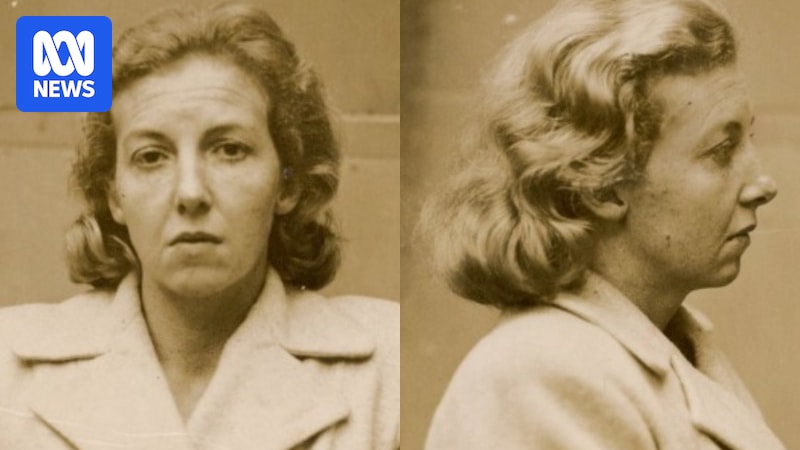
Handwritten letters from Jean Lee, the last woman executed in Australia, have emerged among documents made publicly accessible for the first time in decades. The capital case file of Lee, sealed for 75 years under the Public Records Act, is now open to the public, shedding light on a controversial chapter in Australian legal history.
Jean Lee was hanged in 1951 alongside her partners in crime, Robert Clayton and Norman Andrews, for the 1949 murder of bookmaker William ‘Pop’ Kent in Carlton, Melbourne. Lee’s execution, the first of a woman in Victoria since 1895, remains a topic of debate 75 years later.
A Life of Crime and a Notorious Murder
Born in Dubbo, New South Wales, Jean Lee was described by authorities as coming from “respectable law-abiding parents.” Her life took a turn after marrying at 18 and becoming a mother a year later. Following her separation in 1942, Lee struggled as a single mother, resorting to sex work and petty crime for survival.
Her criminal record, detailed in the case file, includes multiple arrests for theft and solicitation. Lee’s relationship with Robert Clayton, a petty criminal, marked a turning point. Together, they orchestrated a blackmail scheme, exploiting compromising situations for financial gain.
In 1949, Lee, Clayton, and Norman Andrews traveled to Melbourne for the Spring Racing Carnival, targeting ‘Pop’ Kent for his alleged cash stash. Their plan escalated to violence when they failed to find the money, culminating in Kent’s murder.
The Trial and Its Aftermath
The trial’s 436-page transcript, part of the newly released documents, details the police case against the trio. After their arrest, Clayton implicated Lee and Andrews, while Lee initially remained silent before confessing under pressure. Her attempt to recant during the trial was unsuccessful, and all three were convicted and sentenced to death in March 1950.
“I didn’t do it. I didn’t do it,” Lee protested in court, while Clayton’s outburst at the jury underscored the trial’s tension.
Despite the Court of Criminal Appeal initially quashing their convictions due to improper police methods, the High Court upheld them, dismissing Lee’s confession concerns. A subsequent appeal to the Privy Council in London was thwarted by financial constraints, despite public donations to support their case.
Public and Political Reaction
The execution of Jean Lee, a woman, drew significant public and political attention. Labor leader John Cain publicly opposed the death penalty, emphasizing the gravity of executing a woman after more than half a century.
“The decision to hang Lee — a woman — is a course that has not been taken for over half a century and regardless of political feeling must be looked on with grave concern by most citizens,” Cain stated in December 1950.
Despite appeals from various groups, including the Labor Women’s Organising Committee, public sentiment largely favored the execution, and the government proceeded with the sentence.
The Final Days
Jean Lee, Robert Clayton, and Norman Andrews were executed on February 19, 1951. Observations from the Gaol Medical Officer, included in the case file, noted their lack of remorse, with Lee showing emotional distress only when discussing her daughter.
“Jean Lee made certain admissions to me but denied taking any part in the crime herself,” the officer wrote, highlighting her emotional reaction to her daughter’s photograph.
In the hours before her execution, Lee reportedly threw her last meal at a prison warden. A reporter from The Truth documented the execution, describing Lee as being carried “limp and fainting” to the gallows. She was 31 at the time of her death, and all three were buried within Pentridge Prison’s walls.
The case file also contains poignant letters from Clayton and Andrews, requesting their belongings be sent to loved ones. Andrews sought a refund for an unused airplane ticket, while Clayton asked for his possessions to be forwarded to his mother.
The release of these documents offers a rare glimpse into a contentious period in Australian history, reigniting discussions about capital punishment and its implications. As the public delves into these files, the story of Jean Lee and her co-accused continues to resonate, reflecting broader societal debates on justice and morality.