




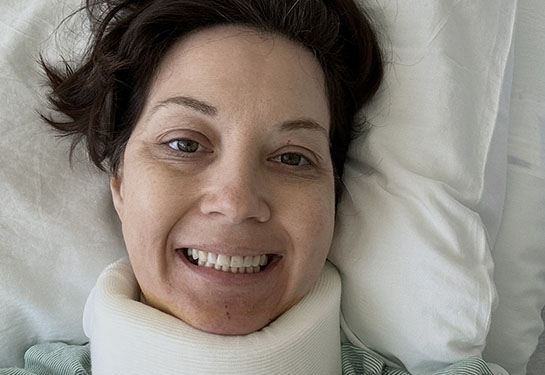
Around four years ago, Hannah Polach, 42, began experiencing numbness and tingling in her arms that would wake her from a deep sleep. By 2024, her arms went numb every time she sat down, and she felt a pinch in her neck whenever she looked up. Despite starting physical therapy near her home in Tulare County, her symptoms persisted.
“I was having to stand a lot of the time, and it affected my sleep,” recounted Polach, an emergency room nurse. “My x-rays looked fine, but I knew something was wrong.”
An MRI revealed Polach was suffering from degenerative disc disease, resulting in herniations and nerve root compression. Despite undergoing more physical therapy, epidural corticosteroid injections, trigger point injections, and taking pain medications, relief was elusive. The misery finally led her to seek surgery to relieve the nerve compression.
Choosing the Right Surgical Option
Initially apprehensive about surgery, Polach consulted with three other orthopedic surgeons before selecting Safdar Khan, a professor in the UC Davis Health Department of Orthopaedic Surgery and the Peter and Sophie Pappas Endowed Chair in Spine Surgery. Khan recommended an innovative spinal implant called the Simplify Cervical Disc, designed to restore mobility and relieve discomfort.
“Dr. Khan took time to explain the procedure, where others made me feel rushed and uncomfortable,” Polach said. “I felt confident going with a reliable institution like UC Davis.”
Understanding Degenerative Disc Disease
Degenerative disc disease can result from advanced age, physical trauma, or genetic factors, causing damage to the soft, flexible discs between each vertebra that allow for spinal mobility. Approximately 400 million people worldwide are diagnosed with the disorder annually.
At UC Davis Health’s new outpatient surgery center, 48X Complex, orthopedic surgeons like Khan apply advanced surgical techniques to improve mobility for patients like Polach. In her case, Khan replaced Polach’s degenerating discs with the new type of cervical discs, which can relieve pressure on irritated nerves.
“When I met Hannah, she was in considerable distress,” Khan said. “The pain was really impairing her ability to experience life’s joys.”
Innovations in Spinal Surgery
Traditionally, patients like Polach might have faced spinal fusion, a procedure where damaged discs are removed and affected vertebrae are fused together, restricting motion. However, this can lead to additional issues.
“Data suggests nearly 23% of patients develop further pathologies above and below the operation site within a decade of fusion surgery,” Khan explained.
While fusions are suitable for some, Khan strives to help patients maintain mobility. In Polach’s case, he recommended implanting two Simplify Cervical Discs.
“This FDA-approved device is on the leading-edge of options available for patients with neck and arm pain that is resistant to physical therapy, anti-inflammatory medications, or pain-relieving injections,” Khan explained.
The Simplify Cervical Disc
The synthetic discs consist of a ceramic core sandwiched between two plates of medical-grade plastic coated with titanium. Their dynamic cores allow for flexible movement of the spine. The device has been approved for replacement of up to two adjacent discs.
“This technology can allow patients to continue what they love to do and perhaps add more activities,” Khan said. “A disc replacement may actually enhance a person’s quality of life.”
The Surgical Procedure
To install the replacement discs, Khan made a small incision in front of Polach’s neck and used a microscope and other precision instruments to remove the damaged discs. Under x-ray guidance, he sized the prostheses to relieve nerve pressure. He created small slots in her vertebrae and slid the new discs between them, ensuring their fit through imaging.
The procedure lasted around an hour and fifteen minutes. Polach stayed at the 48X Complex until she was stable enough to drive and returned home with a soft collar to protect her neck. Patients with severely limited mobility prior to surgery will likely require physical therapy within a few weeks of the procedure.
“I could definitely tell the first night that the numbness and tingling in my arms was gone,” she said. “It was an immediate fix, and I’m no longer taking any nerve pain medications or cortisone injections.”
“At UC Davis, we pride ourselves in providing superb care,” Khan said. “Anyone with severe, unrelenting neck and arm pain should reach out for an evaluation. We’re happy to see if they qualify for a disc replacement procedure.”
This development in spinal surgery offers hope to millions suffering from degenerative disc disease, providing a path to regain mobility and improve quality of life.