




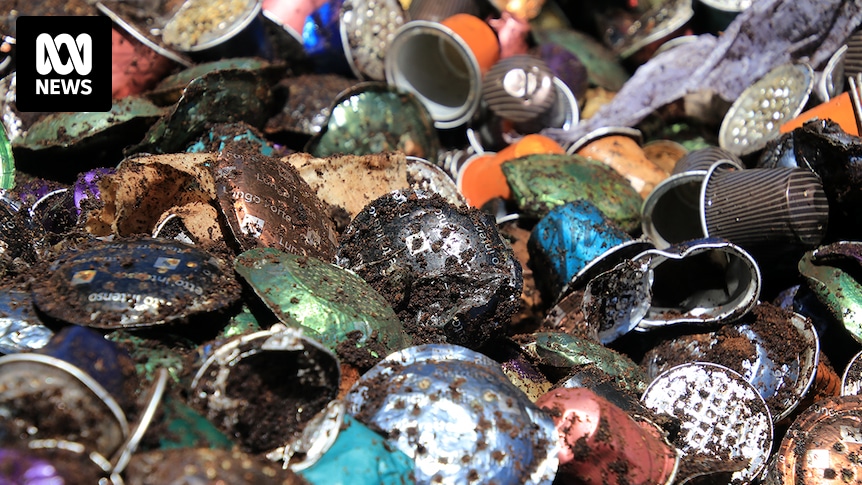
For many caffeine enthusiasts, coffee pods provide a convenient shortcut to a fresh cup of brew at home, offering a cheaper alternative to café purchases. However, this convenience comes at an environmental cost. Since their introduction to Australia in the 1990s, an estimated three million coffee pods are used daily across the country. With only 10 to 20 percent of these pods being recycled, the rest contribute to thousands of tonnes of waste, primarily ending up in landfills.
Designer Lizzie Burscough is among those taking action to address this growing waste issue. For the past six years, she has been upcycling used coffee pod shells into colorful earrings. “I saw [the used coffee pods] and I just wondered,” she said, explaining how her curiosity led to an initiative that has diverted around 40,000 coffee pods from landfills. “I can use the entire pod, everything except the seal that gets perforated,” Burscough noted, highlighting her commitment to sustainability.
Challenges in Recycling Coffee Pods
Despite efforts like Burscough’s, recycling coffee pods remains a significant challenge. In their standard form, coffee pods cannot be disposed of in yellow-lidded recycling bins due to contamination risks from coffee grounds and the pods’ small size, which causes them to fall through cracks at recycling centers.
Tiziana Ferrero-Regis from the Queensland University of Technology’s School of Design elaborates on the complexity of recycling these pods. “Coffee pods, capsules, single serve, whatever we want to call them, they’re mostly non-recyclable or made from a mix of materials … polylaminate, aluminium, plastic,” she said. “These three layers need to be separated by hand, so it’s time and labour consuming.”
“When we ask [people] to do the right thing, we always go to the consumer … and that is like us being responsible for saving the planet, it’s a big ask,” Ferrero-Regis remarked.
She emphasizes that producers should take responsibility for their waste, as relying solely on consumers to dismantle and recycle pods is impractical.
Product Stewardship: A Path Forward
The concept of product stewardship, where companies take responsibility for their products throughout their lifecycle, is gaining traction. Some major brands have adopted schemes like paid-postage bags and corporate drop-boxes to reduce waste from their products. Australian not-for-profit Planet Ark is at the forefront of promoting a circular economy, aiming to minimize waste and provide solutions for products at the end of their life.
Beau Boundy, Head of Product Stewardship at Planet Ark, describes this approach as crucial for reducing waste. “All of the major producers of coffee pods are trying to do the right thing … but they need a system to bring [used pods] together, to collect and process them into other materials so they can stay in the circular economy,” he said.
“The efficiencies of having one system really can’t be underrated … the more [producers] that face the same direction, the cheaper the scheme becomes,” Boundy added.
Planet Ark has guided coffee pod industry leaders into a united product stewardship scheme known as PodCycle. This initiative, trialed since 2024 in parts of Victoria and New South Wales, allows coffee pods of all brands to be collected and recycled. Organizers plan to expand the scheme nationwide by 2026.
Looking Ahead: A Collaborative Effort
While PodCycle is still in its trial phase, it has already collected 55,000 pods, demonstrating its potential to scale up effectively. “That is the hope,” Boundy stated, “there is certainly a lot of moving parts here. We’ve collected 55,000 pods via that system … at the moment it’s more about the proof of that system working.”
Until the scheme is fully operational, the focus remains on educating consumers about proper disposal methods to prevent coffee pod waste from ending up in kerbside bins. “We all need to work together … to make sure that clear messaging is out there on how to keep these materials in the circular economy and out of landfill,” Boundy emphasized.
As Australia grapples with the environmental impact of coffee pods, initiatives like Burscough’s upcycling and the PodCycle scheme offer hope for a more sustainable future. The collaboration between consumers, producers, and organizations like Planet Ark is essential to tackling this complex issue and achieving long-term waste reduction goals.