




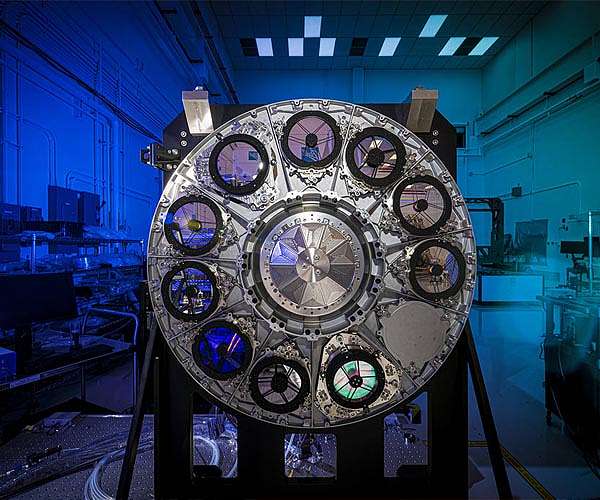
NASA’s Nancy Grace Roman Space Telescope team has unveiled ambitious plans for a groundbreaking survey designed to map the Milky Way in unprecedented detail. Over a span of two years, the Galactic Plane Survey will capture tens of billions of stars, revealing previously unseen structures of our galaxy.
“The Galactic Plane Survey will revolutionize our understanding of the Milky Way,” stated Julie McEnery, Roman’s senior project scientist at NASA’s Goddard Space Flight Center in Greenbelt, Maryland. “We’ll be able to explore the mysterious far side of our galaxy and its star-studded heart. Because of the survey’s breadth and depth, it will be a scientific mother lode.”
Revolutionary Survey Techniques
Set to launch as early as fall 2026, the Roman Space Telescope will conduct its first general astrophysics survey, marking a significant milestone beyond its core programs. At least 25% of Roman’s five-year mission is dedicated to proposals from astronomers worldwide, maximizing its potential for groundbreaking discoveries.
Unlike the European Space Agency’s Gaia spacecraft, which mapped approximately 2 billion stars in visible light, Roman’s infrared capabilities will penetrate dust clouds that obscure many parts of the galaxy. This “heat vision” will allow astronomers to see beyond the veil, offering a more comprehensive view of the galaxy’s structure.
“It blows my mind that we will be able to see through the densest part of our galaxy and explore it properly for the first time,” said Rachel Street, a senior scientist at Las Cumbres Observatory and co-chair of the committee that selected the survey design.
Exploring Cosmic Cradles
The survey will cover nearly 700 square degrees along the Milky Way’s glowing band, mapping up to 20 billion stars and detecting subtle shifts in their positions. This endeavor will provide insights into star formation, allowing astronomers to observe millions of stellar embryos and young stars, some potentially with planetary systems forming around them.
“This survey will study such a huge number of stars in so many different stellar environments that we’ll be sampling every phase of a star’s evolution,” Street explained.
By observing stars in various developmental stages, Roman will help unravel the forces shaping them. The survey will also examine nearly 2,000 young, loosely bound open clusters and dozens of ancient globular clusters, offering clues about the Milky Way’s early history.
Unveiling Stellar Mysteries
Roman’s capabilities extend to identifying stellar remnants such as white dwarfs, neutron stars, and black holes through gravitational microlensing. This phenomenon occurs when light from a background star is bent by the gravity of an intervening object, temporarily brightening the star.
A separate survey, the Galactic Bulge Time-Domain Survey, will focus on deep microlensing observations in the Milky Way’s heart. Roman’s Galactic Plane Survey will provide a comprehensive view of this complex environment, shedding light on ultratight binary objects and their interactions.
“Compact binaries are particularly interesting because they’re precursors to gravitational-wave sources,” noted Robert Benjamin, a visiting professor at the University of Wisconsin-Whitewater and co-chair of the survey design committee.
Implications and Future Prospects
Roman’s observations will also monitor stars that flicker, providing high-resolution snapshots of stellar outbursts and their aftermath. By studying stars that pulse rhythmically, astronomers can refine cosmic distance measurements, enhancing our understanding of the galaxy’s scale.
“Pairing Roman’s Galactic Plane Survey with other Milky Way observations will create the best portrait of the galaxy we’ve ever had,” Benjamin said.
The Roman Space Telescope’s mission represents a significant leap forward in our quest to understand the Milky Way. By unveiling hidden structures and offering new insights into star formation and evolution, it promises to deepen our knowledge of the galaxy we call home.