




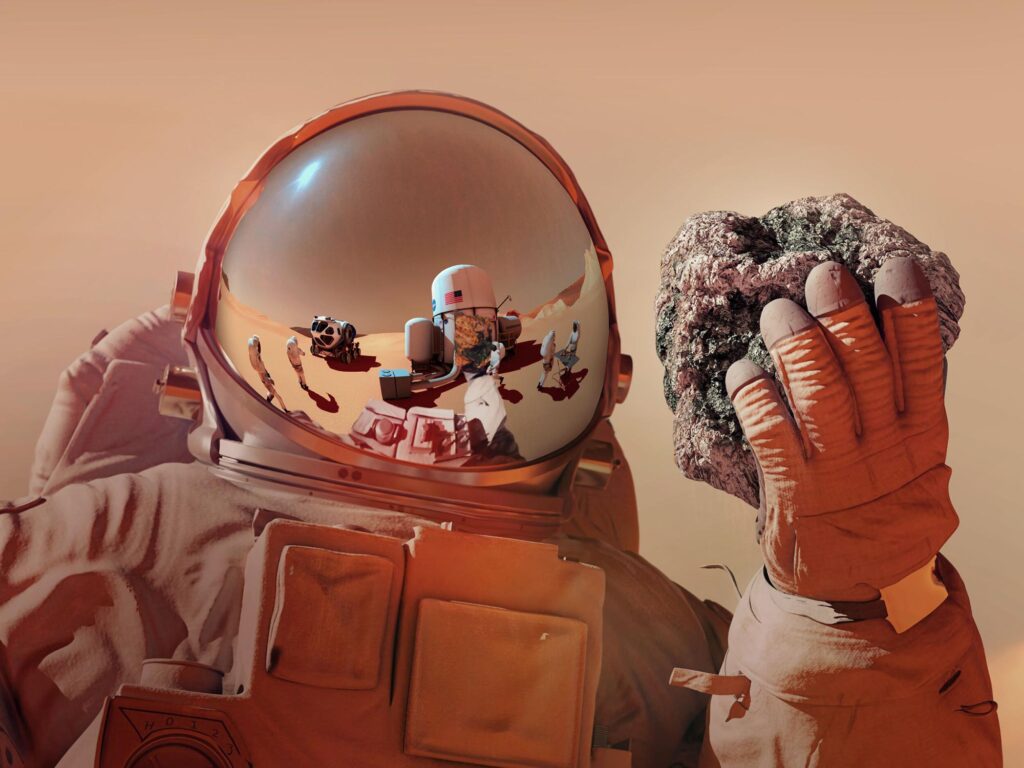
As humanity gears up for its first steps on Mars, a comprehensive report released on December 9 by the National Academies of Sciences, Engineering, and Medicine, guided by scientists at Penn State, sets a detailed science strategy for initial human missions to the red planet. Commissioned by NASA, the report identifies the highest priority scientific objectives and proposes four mission campaigns aimed at maximizing the scientific return from the first three human landings on Mars.
The report is designed to guide decision-makers in government and industry, the scientific community, and the general public. Researchers from Penn State played a pivotal role, contributing across multiple panels and influencing scientific priorities in atmospheric science, astrobiology, biological and physical sciences, and human health.
Strategic Objectives for Mars Exploration
According to Andrew Read, Penn State’s senior vice president for research, “Penn State expertise helped shape the nation’s highest priority science objectives and recommendations for human exploration of Mars. This is a thrilling moment for us as scientists. We are setting the guideposts that will transform our knowledge of Mars and, on a deeper level, our place in the cosmos.”
The 240-page report offers a science-driven roadmap for human Mars exploration, balancing scientific goals with NASA’s existing mission plans and technological capabilities. It acts as a scientific playbook for the first crewed missions to Mars, outlining the “what” and “why” of human exploration, as explained by James Pawelczyk, an associate professor at Penn State and a member of the report’s steering committee.
Innovative Approaches to Space Exploration
Pawelczyk, who has logged over 381 hours in space, remarked, “This report is considering exploration in a very different way than we have conducted human spaceflight before. We are considering the science of Mars itself, its geology, but there will also be the science of being on Mars.”
The report builds on NASA’s Moon to Mars Objectives, a framework using lunar missions to develop and test the requirements for human exploration beyond Earth. It identifies missing goals and proposes new objectives for the in-space phases of crewed Mars missions.
“Getting humans to Mars and back is a doable goal for the next 20 years,” said James Kasting, an emeritus Atherton Professor of Geosciences at Penn State.
Prioritized Scientific Campaigns
The report details crucial objectives across various scientific disciplines, prioritizing them into campaigns for the first three Mars landings. Each campaign includes a roadmap outlining equipment needs, landing site criteria, and key samples and measurements required before, during, and after human presence on Mars.
The top-priority objectives include:
- Determining evidence of habitability, indigenous life, or prebiotic chemistry within the exploration zone.
- Characterizing past and present water and CO2 cycles to understand their evolution.
- Mapping the geologic record and potential niche habitats to reveal Mars’s evolution.
- Assessing the impact of the Martian environment on crew health and confirming countermeasures.
- Understanding the onset and evolution of major dust storms.
- Characterizing the Martian environment for in situ resource utilization (ISRU).
- Examining the effects of the Martian environment on reproduction and genome functionality.
- Monitoring microbial population dynamics and species distribution for astronaut health.
- Assessing the effects of Martian dust on human physiology and hardware.
- Studying the impact of the Martian environment on plant and animal physiology across generations.
- Characterizing radiation levels to improve future mission risk models.
Implications for the Future
Pawelczyk emphasized the collaborative effort in creating the report, “If we’re successful, humans will have set foot on another planetary body, on another planet, for the first time. And the message we’re sending with this report is that science comes with us.”
Other Penn State contributors, such as Laura Rodriguez and Bruce Link, played significant roles in the report’s development, ensuring a robust scientific foundation for future Mars exploration.
The report’s release marks a significant milestone in the journey toward human exploration of Mars, setting the stage for scientific breakthroughs and new understandings of our place in the universe. As NASA and its partners work toward this ambitious goal, the insights from this report will be crucial in shaping the missions that could redefine human presence beyond Earth.