


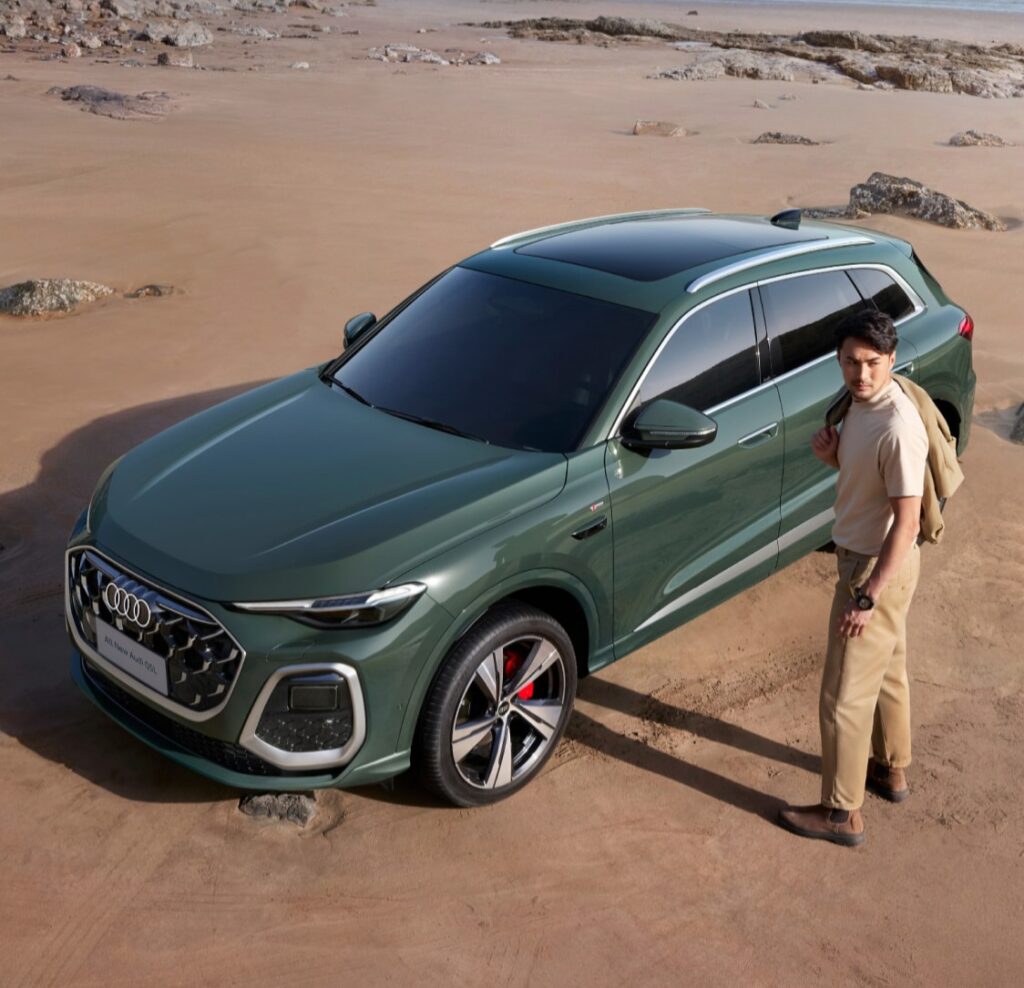
The all-new Audi Q5L, a product of the FAW–Audi joint venture, is now available for pre-order in China. The vehicle is offered in four trims, with prices ranging from 313,000 to 385,000 yuan (approximately 44,500 to 54,700 USD). This latest model is built on Audi’s PPC (Premium Platform Combustion) architecture and integrates Huawei’s Qiankun ADS technology in its high-end trims. The official launch is anticipated for early 2026.
The announcement comes as Audi continues to expand its footprint in the Chinese market, a region where the brand has seen significant growth. The Audi Q5, initially introduced in 2008, began local production in China in March 2010. The second-generation model made its debut at the 2016 Paris Motor Show and entered the Chinese market in 2018 as the long-wheelbase “Q5L”. This version, now available for pre-order, represents the third-generation long-wheelbase variant.
Design and Dimensions
The all-new Audi Q5L boasts dimensions of 4842/1900/1660 mm (length/width/height) and a wheelbase of 2945 mm. Compared to its predecessor, the new model is 72 mm longer, 7 mm wider, and 7 mm shorter in height, with a wheelbase increase of 38 mm. This evolution in size is designed to enhance interior space and comfort, catering to the preferences of Chinese consumers who often prioritize spaciousness in vehicles.
Notably, the vehicle introduces semi-hidden door handles and a projection-type high-mounted brake light, features exclusive to the Chinese market. The exterior is available in a variety of colors, including black, green, white, silver, and brown, offering consumers a range of aesthetic choices.
Technological Innovations and Performance
In terms of advanced driving assistance, the Audi Q5L is equipped with Huawei’s Qiankun technology, utilizing dual lidars to achieve map-free Level 2 driving assistance capabilities. This integration underscores the growing trend of automotive manufacturers partnering with tech companies to enhance vehicle intelligence and safety.
Under the hood, the Q5L is powered by an EA888 Evo5 2.0TFSI engine, similar to the Audi A5L. It offers a maximum power output of 200 kW for the high-power version and 150 kW for the lower-power variant. The vehicle features a 7-speed dual-clutch transmission system paired with Audi’s signature quattro all-wheel-drive system, promising robust performance across various driving conditions.
The suspension system comprises a five-link independent setup at both the front and rear axles, designed to provide a smooth and responsive driving experience.
Interior Features and Market Position
The interior of the Audi Q5L carries over from its overseas counterpart, featuring an 11.9-inch LCD instrument cluster and a 14.5-inch central touchscreen display. Additionally, a 10.9-inch entertainment screen is positioned in front of the co-pilot seat, and a 13.1-inch HUD system is available as an option. Connectivity features include Apple CarPlay and wireless charging, aligning with modern consumer expectations for technology integration.
In the competitive landscape, the Audi Q5L has performed impressively. In the first 11 months of this year, it achieved cumulative sales of 119,600 units. For context, the Mercedes-Benz GLC sold 117,200 units, while the BMW X3 sold 69,500 units in the same period.
“The Audi Q5L’s strong sales performance highlights its appeal in the Chinese market, where luxury and technology are key purchasing factors.”
Looking Ahead
The move to integrate Huawei’s advanced driving systems reflects a broader industry trend towards enhanced vehicle autonomy and connectivity. As Audi prepares for the official launch of the Q5L in early 2026, the focus will likely remain on leveraging technological advancements to maintain a competitive edge in the luxury SUV segment.
With the automotive industry rapidly evolving, the partnership between traditional car manufacturers and tech companies is expected to deepen, potentially reshaping the future of driving. The Audi Q5L, with its blend of luxury, technology, and performance, is well-positioned to capture the interest of tech-savvy consumers in China and beyond.