



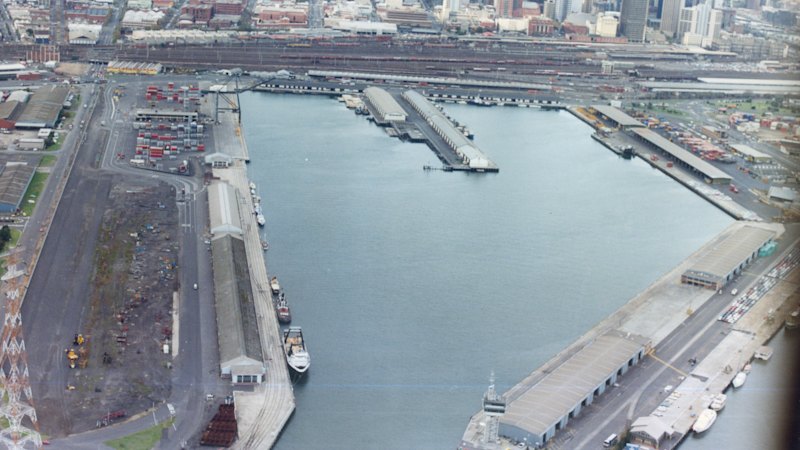
In the twilight of the John Cain and Joan Kirner governments, an alternative vision for Melbourne’s Docklands was quietly taking shape. Absent were the towering high-rises and stadiums that now define the area. Instead, plans focused on medium-density housing and a university campus, alongside a technology hub. The waterfront, once a derelict expanse of warehouses and wharves, was envisioned to include at least 10 percent public housing and a series of public squares.
These plans were detailed in state cabinet papers from 1990 to 1992, released for the first time on Thursday and reviewed by The Age. The documents reveal a project already mired in controversy, long before Docklands became one of Melbourne’s most debated suburbs. A senior public servant’s rebuke described the government’s push to advance Docklands development legislation as “beyond comprehension” amid a real estate slump and economic crisis.
The Olympic Dream and Internal Strife
In 1990, the government aimed to introduce legislation to establish the Docklands Authority, which would oversee the area’s transformation. Melbourne’s bid for the 1996 Olympics included plans for Docklands to host the athletes’ village. However, cabinet papers from August 1990, a month before Melbourne lost the bid to Atlanta, reveal deep divisions within the government.
An internal briefing from the Department of the Premier and Cabinet on August 3, 1990, criticized the creation of the authority as “irresponsible in the current economic climate” and warned it could inflate unrealistic development expectations. John Hartigan of the department’s development branch wrote,
“How one can justify raising expectations concerning a new massive property project like Docklands in the midst of possibly the largest real estate slump in recent history is beyond this department’s comprehension.”
Despite these warnings, the government proceeded with forming the authority, albeit after losing the Olympic bid to Atlanta. The documents suggest that many within the department viewed the legislation as a “bureaucratic agenda” exploiting the Olympic bid as a convenient excuse for urgency.
A New Vision for Docklands
While former Liberal Premier Jeff Kennett is often credited with transforming Docklands, the planning was already underway during the Labor government’s final years. Cabinet papers from 1991 and 1992 reveal a forgotten vision for Melbourne’s future: a high-tech city powered by an optical fiber ring and a global “teleport” satellite hub, designed to attract world-leading research in fields from medicine to transportation.
The 1992 planning documents advocated for a “low-rise environment” with few buildings exceeding 12 storeys. Medium-density housing and pedestrian-friendly, two-to-three-storey structures were prioritized. The Docklands Authority proposed that at least 10 percent of housing be public, with half of all residential development priced below $250,000 (in 1992 dollars).
At the heart of the vision was a 24-hectare education and research precinct. Initially, a “Docklands campus” shared by Victoria’s universities was proposed, later shifting to a postgraduate campus or international institution. Planners also argued for the Melbourne casino to be located in Docklands, citing its capacity to handle the traffic generated by a major casino compared to city center locations.
Ambitious Transport Proposals
Transport plans were equally ambitious, with proposals for a “rapid transit link” to Tullamarine Airport and a future “very fast train” terminal at Spencer Street Station. A $245 million tunnel, considered as an alternative to the Bolte Bridge, was discussed to allow cruise ships access to the inner docks. However, these transport proposals remain unfulfilled more than three decades later.
The Market Takes Over
The dire state of Victoria’s finances, marked by the collapse of the Pyramid Building Society and the forced sale of the State Bank of Victoria, coupled with the Kirner government’s defeat in 1992, ensured these ambitious plans never materialized. Treasury warnings at the time indicated that installing the necessary infrastructure would cost taxpayers at least $300 million over six years.
When Jeff Kennett took office in late 1992, he envisioned Docklands as a market-driven development without government subsidy. The site was divided into seven large precincts and sold to major developers to make the undertaking commercially viable. The economic constraints identified by the Department of the Premier and Cabinet in 1990 ultimately dictated Docklands’ fate. The Labor vision of low-rise housing, public quotas, and educational hubs was replaced by the high-density towers and private investment-driven planning that characterize Docklands today.
As Melbourne continues to evolve, the story of Docklands serves as a reminder of the complex interplay between government vision, economic realities, and market forces. The once-derelict area has transformed, yet the original plans for a tech-driven, low-rise community remain a fascinating ‘what if’ in the city’s history.