




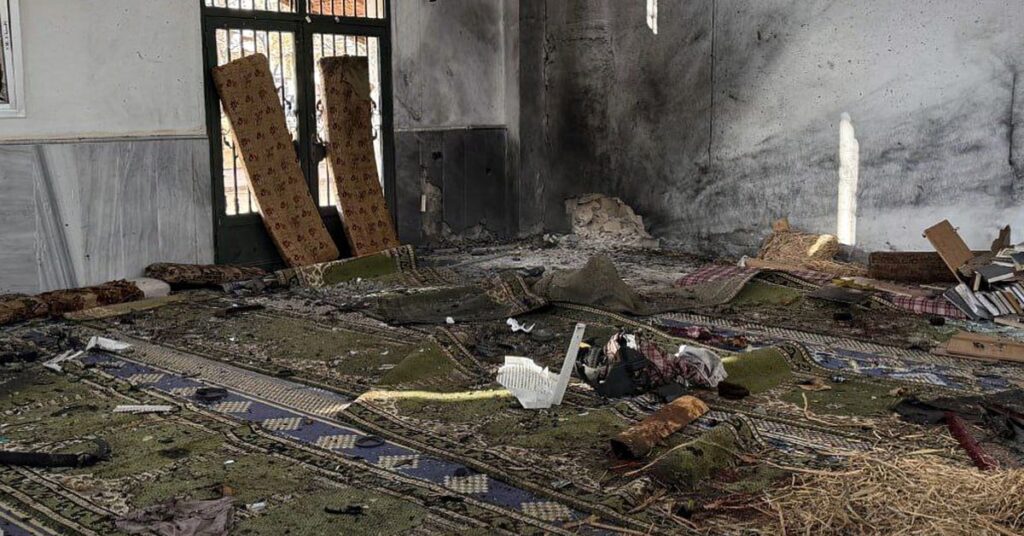
A devastating bombing at the Imam Ali ibn Abi Talib Mosque in Homs, Syria, during Friday prayers has left at least eight people dead and 18 others wounded. The attack underscores the persistent sectarian, ethnic, and political tensions that continue to destabilize the country, despite a decrease in large-scale conflicts.
Images released by Syria’s state-run Arab News Agency depicted a scene of destruction, with bloodstains on the mosque’s carpets, holes in the walls, shattered windows, and fire damage. The mosque is situated in Homs’ Wadi al-Dhahab neighborhood, an area predominantly inhabited by the Alawite minority.
Investigation and Responsibility Claims
According to a security source cited by SANA, preliminary investigations suggest that explosive devices were planted inside the mosque. Authorities have launched a search for the perpetrators, who remain unidentified, and a security cordon has been established around the site, as stated by Syria’s Interior Ministry.
A group calling itself Saraya Ansar al-Sunna has claimed responsibility for the attack via a statement on its Telegram channel. This group had previously claimed responsibility for a June suicide attack at a Greek Orthodox church in Dweil’a, near Damascus, which resulted in 25 fatalities.
“The explosion was huge,” said the mosque’s deputy imam. “It shattered the mosque’s windows and caused a fire that burned copies of the Holy Quran.”
Historical Context and Sectarian Violence
The bombing is the latest in a series of violent incidents targeting Syria’s Alawite community, which has faced increased hostility since the fall of President Bashar Assad last year. Assad, an Alawite himself, fled to Russia amid a wave of sectarian violence.
In March, an ambush by Assad supporters against security forces led to days of violence, resulting in hundreds of deaths, primarily among Alawites. The Supreme Alawite Islamic Council in Syria and the Diaspora condemned the mosque attack as part of “organized extremist terrorism specifically targeting the Alawite community.”
The council held the Syrian government “fully and directly responsible for these crimes,” warning that “these criminal acts will not go unanswered.” Local officials echoed these sentiments, describing the attack as a “desperate attempt to undermine security and stability.”
International Reactions and Regional Tensions
The attack drew swift condemnation from neighboring countries, including Saudi Arabia, Jordan, and Lebanon. Lebanese President Joseph Aoun expressed “Lebanon’s support for Syria in its fight against terrorism.”
Meanwhile, tensions have flared in other parts of Syria. On Monday, clashes erupted between Syrian government forces and Kurdish-led fighters in Aleppo, leading to temporary closures of schools and public institutions. A ceasefire was later announced, but skirmishes resumed on Friday with both sides trading blame.
“Remnants of the former regime, IS militants and collaborators have converged on a single goal: obstructing the path of the new state by undermining stability,” stated the Syrian information minister.
Implications and Future Outlook
The mosque bombing in Homs is a stark reminder of the ongoing challenges facing Syria as it seeks to rebuild and stabilize. The attack not only highlights the enduring sectarian divides but also the broader geopolitical struggles involving various factions within the country.
As Syria continues its efforts to combat terrorism and hold perpetrators accountable, the international community remains watchful. U.N. Secretary-General Antonio Guterres has “unequivocally condemned the deadly terrorist attack,” urging for justice and accountability.
The future of Syria remains uncertain, with ongoing violence threatening to derail progress towards peace and stability. As the nation grapples with these challenges, the resilience and unity of its people will be crucial in overcoming the legacy of conflict and division.