


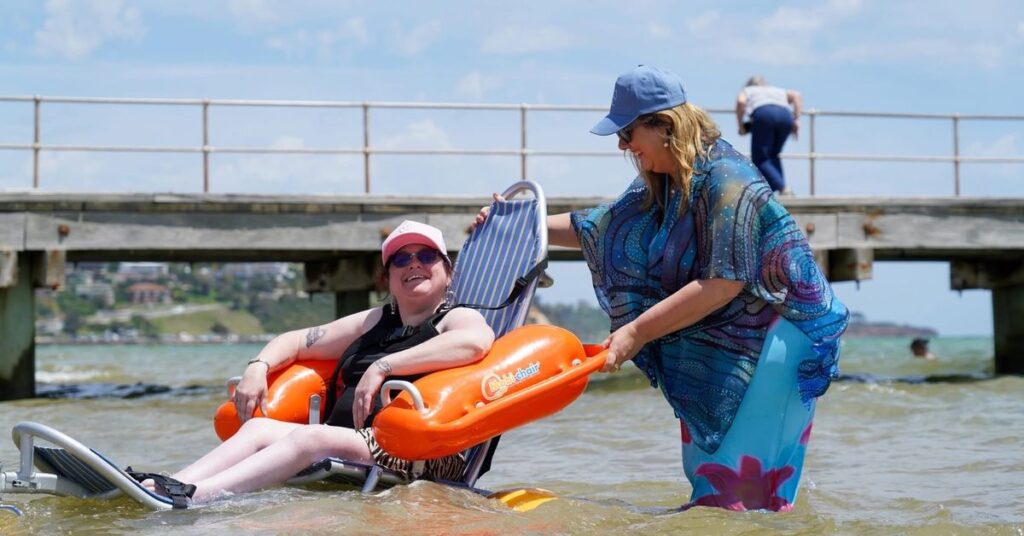
A quick dip to cool off on a scorching summer’s day, or a casual wade through gentle waves with family and friends, is a pastime deeply rooted in the Australian experience. However, for Carly Burns, a 38-year-old from Frankston, Melbourne, such simple pleasures were out of reach until recently. Born with spina bifida, Burns has used a wheelchair for most of her life and struggled to get past the beach car park.
“I’ve never actually been able to get down onto the beach on my own… I would have to be up on the concrete just watching,” she said. This changed with the launch of Australia’s first fully-accessible beach at Frankston, a pilot program unveiled on December 5. The initiative has transformed the beach experience for Burns and approximately 30,000 other Frankston residents living with a disability.
Revolutionizing Accessibility
The three-month pilot program at Frankston Beach includes 70 meters of beach matting that extends to the water’s edge, allowing wheelchairs to traverse the sand. It also features daybeds with cabanas, five beach wheelchairs, two beach walkers, and a hoist to assist with transfers between wheelchairs. Notably, Frankston is the first of Australia’s 160 accessible beaches to provide staff and volunteers to help beachgoers enter and exit the water.
For participant Chris Wiggett, the opportunity to swim at the beach was a long-awaited moment. “Last time I was knocked over, which frightened me,” she said. “This morning, a volunteer helped me down to the water. I put my feet in and walked along the sand, and I cried, because it was the first time in years I could do that.”
A Decade-Long Dream
The mission to create a fully accessible beach was a vision first imagined nearly a decade ago by Accessible Beaches Australia founder Shane Hryhorec. After a swimming pool accident in 2007 left him an incomplete quadriplegic, Hryhorec found the beach, once a place of joy, had become a daunting challenge.
“I just instantly had to stop all the things that I liked to do that I would no longer be able to do, and one of those things that first came into my mind was the beach,” he said. A turning point came when he discovered a photo of a beach mat online, sparking the creation of Accessible Beaches Australia.
“I was blown away, and at that point I was like, we need this in Australia,” Hryhorec said.
His journey led him to visit the world’s most accessible beach in Antibes, France, where he witnessed a level of inclusion he had never seen before. “They went to a new level of inclusion that I’ve never seen before,” he said. “I didn’t realise we could be doing so much better until I experienced the best.”
Expanding the Vision
Hryhorec hopes that the inclusion of daybeds and volunteer staff will also encourage the aging population to visit the beach. “Literally half of the people that were enjoying the beach were probably around their 80s or above, which I just thought was just so special,” he said of the French Handiplage.
Frankston City Council played a crucial role in the success of the summer pilot program, working with the local community to raise $200,000 to bring it to life. “I’ve been doing this work for nearly 10 years, making beaches accessible, and I’ve never seen a council and community get behind something with so much passion and enthusiasm and compassion,” Hryhorec said.
“If other communities could just be a smidgen of what Frankston is, what they could achieve for inclusion would be incredible around the country,” he added.
Looking to the Future
Frankston City councillor Kris Bolam, who recently completed his tenure as mayor, expressed hope that the pilot “becomes the spark that inspires similar programs across Australia.” The sentiment is shared by both Hryhorec and Burns, who dream of a future where every patrolled beach in the country offers the same level of accessibility as Frankston.
“My hope is that every patrolled beach in the entire country has a level of accessibility on the beach, just like in Frankston,” Hryhorec said. Burns echoed this, saying, “I hope that others would be able to get the same opportunity that I have been able to get, and I would recommend that they do it.”
Until then, Burns is eagerly anticipating her first summer at the beach. “I have young nieces and nephews, so it will be good to be able to join them in the water rather than having to just sit back and watch,” she said.
The pilot program will operate on Thursdays, Fridays, and Saturdays from 10:30 am to 2:30 pm, running from December 6 to February 28, located between the Frankston Pier and Kananook Creek.