

Washington: In a move that underscores the ongoing political tensions in the United States, former President Donald Trump has made headlines by replacing Joe Biden’s image with an autopen on his newly unveiled Presidential Walk of Fame. The White House has also installed derogatory plaques under several presidential portraits, sparking controversy and debate.
The plaques offer harsh critiques of past presidents, describing Biden as “by far the worst president in American history” and accusing him of suffering “severe mental decline” during his tenure. Barack Obama is blamed for the spread of Islamic State and Russia’s invasion of Crimea, while even Republican George W. Bush faces criticism over the wars in Iraq and Afghanistan. In stark contrast, Trump’s plaques laud his achievements and the magnitude of his electoral victories. White House press secretary Karoline Leavitt noted that Trump, described as “a student of history,” personally dictated many of the plaques.
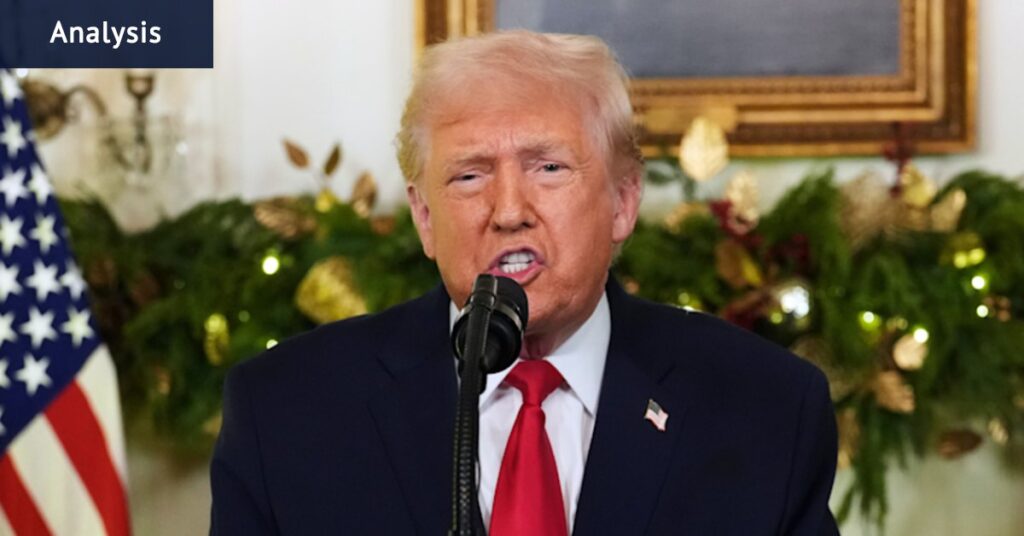
This development follows Trump’s rare prime-time address on Wednesday night, where he sought to reset the national conversation on the economy ahead of the Christmas break. The speech, characterized by its rushed and angry tone, began with a litany of grievances about the state of the country under Biden, claiming, “one year ago our country was dead, we were absolutely dead.”
Trump’s Prime-Time Address: A Political Strategy
Trump’s address was a departure from the usual purpose of prime-time speeches, which are typically reserved for major announcements or reassurance during crises. The only new policy unveiled was a $US1776 “warrior dividend” for 1.45 million military service members, purportedly funded by revenue from Trump’s tariffs. Yet, the speech offered little in terms of empathy or acknowledgment of the challenges many Americans face.
Instead, Trump claimed, albeit falsely, that prices were falling rapidly, stating, “it’s not done yet, but boy, are we making progress.” In reality, US inflation remains at 3 percent, unchanged from when Biden left office, and is trending upwards, although the Federal Reserve anticipates a cooling.
Another devastating Reuters/Ipsos poll this week found Trump’s approval rating had slumped to 39 percent, with just a third of voters approving of his handling of the economy – a new low.
Economic Realities and Political Perceptions
Economic management should be a natural area of strength for Trump, who rose to national fame as a businessman. However, only 20 percent of Americans believe the country is “on the right track” regarding inflation, and 27 percent for employment. These figures suggest that Trump’s economic narrative may not be resonating with the public as intended.
Trump’s need to appear on prime-time television to shift blame to his predecessor and assure Americans of current progress speaks volumes about the political landscape. In last year’s election, Trump was perceived as more in touch with voters’ concerns, while Democrats were seen as preoccupied with identity politics. Now, Trump risks being viewed as disconnected from reality.
The Republican Dilemma: Searching for a New Direction
Republican congressman Kevin Kiley commented on CNN that while Trump addressed the right issues, “I think we can do a better job of really empathizing with what people are going through right now.” This sentiment reflects a broader challenge for the Republican Party as it navigates its future direction.
Finding fault with predecessors is a staple of electoral politics, but there comes a point when this strategy loses its effectiveness. The question now, particularly for Republicans, is whether Trump has the capacity to evolve his approach. Recent evidence suggests that a change in strategy may be necessary.
The announcement comes as the Republican Party grapples with its identity and strategy moving forward. As the political landscape continues to shift, the party must decide whether to double down on Trump’s approach or seek a new path.
Stay informed with insights from our foreign correspondents on global headlines. Sign up for our weekly “What in the World” newsletter.