




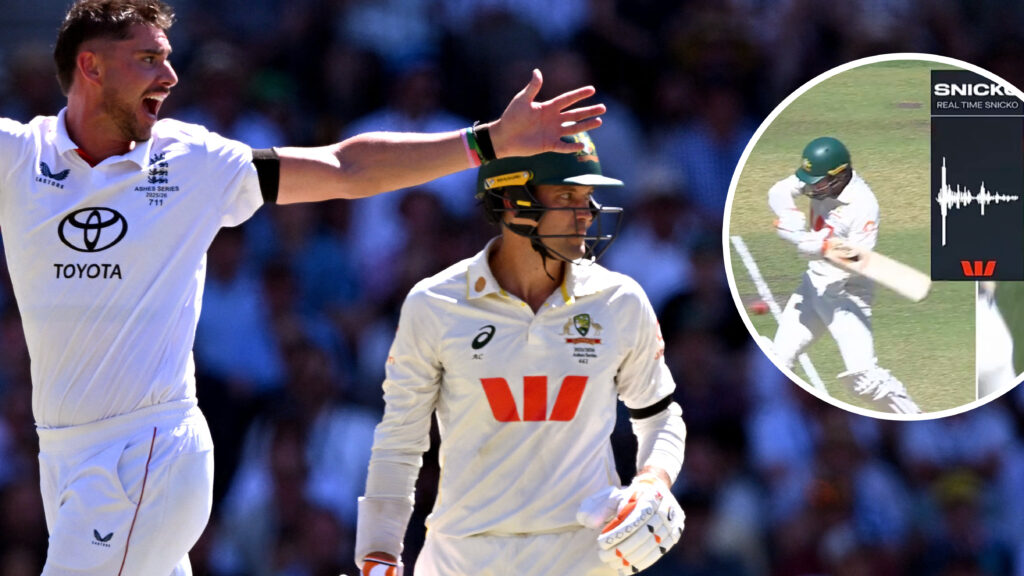
Alex Carey found himself at the heart of another Ashes controversy after England’s team expressed frustration, claiming that faulty technology played a role in enabling his century in Adelaide. The incident unfolded when Carey, who had previously been involved in a contentious stumping of Jonny Bairstow at Lord’s in 2023, was suspected of edging a delivery from Josh Tongue while on 72 runs. A puzzling noise was detected on the Real-Time Snickometer (RTS) technology, but the evidence was inconclusive.
After on-field umpire Ahsan Raza ruled Carey not out, England’s wicketkeeper Jamie Smith urged a review. The RTS showed a noise, but it did not align with the footage of the ball passing Carey’s bat. Television umpire Chris Gaffaney upheld the not out decision, allowing Carey to continue and eventually score an emotional century in front of his home crowd in Adelaide.
Technology Under Scrutiny
England’s bowling coach, David Saker, expressed concern over the technology’s reliability during the series. “The boys were pretty confident he hit it,” Saker stated at the close of play on day one, with Australia reaching 8-326. “I think the calibration of the ‘Snicko’ is out quite a bit, and that’s been probably the case for the series. There have been some things that don’t really measure up.”
“You’d think in this day and age, you would hope the technology is good enough to pick things up like that.” – David Saker
The decision ultimately cost England 34 runs, as Carey was dismissed for 106 late in the final session. Reflecting on the incident, Carey remarked, “It looked a bit funny on the replay, didn’t it, with the noise coming early. But if I was given out, I think I would have reviewed it – probably not confidently though.”
Historical Context and Expert Opinions
This is not the first time technology has been questioned in cricket. The Decision Review System (DRS) has been a topic of debate since its introduction, with discussions around its accuracy and the human element in decision-making. Former international umpire Simon Taufel weighed in on the controversy, explaining the challenges faced by umpires in such situations.
“The confusing element here for everyone was that the spike occurred at least a couple of frames before the bat, which was just amazing.” – Simon Taufel
Taufel emphasized the need for clear evidence to overturn on-field decisions, noting that the spike should occur in sync with the ball passing the bat. “There’s nothing else out there, absolutely nothing else out there, so my gut tells me from all of my experience on field and also as a TV Umpire that I think Alex Carey has actually hit that ball and the technology calibration hasn’t been quite right,” he added.
Implications for Future Matches
The controversy has reignited calls for the introduction of specialist television umpires, a concept already implemented in the UAE’s ILT20 competition. However, the International Cricket Council (ICC), which oversees international cricket, has yet to adopt this approach globally.
As the Ashes series continues, the debate over technology and its role in cricket decisions remains a hot topic. The third Test is set to take place from December 17-21 at the Adelaide Oval, with Australia leading the series after victories in the first two Tests.
2025-26 NRMA Insurance Men’s Ashes Schedule:
- First Test: Australia won by eight wickets
- Second Test: Australia won by eight wickets
- Third Test: December 17-21: Adelaide Oval, 10:30am AEDT
- Fourth Test: December 26-30: MCG, Melbourne, 10:30am AEDT
- Fifth Test: January 4-8: SCG, Sydney, 10:30am AEDT
As cricket technology evolves, the balance between human judgment and technological assistance will continue to shape the sport’s future. With the Ashes series drawing significant attention, the ICC may soon face increased pressure to refine the technology used in decision-making processes.