



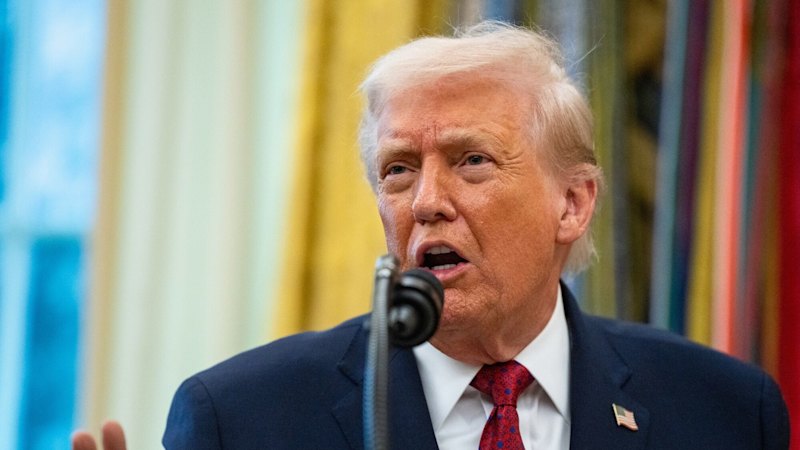
Washington: President Donald Trump has announced a blockade on all “sanctioned oil tankers” entering Venezuela, intensifying pressure on President Nicolas Maduro. This move appears aimed at further constricting the South American nation’s already struggling economy.
The escalation follows an incident last week where U.S. forces seized an oil tanker off Venezuela’s coast, marking a significant military presence in the region. In a social media post on Tuesday night, Trump accused Venezuela of using oil revenues to fund drug trafficking and other illicit activities. He pledged to continue the military build-up until Venezuela relinquishes its oil, land, and assets to the U.S., although the basis for such claims remains unclear.
“Venezuela is completely surrounded by the largest Armada ever assembled in the History of South America,” Trump declared. “It will only get bigger, and the shock to them will be like nothing they have ever seen before – Until such time as they return to the United States of America all of the Oil, Land, and other Assets that they previously stole from us.”
Legal and Economic Implications
Trump’s decision to enforce a blockade raises significant questions about presidential authority. Elena Chachko, an international law scholar at UC Berkeley Law School, noted that while blockades are traditionally seen as “instruments of war,” their use is subject to strict legal conditions. “There are serious questions on both the domestic law front and international law front,” Chachko explained.
Meanwhile, U.S. Democratic Congressman Joaquin Castro labeled the blockade “unquestionably an act of war,” reflecting the deep divisions within American political circles. Another official suggested that the blockade could severely impact Maduro’s regime.
David Goldwyn, a former State Department energy diplomat, warned, “If Venezuelan oil exports are not replaced by increased OPEC spare capacity, oil prices could rise from $US5 – $US8 a barrel.”
Goldwyn further predicted that such economic strain could lead to skyrocketing inflation and trigger massive migration from Venezuela to neighboring countries.
Venezuela’s Response and Economic Realities
As of last week, over 30 of the 80 ships in Venezuelan waters or approaching the country were under U.S. sanctions, according to TankerTrackers.com. In response, Maduro accused the U.S. of imperialistic ambitions. “Imperialism and the fascist right want to colonize Venezuela to take over its wealth of oil, gas, gold, among other minerals,” he stated at an event on Tuesday before Trump’s announcement.
Venezuela, possessing the world’s largest crude reserves, produces about 1 million barrels of oil daily. The nation has long depended on oil revenue, which has been significantly affected by U.S. sanctions since 2017. These sanctions have forced Maduro’s government to rely on a fleet of unflagged tankers to smuggle crude into global markets.
Francisco Monaldi, a Venezuelan oil expert at Rice University, explained, “About 850,000 barrels of the 1 million daily production is exported. Of that, 80 percent goes to China, 15 to 17 percent goes to the U.S. through Chevron Corp, and the remainder goes to Cuba.”
Military Strategy and Global Reactions
The U.S. Navy has deployed 11 ships in the region, including an aircraft carrier and several amphibious assault ships, equipped with a range of aircraft. This military build-up has coincided with a series of strikes on vessels in international waters, which have resulted in at least 95 deaths across 25 known strikes.
The Trump administration defends these actions as necessary to prevent drug shipments to the U.S., despite concerns about the legality of such military operations. Trump’s chief of staff, Susie Wiles, confirmed in a Vanity Fair interview that the campaign is part of a broader effort to remove Maduro from power.
As tensions continue to rise, the international community watches closely. The blockade and military maneuvers represent a significant escalation in U.S.-Venezuela relations, with potential global economic repercussions.
The unfolding situation leaves many questions unanswered about the future of U.S. foreign policy in the region and the potential humanitarian impact on the Venezuelan people.