




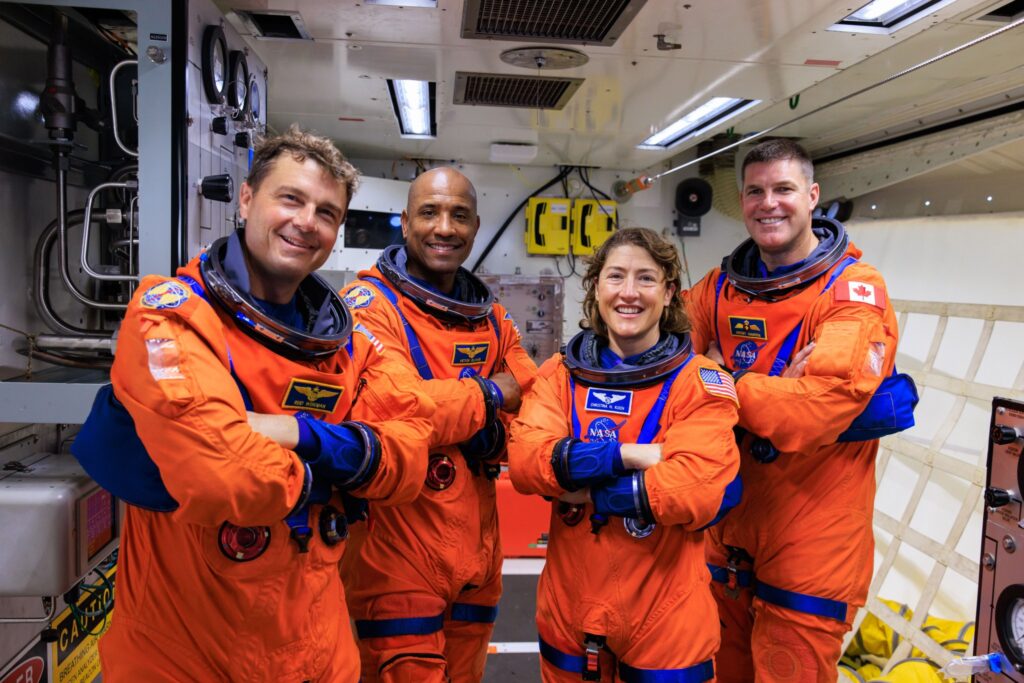
In 2025, under the leadership of a second Trump Administration, NASA has made significant strides in advancing its ambitious space exploration agenda. With the Artemis II test flight scheduled for early next year, NASA is on the brink of launching the first crewed mission around the Moon in over half a century. This mission is a pivotal step towards the agency’s long-term goal of sending the first astronauts to Mars.
As part of what is being hailed as NASA’s “Golden Age” of innovation and exploration, the agency, alongside its international partners, has successfully landed two robotic science missions on the Moon. Additionally, the Artemis Accords, which promote safe and responsible lunar exploration, have gained traction, with 59 nations now on board. These efforts underscore NASA’s commitment to fostering international collaboration in space exploration.
Key Milestones in Lunar and Martian Exploration
NASA’s Artemis program is at the forefront of its exploration initiatives, aiming to send astronauts on increasingly complex missions to the Moon. The Artemis II test flight, slated for early 2026, will be the first crewed mission under the Artemis campaign, setting the stage for future lunar landings, including the highly anticipated Artemis III mission.
In September, NASA introduced a new class of astronaut candidates, selected from over 8,000 applicants. These individuals are undergoing rigorous training for future missions to low Earth orbit, the Moon, and eventually Mars. The agency’s efforts to prepare for human exploration of Mars include launching the ESCAPADE mission to study Mars’ magnetic environment, which will provide crucial data for future crewed missions.
Technological and Scientific Advancements
NASA’s technological innovations are not limited to lunar and Martian exploration. The agency has made significant progress in developing new technologies for long-duration space missions. These include hand-held X-ray equipment and navigation capabilities, which are essential for future deep space missions.
Moreover, NASA has achieved a milestone with the test flight of the X-59 supersonic plane, which aims to revolutionize air travel by reducing sonic booms. This year also marks 25 continuous years of human presence aboard the International Space Station (ISS), a testament to NASA’s enduring commitment to space exploration.
International Collaborations and the Artemis Accords
The Artemis Accords, a set of principles for lunar exploration, have seen increased international participation. Seven new nations, including Bangladesh, Finland, and Norway, have joined the United States in signing the accords this year. This growing coalition reflects a global commitment to the peaceful and cooperative exploration of space.
NASA’s participation in the 76th International Astronautical Congress in Sydney further solidified international partnerships. The agency co-chaired the Artemis Accords Principals’ Meeting, bringing together representatives from dozens of nations to discuss the implementation of these accords.
Scientific Discoveries and Planetary Defense
NASA’s scientific endeavors extend beyond exploration. The agency is actively involved in planetary defense, monitoring near-Earth objects and developing impact models to protect our planet. The successful DART mission, which altered the trajectory of an asteroid, is a prime example of NASA’s efforts in this area.
In the realm of astrobiology, NASA’s Perseverance rover has discovered potential biosignatures on Mars, sparking excitement about the possibility of life beyond Earth. Additionally, the Curiosity rover has found the largest organic compounds on Mars to date, furthering our understanding of the Red Planet’s potential habitability.
Public Engagement and Future Prospects
NASA has made significant strides in engaging the public with its missions. The agency’s social media presence has grown, reaching nearly 367 million followers. NASA’s streaming service, NASA+, has expanded its reach, offering live broadcasts of rocket launches and spacewalks to a global audience.
Looking ahead, NASA’s focus remains on advancing space exploration and fostering international collaboration. The agency’s efforts to develop new technologies and conduct groundbreaking scientific research continue to inspire the next generation of explorers and innovators.
As NASA prepares for the Artemis II mission and beyond, the agency’s commitment to exploration, innovation, and international cooperation remains unwavering. With the support of its partners and the global community, NASA is poised to usher in a new era of space exploration that promises to unlock the mysteries of the universe and pave the way for humanity’s future in space.