




An interstellar comet, identified as 3I/ATLAS, is set to make a remarkable flyby near Earth this Friday. First observed in July, the comet is now departing our solar system, leaving scientists eager to capture its fleeting presence. Despite its proximity, 3I/ATLAS will not be visible to the naked eye, requiring telescopes for observation.
The comet will pass within approximately 167 million miles (270 million kilometers) of Earth, albeit on the opposite side of the sun. For context, this is nearly twice the distance from the Earth to the sun, which is about 93 million miles (150 million kilometers).
Viewing Opportunities and Scientific Endeavors
While the optimal viewing window for 3I/ATLAS has already closed, enthusiasts can still catch a glimpse using an 8-inch (20-centimeter) telescope or larger, as advised by EarthSky. The Virtual Telescope Project plans to broadcast a live stream of the comet at 4:00 a.m. UTC on Friday, or 11 p.m. ET on Thursday. Should weather conditions prove unfavorable, the webcast will be postponed by 24 hours, according to Gianluca Masi, an astronomer and astrophysicist at the Bellatrix Astronomical Observatory in Italy.
According to NASA, the comet will remain observable to telescopes and space missions for several more months before it exits our solar system. Since its discovery, astronomers have been closely monitoring 3I/ATLAS to gather insights into its origins and composition, employing optical, infrared, and radio wavelengths.
X-raying an Interstellar Visitor
One of the most intriguing aspects of 3I/ATLAS is the recent detection of X-rays emanating from the comet. Historically, comets originating within our solar system have been known to emit X-rays, but it was uncertain whether interstellar comets would exhibit the same behavior.
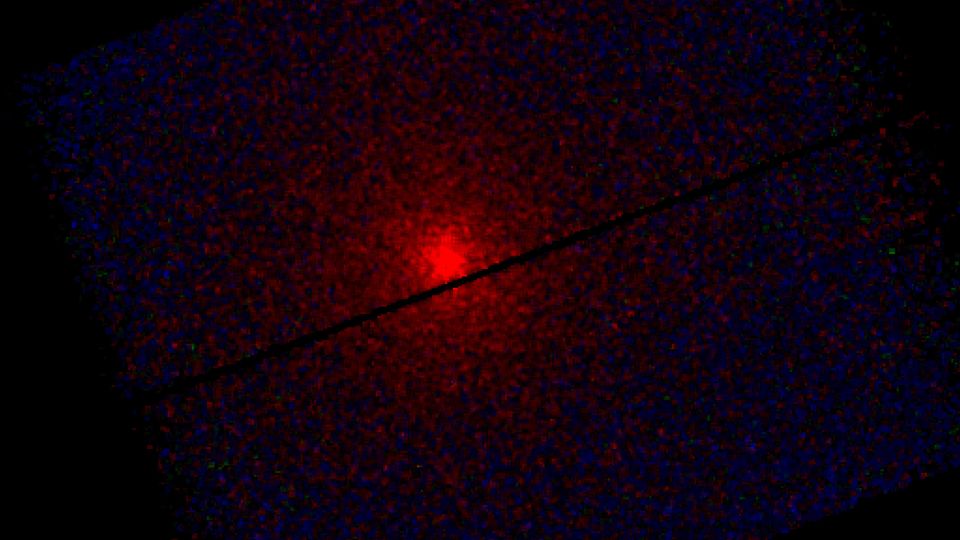
Japan’s X-Ray Imaging and Spectroscopy Mission (XRISM) observed 3I/ATLAS for 17 hours in late November using its Xtend telescope. The mission detected X-rays extending up to 248,000 miles (400,000 kilometers) from the comet’s nucleus, potentially due to gas clouds surrounding the object, as reported by the Japan Aerospace Exploration Agency. However, further observations are necessary to confirm these findings.
X-rays can result from interactions between gases released by the comet, such as water vapor, carbon monoxide, or carbon dioxide, and the solar wind — a continuous stream of charged particles from the sun.
Comets, composed of ice, rock, dust, and gas, heat up as they approach stars like the sun, causing them to release materials. XRISM identified signatures of carbon, oxygen, and nitrogen near the comet’s nucleus.
Comparative Observations and Future Implications
The European Space Agency’s X-ray space observatory, XMM-Newton, also observed the comet on December 3 for approximately 20 hours using its most sensitive camera. The agency released a striking image showcasing the comet’s red X-ray glow.
These X-ray observations, when combined with data across various light wavelengths, could provide a deeper understanding of the comet’s composition and how it compares to those within our solar system. This knowledge could offer valuable insights into the nature of interstellar objects and their potential differences from solar system bodies.
The discovery of X-rays in 3I/ATLAS marks a significant milestone in the study of interstellar comets. As scientists continue to analyze the data, they hope to uncover more about the comet’s journey and its implications for our understanding of the universe.
As 3I/ATLAS continues its voyage beyond our solar system, the scientific community remains eager to learn from this rare visitor. The findings could pave the way for future explorations and deepen our knowledge of the cosmos.