




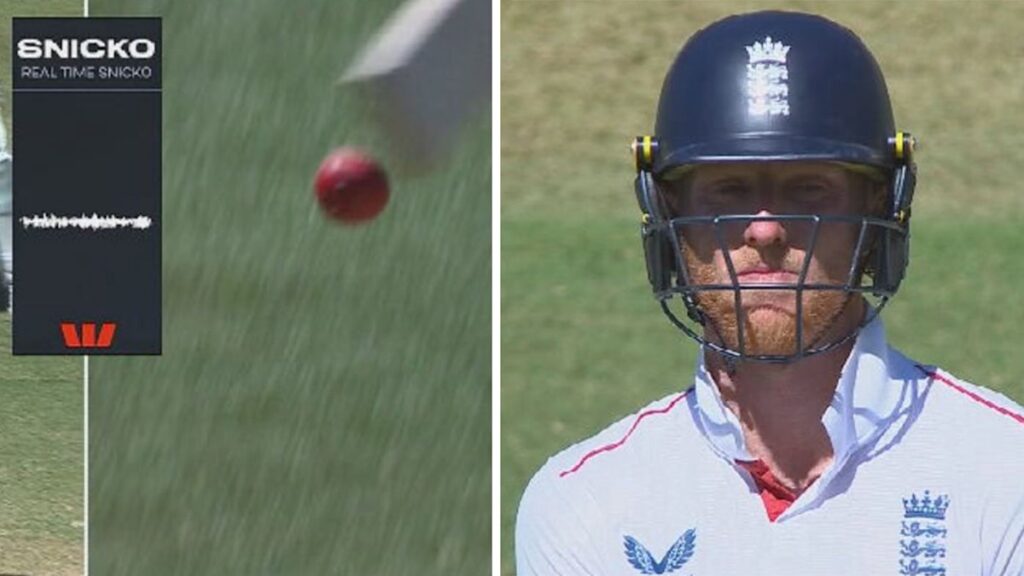
On the second day of the third Ashes Test in Adelaide, Australia tightened its grip on the series, leaving England struggling at 8-168. Scott Boland’s exceptional bowling dismantled the English batting lineup, claiming crucial wickets and intensifying the pressure on the visitors. The day’s play was further marred by controversy surrounding the Snicko technology, which once again came under scrutiny.
England’s innings faced an early setback when Scott Boland dismissed Brydon Carse for a five-ball duck. Boland’s delivery sneaked through Carse’s defenses, crashing into the stumps and leaving England reeling. The English side, already trailing by 203 runs, found themselves in dire straits, with Ben Stokes left to anchor the innings cautiously.
Snicko Controversy and Key Dismissals
The day’s play was overshadowed by a contentious decision involving the Snicko technology. Jamie Smith was given out after a spike appeared on the Snicko, despite inconclusive evidence of the ball hitting his bat. Former Australian wicketkeeper Adam Gilchrist remarked,
“That’s a decision that’s going to be spoken about and written about for a long while,”
highlighting the ongoing debate about the reliability of the technology.
Smith’s dismissal for 22 left England at 6-159, with Ben Stokes visibly frustrated at the decision. The controversy followed a similar incident involving Alex Carey, where Snicko failed to detect a possible edge. Mitchell Starc voiced his frustration, caught on the stump mic saying,
“Snicko needs to be sacked!”
Warren Brennan, head of Snicko operator BBG Sports, took responsibility for the errors, further fueling the debate.
England’s Struggle and Australian Dominance
Despite the controversy, Australia’s dominance was evident throughout the day. Pat Cummins and Nathan Lyon each claimed two wickets, while Cameron Green made an immediate impact by dismissing Harry Brook for 45. The English side, now trailing 0-2 in the series, faced an uphill battle to avoid a significant first-innings deficit.
Ben Stokes, known for his aggressive style, adopted a more cautious approach, grinding out 31 runs from 115 balls. The absence of the aggressive “Bazball” strategy was evident, as England struggled to build momentum. Joe Root, the only English player to score a century on this tour, remained the side’s beacon of hope, but his early dismissal added to England’s woes.
Looking Forward: England’s Challenges
As play resumes for the third session, England faces a daunting task. With a considerable deficit and only two wickets in hand, the visitors must find a way to counter Australia’s formidable bowling attack. The series, already leaning heavily in Australia’s favor, could see the hosts take an unassailable lead if England fails to mount a comeback.
The Snicko controversy adds another layer of complexity to the series, with calls for a review of the technology’s reliability growing louder. As the Ashes continue, the focus will not only be on the on-field performances but also on the decisions made off the field, which could have lasting implications for the series and the future use of technology in cricket.
With the third session underway, England’s resilience will be tested as they strive to salvage their innings and keep their hopes alive in the Ashes 2025 series.