

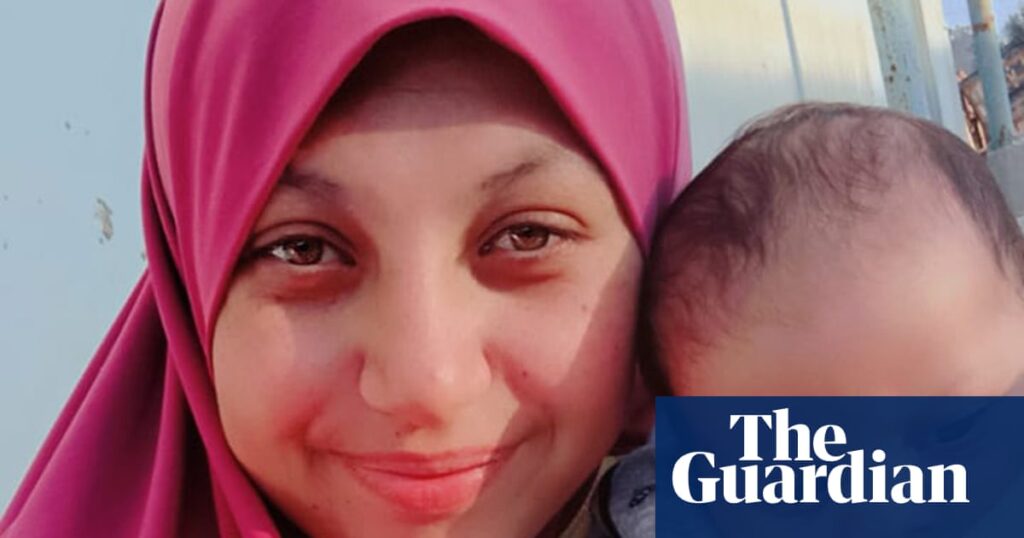
Hadeel Al Gherbawi was seven months pregnant when the conflict erupted in Gaza in October 2023. At 26, she had been diligently preparing for her son’s arrival, attending bi-monthly doctor’s visits due to her high-risk pregnancy, undergoing regular ultrasounds, and taking vitamins. “I love the details,” she says, reflecting on her careful preparations.
Residing on the eastern side of Gaza City, near the Israeli border, Al Gherbawi foresaw the challenges of rapid movement due to her pregnancy. She decided to relocate to her parents’ home in the western part of the city, believing the displacement would be temporary. However, the family has since been displaced 13 times, and the home she shared with her husband has been destroyed.
The Onset of Conflict and Displacement
In late October, just five weeks before her due date, Al Gherbawi experienced the terror of a massive Israeli airstrike on a residential building in Gaza City. “It felt like an earthquake,” she recalls. Seeking refuge, she fled to al-Shifa hospital, which was overwhelmed with displaced individuals. Basic facilities, like bathrooms, were nearly inaccessible.
“I can’t forget the horror of that night,” she recounts. The aftermath of the strike was devastating, with over 100 reported casualties. Al Gherbawi vividly remembers the smell and the sight of a place for unidentified bodies. “I couldn’t take it. I was pregnant. I felt sick … may God have mercy on those who were killed.”
Seeking Safety and Giving Birth Amidst Chaos
Determined to find a safer environment for childbirth, Al Gherbawi and her husband moved south. Living conditions in displacement camps remained dire, with bathroom access being a constant struggle. Fearing the unpredictability of labor and the difficulty of finding transportation, especially at night, she requested an induced labor at Nasser hospital in Khan Younis.
During labor, a nearby building was struck, heightening her fear of chaos and potential mix-ups with her newborn. She asked her mother to keep a vigilant watch. “Fear, unbearable fear,” she describes the experience. After her son Jawad was born, they moved to a rented flat, sharing a room with 30 others. Painkillers were scarce, and Al Gherbawi silently endured her postpartum pain, suspecting she also suffered from postnatal depression.
Life in a Tent and a Second Pregnancy
Months later, the family relocated to a tent. “It was the first time that I lived in a tent,” she says bitterly, worried about Jawad’s safety from insects and the cold. Then, when Jawad was nine months old, she discovered she was pregnant again. “At first I was shocked and upset,” she admits, questioning the feasibility of raising another child under such conditions.
The January 2025 ceasefire brought a glimmer of hope. “I can’t describe how happy I was,” she recalls. Despite being in her first trimester and against advice, she insisted on returning north to her flat. They spent a cold night on the coastal road, waiting for a checkpoint to open, finally reaching their home with Jawad’s decorated room intact.
Enduring Hardship and Starvation
However, the ceasefire was short-lived. On March 18, Israel resumed hostilities, and the family was displaced once more, with their home eventually destroyed. This pregnancy was more arduous than the last, with continuous conflict and scarcity of food. “There would be whole days where all I had was one cucumber,” she says, her heart breaking as she watched Jawad cry for food.
The United Nations has found that Israel’s actions in Gaza, with mass civilian casualties and life-threatening conditions intentionally imposed, are ‘consistent with the characteristics of genocide’, including ‘using starvation as a method of war’.
As her due date approached, Al Gherbawi moved back with her parents, near a hospital equipped with incubators. Although she requested induction, the hospital was overwhelmed, and doctors assured her she could deliver naturally.
The Birth of Fares Amidst Continued Conflict
One night, her contractions began. Not wanting to disturb others, she called an ambulance before waking her mother. Her husband was in the south. With contractions every five minutes, she descended five floors on foot due to a power outage. She delivered her second son, Fares, in the ambulance.
Fares weighed just 2kg (4.4lb), a consequence of the starvation. At the hospital, lacking anesthesia, she endured the pain of stitches. The hospital’s need for beds forced her to wait on a chair until the observation period ended. Transportation back to her parents’ flat was challenging, and five hours after giving birth, she walked back and climbed the five floors to their home.
Al Gherbawi’s story is a poignant reminder of the human cost of conflict, illustrating the resilience and strength required to navigate life and motherhood amidst war. Her experience underscores the urgent need for international attention and humanitarian aid to alleviate the suffering of those caught in conflict zones.