



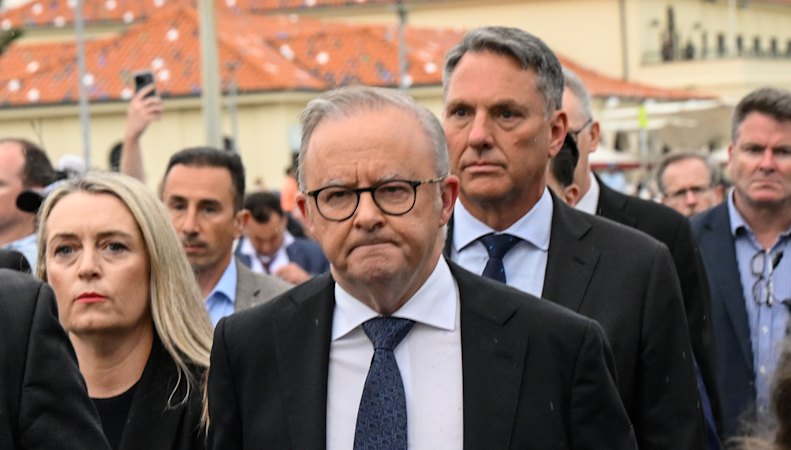
In the wake of the tragic events at Bondi, where a memorial service intended to foster peace and unity was marred by political discord, the Australian public finds itself grappling with the complexities of grief and blame. The service, attended by thousands, witnessed a moment of controversy when some attendees booed Prime Minister Anthony Albanese. This reaction has sparked a broader debate about the politicization of tragedy and the role of leadership in times of national crisis.
The booing incident, which quickly overshadowed the solemnity of the service, has become a focal point of discussion. Many attendees, like Beverley Fine from Pagewood, expressed dismay at the disrespect shown during the service. “We all sat there in the heat, and then the rain, listening with sorrow, awe, and deep love for those who gave their all to keep us safe,” she noted, emphasizing the need to focus on acts of kindness and unity.
Political Blame and Opportunism
Critics argue that blaming Albanese for not preventing the Bondi attack is a form of political opportunism. As Barrington Salter from Elanora points out, the attack was carried out by “radicalised lone wolves,” making it difficult for any government to predict or prevent. Despite this, the prime minister has faced criticism for his actions post-attack, including his decision not to attend certain funerals at the request of the victims’ families.
The politicization of the tragedy has also seen former Coalition politicians exploit the situation to attack the Labor government. John Oakley from Wollongong highlights the hypocrisy of these attacks, noting that the shooter, Sajid Akram, entered Australia and obtained a gun license under previous Coalition governments. This historical context underscores the complexity of assigning blame in such situations.
Community Response and National Reflection
Despite the political turmoil, the Australian public has demonstrated remarkable solidarity. The spirit of mateship was evident as people from all walks of life came together to support the Jewish community. “50,000 people donated blood for the victims,” Salter noted, illustrating the nation’s collective empathy and resilience.
However, the incident has also prompted a national reflection on deeper societal issues. As Celia Ziegler from Maroubra asserts, “We have to face the fact that antisemitism does exist,” calling for a cultural shift to prevent future tragedies. This sentiment is echoed by Frederick Jansohn from Rose Bay, who urges Australians to practice cohesion and unity in their daily lives.
Calls for Legislative Caution
In response to the tragedy, there have been calls for legislative changes to address security concerns. However, Dominic Toomey SC, president of the NSW Bar Association, warns against rushing such measures. “Rushing legislation through in the current environment is inadvisable and potentially dangerous,” he cautions, advocating for careful consideration and consultation.
John Coyne’s analysis further highlights the pitfalls of knee-jerk reactions, emphasizing the need for objective, long-term solutions rather than quick fixes driven by emotion. “Blame-hunting hysterics and rage-baiting serve a nation poorly,” Coyne observes, advocating for a measured approach to policy-making.
Looking Forward: Unity and Action
The Bondi tragedy has undeniably altered the Australian landscape, prompting calls for unity and action. As Kath Maher from Lidcombe notes, the prime minister deserves the courtesy and support to implement measures to prevent future incidents. Meanwhile, letters from readers like Cecily Chittick from Wyong emphasize the need for hope and positive change to strengthen Australia’s multicultural society.
Ultimately, the Bondi memorial service and its aftermath serve as a poignant reminder of the challenges and responsibilities facing Australian society. As the nation mourns and reflects, the path forward will require collective effort and a commitment to addressing the root causes of division and hatred.