




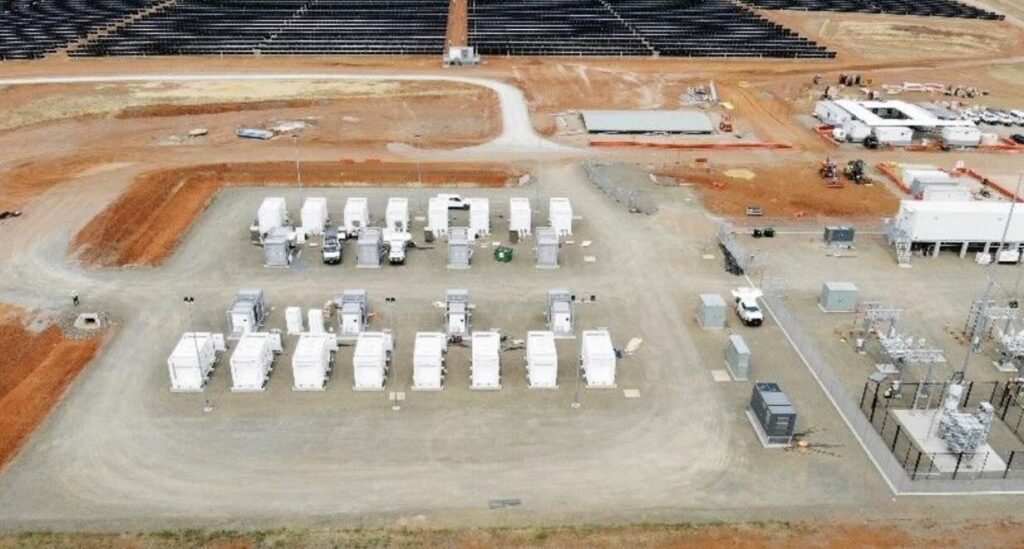
The first large-scale solar-battery hybrid power plant on Australia’s main grid has been energized and is now poised to deliver solar power during evening demand peaks. Located near Parkes in western New South Wales, the Quorn Park facility integrates an 80 megawatt (MW) solar farm with a 20 MW, 40 megawatt-hour (MWh) battery, strategically positioned behind the same connection point. This configuration allows solar energy to be stored and released during the more lucrative evening demand periods, rather than being sent out into an oversupplied market.
The announcement comes as Potentia Energy, a joint venture between Italy’s Enel Green Power and Japan’s Inpex, confirmed the energization of Quorn Park following the approval of its generator performance standard. This marks a significant milestone for the National Electricity Market, given the complexities involved in such agreements.
Setting a Precedent for Future Projects
Although Quorn Park is the first solar-battery hybrid on the National Electricity Market, it is expected to be the precursor to a wave of similar projects. Nearly 20 such initiatives have secured underwriting agreements from state and federal schemes, including the Capacity Investment Scheme, which is gradually displacing wind projects due to their higher costs.
Potentia Energy expressed its pride in a statement, saying, “The project demonstrates how renewable energy and battery storage can work together to deliver reliable, cost-effective support to the grid, meeting the evolving needs of NSW communities while accelerating the energy transition.”
The Rise of Solar-Battery Hybrids
The development follows the success of the Cunderdin facility in Western Australia, which combines 128 MWdc of solar with a 55 MW, 220 MWh battery. This facility has been instrumental in feeding power into the isolated grid during evening peaks, often extending to midnight and sometimes beyond.
Solar-battery hybrids are gaining traction due to several factors: the decreasing cost of solar modules, the plummeting cost of battery storage, the increasing costs and challenges of wind energy development, and the growing demand from industrial customers for dispatchable power, particularly during evening peaks.
By the Numbers: Nearly 20 solar-battery hybrid projects have received underwriting agreements, paving the way for a significant shift in Australia’s energy landscape.
Challenges and Opportunities
Stand-alone solar farms have faced curtailments due to negative wholesale electricity prices during midday, driven by the proliferation of rooftop PV and the competitive pricing strategies of coal-fired generators eager to remain in operation. The integration of solar-battery hybrids offers a solution by consolidating solar generation and storage into a single, efficient package.
Potentia Energy is also preparing to commence construction on the Tallawang solar battery hybrid in central west NSW, which will feature a 500 MW solar farm paired with a 500 MW, 1,000 MWh battery. Other projects are exploring the use of four to eight-hour batteries to extend solar output further into the evening.
Implications for Australia’s Energy Transition
The move represents a significant step forward in Australia’s energy transition, highlighting the potential of solar-battery hybrids to meet the country’s evolving energy needs. As more projects come online, they are expected to significantly enhance grid reliability and support the shift towards a more sustainable energy future.
Meanwhile, the success of these projects could serve as a model for other regions, demonstrating the viability of integrating renewable energy with storage solutions to address peak demand challenges and reduce reliance on traditional fossil fuels.
As the industry continues to evolve, stakeholders are closely watching the performance of these hybrid facilities, which could redefine energy strategies and contribute to a cleaner, more resilient grid.