

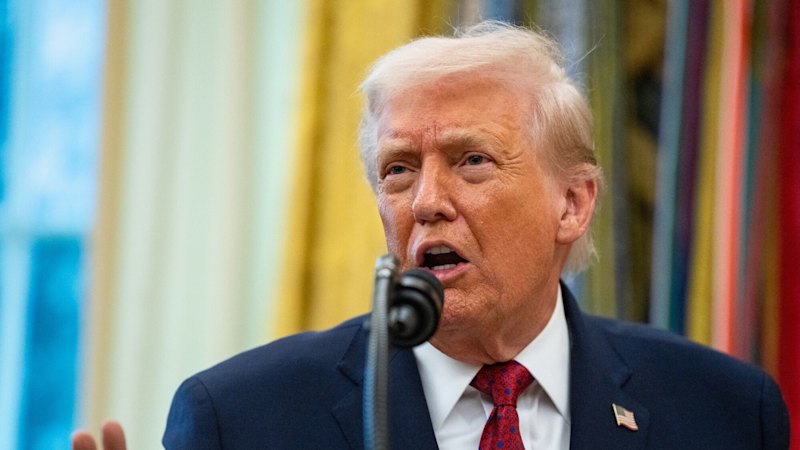
Washington: In a dramatic escalation of U.S. foreign policy, President Donald Trump announced a blockade of all “sanctioned oil tankers” entering Venezuela, intensifying pressure on the country’s embattled president, Nicolas Maduro. This move, declared through a social media post on Tuesday night, aims to tighten the economic noose around the South American nation.
The announcement follows the recent seizure of an oil tanker by U.S. forces off Venezuela’s coast, a rare military maneuver that coincided with a significant buildup of American military presence in the region. Trump accused Venezuela of using its oil revenues to fund drug trafficking and other illicit activities, pledging to continue the military buildup until Venezuela returns “oil, land, and assets” allegedly taken from the United States.
Legal and Political Ramifications
Trump’s order has sparked a debate over the limits of presidential authority. Elena Chachko, an international law scholar at UC Berkeley Law School, noted that blockades are traditionally considered “instruments of war” and are subject to stringent legal conditions. “There are serious questions on both the domestic law front and international law front,” Chachko stated.
U.S. Democratic Congressman Joaquin Castro labeled the blockade as “unquestionably an act of war,” while other officials speculated on its potential impact on Maduro’s regime. Meanwhile, David Goldwyn, a former State Department energy diplomat, warned that if Venezuelan oil exports are not compensated by increased OPEC production, global oil prices could surge by $5 to $8 per barrel.
“I would expect inflation to skyrocket, and massive and immediate migration from Venezuela to neighboring countries,” Goldwyn predicted.
Venezuela’s Economic Struggles
Venezuela, which produces approximately one million barrels of oil daily, has long depended on oil revenues to sustain its economy. Since the imposition of U.S. oil sanctions in 2017, Maduro’s government has resorted to using unflagged tankers to clandestinely integrate crude into global supply chains. The state-owned oil company, Petroleos de Venezuela (PDVSA), has been largely shut out of international markets, selling most of its exports at a discount in China’s black market.
Francisco Monaldi, a Venezuelan oil expert at Rice University, highlighted that about 850,000 barrels of the daily production are exported, with 80% going to China, 15-17% to the U.S. through Chevron Corp, and the remainder to Cuba.
Military and Strategic Implications
The U.S. Navy’s presence in the region includes 11 ships, among them an aircraft carrier and several amphibious assault ships equipped with a variety of aircraft. The recent military buildup has been accompanied by a series of strikes on vessels in international waters, resulting in at least 95 casualties from 25 known strikes.
While the Trump administration defends these actions as part of a broader campaign to curb drug trafficking, critics argue that it stretches the boundaries of lawful warfare. Susie Wiles, Trump’s chief of staff, confirmed in a Vanity Fair interview that the military campaign is part of a strategy to depose Maduro.
Reactions and Future Prospects
Maduro, addressing an audience prior to Trump’s announcement, accused the U.S. of imperialistic ambitions aimed at seizing Venezuela’s vast natural resources. “Imperialism and the fascist right want to colonize Venezuela to take over its wealth of oil, gas, gold, among other minerals. We have sworn absolutely to defend our homeland, and in Venezuela, peace will triumph,” he declared.
The blockade represents a pivotal moment in U.S.-Venezuela relations, with significant economic and humanitarian implications. As tensions mount, the international community watches closely, wary of the potential for further escalation and its impact on global oil markets and regional stability.