

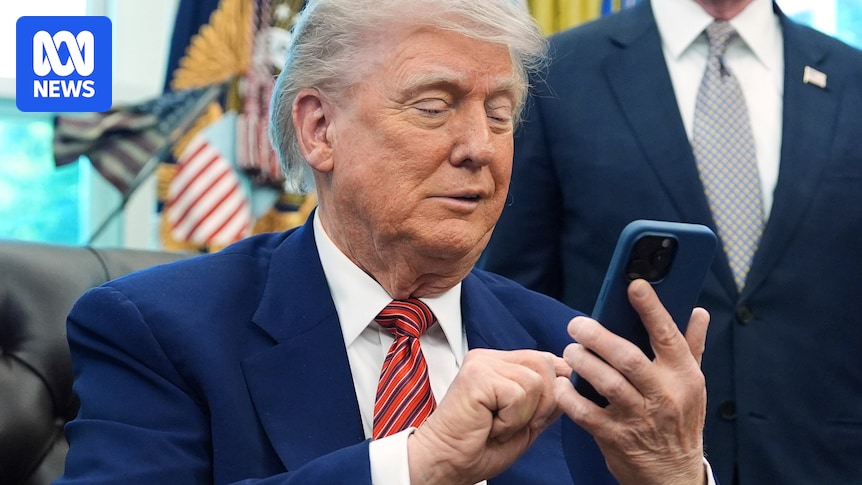
Donald Trump has ignited a global race for 6G technology, declaring his ambition for the United States to lead the world in this next generation of mobile connectivity. The former U.S. president has mandated a one-year deadline for his administration to explore the feasibility of implementing 6G, marking a significant step in the evolution of wireless networks.
Trump’s directive includes vacating national radio frequencies currently used by federal agencies, allowing private companies to begin planning and testing the rollout of 6G networks. In a statement released on Friday, Trump emphasized the strategic importance of 6G, stating, “The next generation of mobile communications networks (6G) will be foundational to the national security, foreign policy, and economic prosperity of the United States.”
Understanding 6G: The Next Frontier
6G technology promises to revolutionize communications, with experts highlighting its potential to integrate terrestrial and non-terrestrial networks. Jay Guo, a distinguished professor from the University of Technology Sydney, outlines three key differences between 6G and its predecessor, 5G. These include the integration of satellite and drone technology to expand coverage, network sensing capabilities to predict environmental changes, and the use of artificial intelligence to enhance network functionality.
Professor Guo asserts that Australia requires 6G to improve coverage, particularly in areas where terrestrial networks are insufficient. “Australia definitely needs [6G] for coverage purposes because we can’t roll out the [existing] terrestrial networks to cover 100 percent of the land,” he explained.
Potential Applications and Innovations
Dr. Ming Ding from the CSIRO’s Data 61 Privacy Technology Group elaborates on the innovative applications 6G could support, such as unmanned aerial vehicles, holographic presence, and intelligent healthcare. “6G might include new and higher radio frequencies, new protocols, higher data rates, integrated sensing, more modular infrastructure, AI-supported network optimization, and integration of terrestrial and non-terrestrial networks,” Dr. Ding noted.
U.S. Strategy for 6G Deployment
The U.S. strategy for rolling out 6G involves a comprehensive study of federal radio frequencies, with a deadline set for December 2026. Trump has tasked Assistant Secretary of Commerce for Communications and Information, Arielle Roth, with overseeing this initiative. The plan also includes forming a coalition of industry and foreign partners to support U.S. positions on 6G development.
Despite these ambitious plans, experts like Professor Guo remain skeptical about the feasibility of a functioning 6G network within the next year. “This mobile telecommunications technology follows a global standard. The standardization activity just started this year. It will take at least four years to complete,” he stated.
Global Collaboration and Challenges
Australia has joined a coalition with countries including the U.S., Canada, and several European nations to share research and development efforts for 6G. This collaboration aims to address challenges such as national security, privacy, and environmental sustainability. However, geopolitical tensions, particularly with China, could complicate these efforts.
Former government cyber adviser Alastair MacGibbon warned of potential security risks in collaborating with Beijing on 6G, citing “extraordinary and irreversible national security risks.” Prime Minister Anthony Albanese has assured that any 6G rollout will be carefully assessed for national security implications.
Australia’s Path to 6G
Currently, Australia lacks 6G network connectivity, with major telecommunications companies like Telstra, Optus, and Vodafone providing 5G coverage primarily in urban areas. The transition to 6G is expected to take years, with experts like Professor Guo predicting a rollout by 2030.
The Australian Telecommunications Alliance CEO, Luke Coleman, highlights the potential of 6G to enhance connectivity by replacing existing 4G and 5G networks. However, the high cost of accessing the necessary spectrum could pose significant challenges.
“The ACMA recently valued the renewal fees for telcos’ existing spectrum licenses at $7.3 billion, up from the previously indicated range of $5.0 to $6.2 billion,”
Coleman explained.
As Australia prepares for the eventual arrival of 6G, the focus will remain on balancing technological advancement with economic and security considerations. The global race for 6G is not just about speed and connectivity but also about shaping the future landscape of communication technologies.