



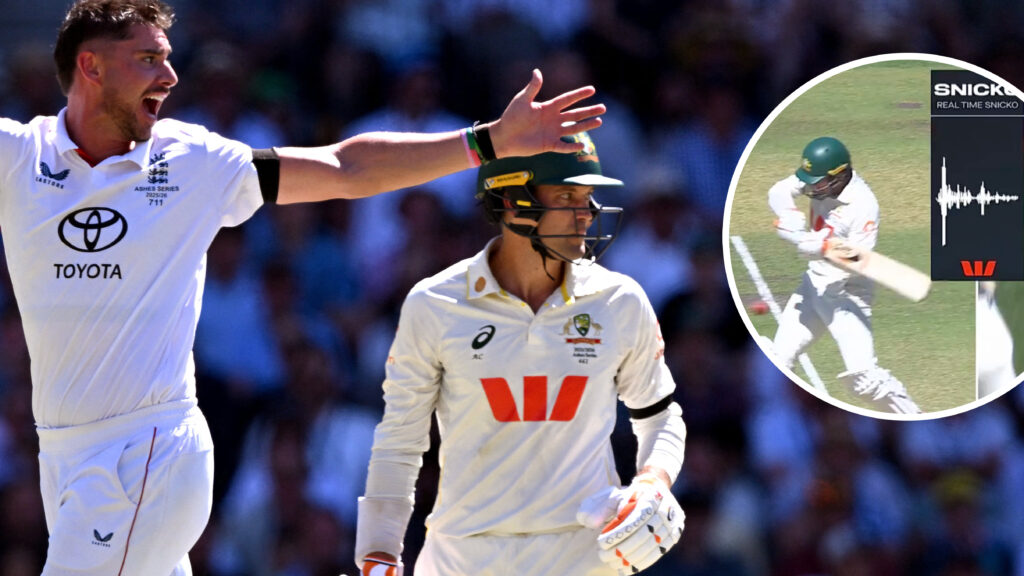
Alex Carey found himself at the center of a fresh Ashes controversy after England claimed his century in Adelaide was aided by faulty technology. The incident occurred when Carey, who had previously been involved in a contentious stumping of Jonny Bairstow at Lord’s in 2023, was suspected of edging a delivery from Josh Tongue when a noise was detected on the Real-Time Snickometer (RTS).
Despite the noise, on-field umpire Ahsan Raza ruled Carey not out. England, prompted by wicketkeeper Jamie Smith, opted for a review. However, the RTS noise did not align with the video footage of the ball passing Carey’s bat during his attempted cut shot. Television umpire Chris Gaffaney upheld the not out decision, allowing Carey to score an emotional century in front of his home crowd in Adelaide.
Technology Under Scrutiny
England’s bowling coach, David Saker, expressed concerns over the reliability of the RTS technology. Saker, a former fast bowler for Tasmania and Victoria, noted that this wasn’t the first instance of questionable technology in the NRMA Insurance series.
“The boys were pretty confident he hit it,” Saker stated. “I think the calibration of the ‘Snicko’ is out quite a bit, and that’s been probably the case for the series. There’s been some things that don’t really measure up.”
The decision cost England 34 runs, as Carey was eventually dismissed for 106 late in the final session. Reflecting on the incident, Carey admitted he heard a noise as the ball passed his bat but remained uncertain about the source.
“It looked a bit funny on the replay, didn’t it, with the noise coming early,” Carey remarked. “But if I was given out, I think I would have reviewed it – probably not confidently though.”
Historical Parallels and Calls for Change
This incident is reminiscent of a similar situation in Perth where roles were reversed between Smith and Carey, with England again feeling shortchanged. During that match, Smith began walking off after a spike on RTS suggested an edge, only to be given out after further deliberation by the television umpire.
These events have intensified calls for the inclusion of specialist television umpires, a move already implemented in the UAE’s ILT20 competition with the involvement of former international official Simon Taufel. However, the International Cricket Council (ICC) has yet to adopt such measures.
“The DRS was applied, and for the third umpire to overturn the not out decision, we need to see a clear deflection off the bat, or we have to see a spike next to the bat or up to one frame past the bat,” Taufel explained. “The confusing element here for everyone was that the spike occurred at least a couple of frames before the bat, which was just amazing.”
Implications for the Ashes Series
The ongoing debate over technology’s role in cricket decisions underscores the need for improved accuracy and reliability, especially in high-stakes series like the Ashes. As the series progresses, both teams will be keenly aware of the potential impact of technological errors on match outcomes.
The NRMA Insurance Men’s Ashes series continues with Australia having won the first two tests by eight wickets each. The third test is scheduled to take place from December 17-21 at Adelaide Oval, followed by the fourth and fifth tests in Melbourne and Sydney, respectively.
Australia’s squad for the third test includes notable players such as Pat Cummins, Alex Carey, and Steve Smith, among others. As the series unfolds, the scrutiny on technology will likely persist, with teams and officials alike seeking clarity and fairness in decision-making processes.