
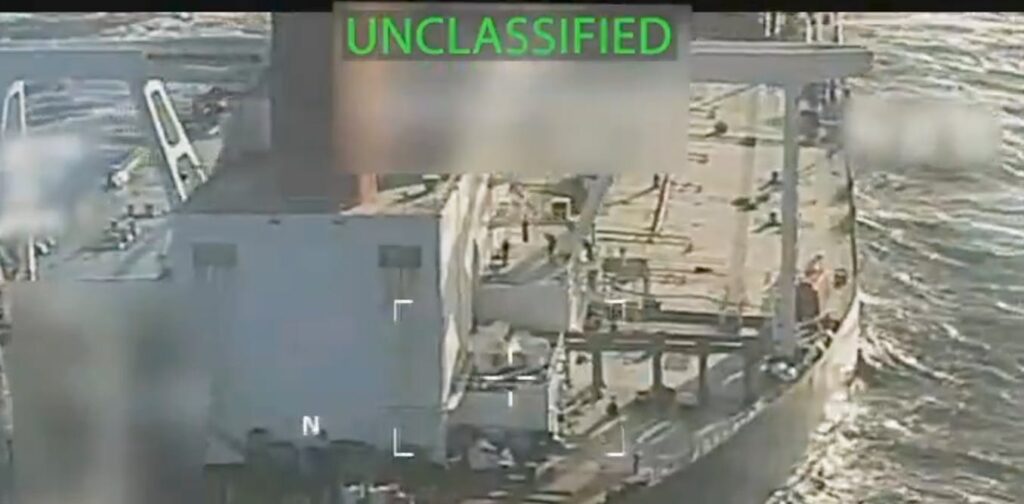
The recent U.S. seizure of an oil tanker off the coast of Venezuela marks a significant escalation in the ongoing economic pressure on President Nicolás Maduro’s regime. On December 10, 2025, American forces executed the operation, descending from helicopters onto the vessel, a move that has been met with vehement condemnation from the Venezuelan government, labeling it as “barefaced robbery and an act of international piracy.”
This operation follows months of U.S. military buildup in the Caribbean, raising questions about the Trump administration’s objectives in targeting the tanker and the potential repercussions for Venezuela’s already struggling economy. To shed light on these developments, The Conversation U.S. consulted Francisco J. Monaldi, a Latin American energy policy expert from Rice University.
The Seized Tanker: A Closer Look
The vessel in question, a 20-year-old supertanker named the Skipper, has the capacity to carry approximately 2 million barrels of oil. According to the Trump administration, the tanker was en route to Cuba. However, Monaldi suggests that its ultimate destination was likely China, given the ship’s size, which is typically not utilized for transporting oil across the Caribbean to Cuba.
Previously sanctioned by the U.S. Treasury in 2022 for carrying prohibited Iranian oil, the tanker, then known as Adisa, was linked to Russian oil magnate Viktor Artemov and an oil smuggling network. The latest seizure, captured in a video released by Attorney General Pam Bondi, appears unrelated to the broader sanctions imposed on Venezuela in 2019 and expanded in 2020 to include secondary sanctions on countries engaging with the nation or its companies.
Impact on Venezuela’s Oil-Dependent Economy
Venezuela’s economy is heavily reliant on oil production, with estimates suggesting that oil constitutes over 80% of the nation’s exports, with some analysts placing this figure above 90%. A significant portion of this oil finds its way to the black market, primarily reaching independent refiners in China, as state-owned enterprises avoid engaging due to sanctions risks.
Approximately 80% of Venezuelan oil is directed to China, while 17% is sent to the U.S. under a license granted to Chevron by the U.S. Treasury, and 3% is subsidized to Cuba. The oil sector is crucial, accounting for about 20% of Venezuela’s GDP and over 50% of government revenue.
Decline of Venezuela’s Oil Sector
Even before the imposition of U.S. sanctions in 2019, Venezuela’s oil production was in decline. Production peaked at 3.4 million barrels per day in 1998, prior to Hugo Chávez’s presidency. By the time of Chávez’s death in 2013, production had fallen to 2.7 million barrels per day. The 2019 sanctions targeting Petróleos de Venezuela reduced production further to 1.3 million barrels per day.
The closure of the U.S. market, which previously received half a million barrels daily, forced Venezuela to pivot towards India and China. However, the 2020 secondary sanctions, coupled with the COVID-19 pandemic, further restricted Venezuela’s market access, leading to a production collapse to 400,000 barrels per day. Today, production has rebounded to around 1 million barrels per day, aided by Chevron’s continued operations.
Strategies to Circumvent Sanctions
To navigate U.S. sanctions, Venezuela employs a shadow fleet that conceals its identity using false flags and names. These vessels, often rebranded and repainted, manipulate transponders to mask their true locations. After picking up oil in Venezuela, they may transfer cargo to another ship, a process fraught with environmental hazards, before assuming a new identity in Malaysia and continuing to China.
Market Reactions and Future Implications
The seizure of the tanker has had minimal impact on global oil prices due to existing oversupply and Venezuela’s relatively small market share. However, the situation could change depending on the U.S.’s level of aggression. The Trump administration is cautious to avoid domestic price increases.
For Venezuelan oil, the implications are more severe. The black market already sells Venezuelan oil at a discount due to sanctions-related risks. The recent U.S. action is likely to deepen these discounts, as buyers become increasingly hesitant to prepay for cargo, given the heightened risk of seizure. Consequently, Venezuela may be forced to offer higher discounts and fewer prepayment requirements to attract buyers, potentially leading to reduced export volumes and production cuts.
This development further constrains the limited revenue that Maduro’s government relies on to sustain its functions, exacerbating the economic challenges facing Venezuela.