



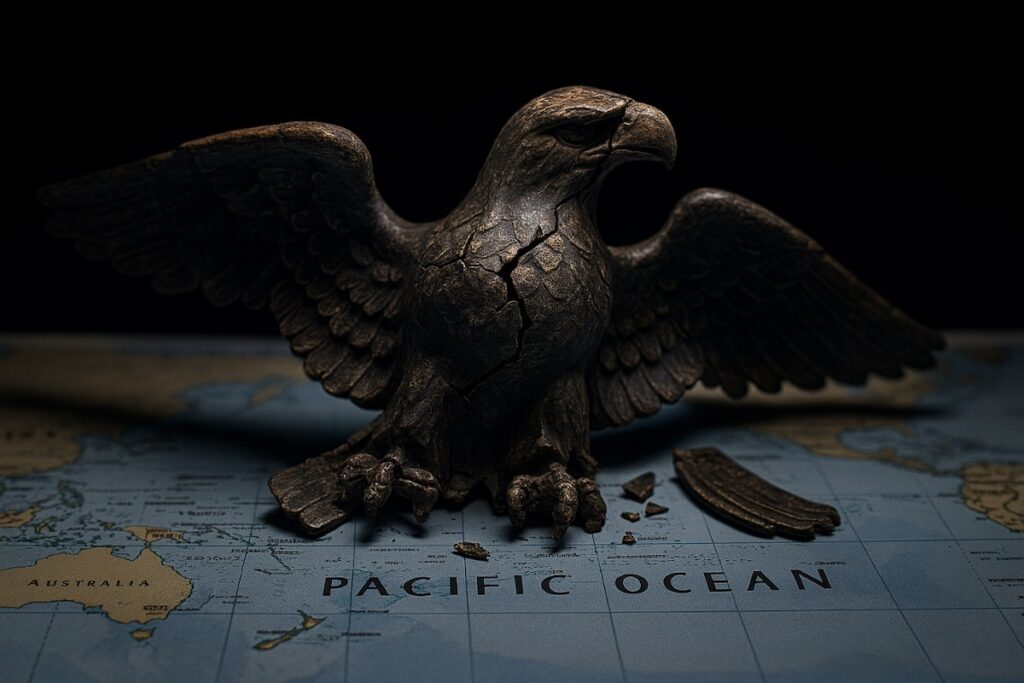
A leaked assessment from the US Department of Defense, known as the “Overmatch” brief, has raised alarms about the United States’ ability to win a high-stakes conflict with China over Taiwan. The report, obtained by the New York Times, suggests that under current conditions, the US would likely face defeat.
The classified, multiyear report was prepared by the DoD’s Office of Net Assessment and has been delivered to senior White House officials over several years. It outlines how a conflict could unfold, concluding that China now has the capability to destroy US aircraft, large naval vessels, and satellites early in a confrontation, while exploiting critical vulnerabilities in the US supply chain.
China’s Military Advancements
The brief highlights China’s expanding missile forces, low-cost drones, and cyber capabilities, which could overwhelm the US’s reliance on expensive, vulnerable platforms such as aircraft carriers and advanced fighter jets. According to officials cited by the New York Times, DoD war games consistently show US defeat, with one former senior national security official describing the assessment as revealing Chinese “redundancy after redundancy” against US advantages.
The findings underscore a broader warning that decades of investment in bespoke, slow-to-produce weapons, combined with eroded industrial capacity and limited munitions stockpiles, have left the US military ill-prepared for a conflict with a peer adversary. This comes as China accelerates its military preparations, including a potential move against Taiwan by 2027.
Industrial Capacity and Production
Seth Jones and Alexander Palmer, in a March 2024 report for the Center for Strategic and International Studies (CSIS), note that China has put its defense industry on a wartime footing. By leveraging a military-civil fusion (MCF) strategy, China has effectively utilized its massive shipbuilding, missile, and munitions production capacity.
“China now produces weapons systems five to six times faster than the US in key areas, such as missile and combat aircraft production, and has a shipbuilding capacity 230 times that of the US,” Jones and Palmer report.
By contrast, the US defense industrial base has atrophied after decades on a peacetime footing, suffering from limited surge capacity, munitions shortfalls, fragile supply chains, workforce shortages, bureaucratic delays, and inconsistent demand signals, which undermine deterrence in a prolonged great-power conflict.
Technological Edge and Strategic Implications
Focusing on China’s near-constant reveals of new military technology, Timothy Heath notes in a November 2025 article for The War Zone that China’s growing inventory of advanced, hard-to-track systems such as stealth aircraft, hypersonic missiles, and directed energy weapons (DEWs) may outpace US counters.
Robert Peters stresses that China’s mass production of fighters, ships, and missiles—despite uncertain quality—creates a concentrated regional advantage against globally dispersed US forces. However, Brad Bowman mentions that China may be trying to inundate US intelligence with reveal after reveal to confuse hype with real capability, while sprinting towards capabilities necessary to take Taiwan.
Zack Cooper adds that while only a few of China’s reveals are actually completely new systems, analyzing each reveal still requires time and resources, thus becoming a significant strain on intelligence capabilities.
Potential Consequences for US Alliances
If China eventually closes the technological and defense-industrial gap with the US, it could lead to a US equivalent of the “Suez Crisis,” according to Bence Nemeth in a 2025 article for the Texas National Security Review journal. Nemeth argues that such an event—whether a disastrous defeat, refusal to intervene in a Taiwan conflict, or a limited skirmish in the South China Sea—exposing US weakness would make the US’s decline obvious to the world.
“The resulting psychological rupture could shatter the credibility of US security guarantees across its alliance system in the Pacific,” Nemeth emphasizes.
Such a shock would not collapse US alliances outright but could push them toward either hollowing out—reduced to mere symbolism without substance—or adaptation, where US dominance gives way to a more distributed and negotiated security order.
Adapting to a New Strategic Landscape
In a hollowing-out scenario, South Korea may face intensified pressure to pursue nuclear weapons if confidence in US extended deterrence collapses. Japan, while unlikely to move immediately toward nuclearization, possesses significant nuclear latency, and a similar credibility shock could bring long-suppressed arguments for an independent nuclear deterrent back into serious strategic debate.
Some Philippine nationalists and politicians, banking on historical colonial grievances and sovereignty concerns regarding the US military presence in the country, would gain wider support. A US debacle in the Taiwan Strait or in the South China Sea may raise questions about the US military presence in the country, which could then prompt Philippine leaders to scale down combined exercises or even revoke US access to Philippine military facilities.
Meanwhile, such a blow to US credibility could push Australia and New Zealand toward rapprochement with China, given their heavy trade reliance on China as their primary export market.
Maintaining Core Alliance Elements
A less bleak outcome is adaptation, where the US loses its primacy but keeps core alliance elements like political alignment, cooperation, and niche capabilities, acting more as an enabler than a leader in a distributed security architecture. In this connection, Japan has signed Reciprocal Access Agreements (RAAs) with Australia and the Philippines. Similarly, the Philippines has expanded its defense partnerships beyond the US to include Japan, Australia, Canada, and New Zealand.
While these defense partnerships do not replace the bilateral US alliance system, they build on the latter—filling in capability gaps while avoiding the onerous obligations of treaty alliances. Viewing US capabilities as enablers, US space-based intelligence, surveillance, and reconnaissance (ISR) may be essential in helping Japan execute its counterstrike options against China and North Korea—addressing a critical capability gap until Japan can develop its own.
South Korea might choose to sustain its strong military ties with the US while continuing to build its independent conventional forces and working toward the eventual transfer of wartime operational command (OPCON) from the US. US space-based ISR and command and control (C2) could enhance the Philippines’ maritime domain awareness (MDA), allowing the country to conduct resupply missions to its South China Sea outposts and respond effectively to China’s gray zone provocations, enabling Manila to take the lead in asserting its territorial claims.
While Australia remains a hub for sensitive US military technology, such as nuclear propulsion for the planned AUKUS nuclear attack submarines (SSN-AUKUS), it may decide that US security guarantees alone are not enough for its security. Australia could thus revitalize its longstanding Five Power Defense Arrangement (FPDA) with the UK, Singapore, Malaysia, and New Zealand.
Taken together, the Overmatch brief may matter less as a warning than as an acknowledgment that the Indo-Pacific is already adapting to a strategic landscape in which US military primacy can no longer be assumed. The more immediate question, then, is not how the US restores unquestioned military-industrial dominance but how effectively it adjusts to a region learning to operate without it.