


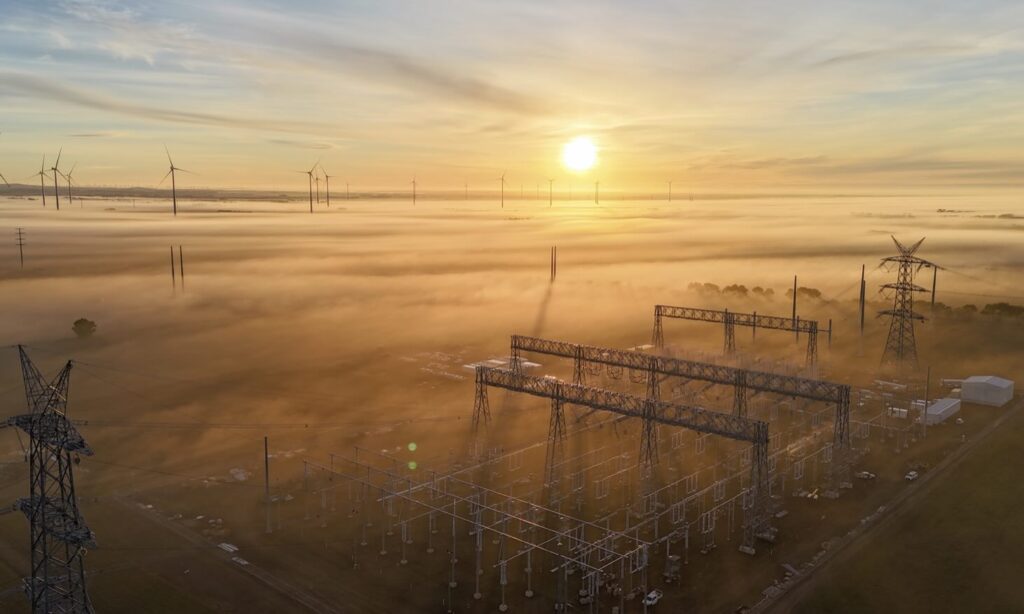
In a significant milestone for Australia’s renewable energy sector, the Golden Plains wind farm near Geelong has achieved on-time commissioning, marking a breakthrough in grid connections. This achievement is particularly noteworthy given the historical challenges associated with grid integration in the country. Industry stakeholders, investors, and policymakers are hopeful that this success is not an isolated incident.
Five years ago, the experienced renewable energy developers at TagEnergy began planning what would become Australia’s largest wind farm, the 1.33 gigawatt Golden Plains project. At that time, grid connection issues were among the biggest risks for wind and solar developers and their financial backers. Slow connections could lead to delays in the transition to green energy, missed targets, and higher costs.
Overcoming Grid Challenges
TagEnergy managing partner Andrew Riggs recalls the challenges faced during the project’s early stages. “When we were getting ready to go to financial close in 2021/22, that was a very different time,” says Riggs, a former head of sales and proposals at Siemens. The project emerged from the “Rhombus of Regret,” a part of the Victoria grid plagued by capacity limits and connection delays.
The breakthrough for Golden Plains came with the Australian Energy Market Operator’s (AEMO) agreement to share its grid models. This allowed TagEnergy and its partners, including wind supplier Vestas, VicGrid, and AusNet, to test their own models offline and determine the best approach. This proactive strategy enabled the team to proceed with confidence, armed with the necessary information.
Milestones Achieved
Vestas submitted a comprehensive R0 package for early assessment in November 2021. Within nine months, the project achieved AEMO’s S5.3.4A compliance, allowing for a Notice to Proceed to be issued on November 22, 2022. These timelines, while technical, represent a landmark achievement for those familiar with the complexities of connecting to Australia’s heavily regulated grid.
“Five years ago, investor confidence was at a low because of the connections problems,” Riggs tells Renew Economy. “The story here is that it can be done. You can connect large scale projects on time. This is an example that other investors can look at.”
The Golden Plains project contrasts with other projects that have experienced delays in grid registration or commissioning hiccups. Despite starting its commissioning process after the 923 MW MacIntyre wind project and the 400 MW Clarkes Creek project in Queensland, Golden Plains reached full commissioning before both.
Resilience Amid Challenges
The project reached full output in October, following extensive grid tests across four Hold Points. These tests were carefully planned through narrow “wind-windows,” often conducted on weekends and overnight. The connection process was completed on time despite major transmission failures caused by storms in 2024 and the tragic death of a contractor during turbine blade transport.
The first stage of 756 MW is now complete, with the 576 MW second stage under construction and set for progressive commissioning through 2026. Additionally, a 150 MW, 600 MWh big battery is being built at the site.
Policy and Human Factors
Riggs attributes part of the project’s success to changes in the Connection Reform Initiatives, which provided improved investment certainty for adding the second stage. However, he emphasizes the importance of team consistency. “That is a super important thing that you cannot legislate for,” Riggs notes. “I have some slides from 2020 where we mapped out how to do it. We allocated the risks, the big thing was keeping the humans the same.”
Claire Cass, VicGrid’s head of access and connections, highlighted the seamless process achieved through close collaboration with AEMO. “Connection of Golden Plains is an important milestone in this transition and in the work to secure Victoria’s renewable energy future,” she stated.
Vestas’ Australia and New Zealand country head, Danny Nielsen, emphasized the trust in technology, while AusNet’s chief development officer, Jon D’Sylva, credited delivery partners CPP, Jacobs, SRS, and Hitachi for their roles in the project. “This milestone demonstrates the critical role collaboration and technical excellence play in enabling Victoria’s clean energy future,” he said.
Looking Forward
The success of the Golden Plains wind farm sets a new benchmark for future projects in Australia, demonstrating that large-scale renewable energy projects can be connected on time. This achievement offers a template for overcoming grid connection challenges, boosting investor confidence, and accelerating the transition to a sustainable energy future.
As the renewable energy landscape continues to evolve, the lessons learned from Golden Plains will likely influence future projects and policies, paving the way for more efficient and reliable grid integration across the nation.