
Under the cover of cold and gloomy darkness in Western Ukraine, Tymur Mindich, one of the country’s most influential men, entered a black Mercedes S Class bound for Poland. Detectives were closing in, and this wealthy business magnate wanted out. By November 10 — the night of his escape — Mr. Mindich had realized he was being recorded by anti-corruption spies, who had also discovered his code name: Carson.
The investigators from Ukraine’s National Anti-Corruption Bureau (NABU) believed he and some high-powered accomplices, including cabinet ministers, were embezzling money from the state’s biggest energy company in a lucrative kickback scheme that saw them pocket millions. Hours after Mr. Mindich slipped over the border, anti-corruption cops began raiding properties linked to the alleged graft. Kyiv newspapers reported that in an apartment connected to Mr. Mindich, officers discovered a lavishly decorated bathroom. Its opulent centerpiece? A golden toilet.
The Scandal’s Political Reverberations
This glittering commode has become synonymous with the investigation, which some analysts believe poses the greatest threat to President Zelenskyy’s administration since Russia launched its full-scale invasion of Ukraine more than three and a half years ago. Mr. Mindich, the alleged ringleader of the scam, was a longtime business associate of the president and co-owned a film production company with Mr. Zelenskyy, who was once a popular actor.
Andriy Yermak, who resigned late last week from his role as the president’s chief of staff after his property was searched by detectives, was also a long-time friend of Mr. Zelenskyy. Like the president, he spent his career prior to politics in show business. Mr. Yermak acted as Mr. Zelenskyy’s most trusted fix-it man and was intimately involved in drafting and negotiating peace proposals on behalf of Kyiv.
Ukrainian Justice Minister Herman Halushchenko, as well as former deputy prime minister Oleksiy Chernyshov, are alleged to have either facilitated or taken a cut of the $100 million embezzled from the state-owned energy company Energoatom, the largest electricity provider in the country.
Operation Midas and Its Findings
The anti-corruption watchdog has said the money was made through illegal 10–15 percent kickbacks on contracts connected to the company. The contracts were lucrative construction deals, signed by Energoatom as it looked to build defenses to its energy infrastructure during constant bombardment from Russian aerial attacks.
In one wire-tapped conversation, one suspect reportedly complained of bad back pain from lugging wads of notes around.
Six people have been arrested. Energy minister Svitlana Hrinchuk has resigned, Mr. Halushchenko has been sacked, and although Mr. Yermak’s house was raided, NABU is yet to reveal whether they believe he was involved. Mr. Mindich remains on the lam, with reports the businessman is hiding out in Israel.
Mr. Zelenskyy has publicly praised the work of the detectives who carried out the investigation and expressed shock that some personal allies were allegedly involved. Nevertheless, the scandal involving the country’s main energy supplier has angered many in Ukraine, where power outages have been regular during the war. It has led many Ukrainians to question Mr. Zelenskyy’s leadership, and whether his pre-election pledge to end corruption in the country was just lip service.
Historical Context and Endemic Corruption
Since gaining independence after the Soviet Union collapsed in 1991, Ukraine’s halls of power have been marred by endemic graft. Crooked deals often went to the very top of the country’s government. Pavlo Lazarenko, who was Ukraine’s prime minister between 1996 and 1997, was accused of embezzling $200 million during his years as a politician, much of it through the country’s gas sector. In 1999, he fled Europe to the United States, where he spent time in prison for fraud and money laundering.
Even after Russia’s full-scale invasion in February 2022, allegations of corruption continued. In January 2023, Ukraine’s then-infrastructure minister was sacked after he was accused of stealing $400,000 from the country’s winter aid budget. This type of corruption is seen to undermine international support, and Ukraine is in desperate need of international aid at the moment.
“Corruption has been an endemic problem in Ukraine and it certainly does not have a good record in uncovering corruption in the past,” said Jaroslava Barbieri, a research fellow at Chatham House.
The Future of Ukraine’s Anti-Corruption Efforts
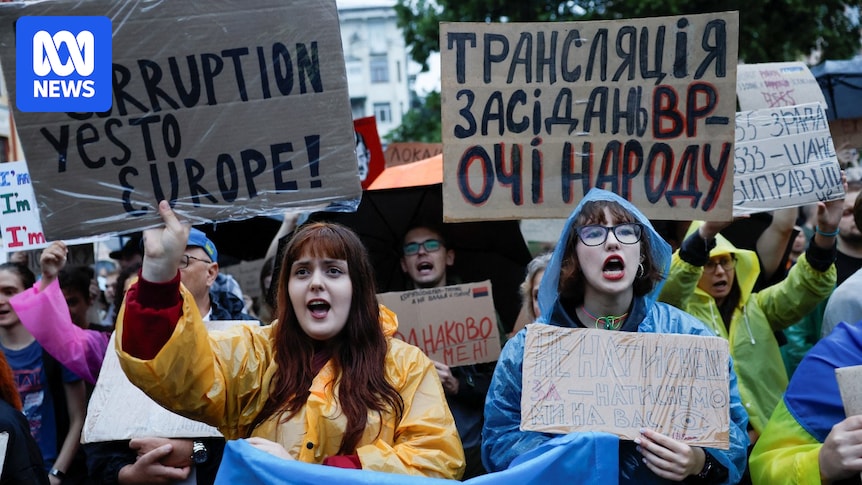
Despite Mr. Zelenskyy’s pre-election anti-corruption crusade, he, with Mr. Yermak’s help, has controversially tried to dilute the powers of the country’s watchdogs. In July, he signed a bill that granted the country’s top prosecutor, a staunch loyalist to Mr. Zelenskyy, full control over NABU. It meant the president’s political pal could reassign certain cases to “favorable” investigators. Mr. Zelenskyy backflipped and scrapped the bill after massive protests across Ukraine.
While opinion polls show Mr. Zelenskyy remains popular among Ukrainians, the scandal has sparked some agitation for elections in the country. Ukraine has been under martial law since Russia’s full-scale invasion, and the country’s constitution forbids elections being held while that’s in effect. While a national vote is not a possibility, there are calls for Mr. Zelenskyy and his government to show more accountability.
“People in Ukraine have rallied around the president, he’s a symbol of our resistance and if you take a look at the polls, his popularity went down but not dramatically,” said Oleksandr Merezhko, a Ukrainian MP and a member of Mr. Zelenskyy’s party.
NABU is continuing its investigation into the energy scandal, the details of which read like the plot of a spy novel. In addition to discovering Mr. Mindich’s “Carson” pseudonym, the detectives uncovered other code names. “Professor” was reportedly the moniker given to Mr. Halushchenko and Mr. Chernyshov was allegedly referred to as the Argentine revolutionary Che Guevara. Police are yet to reveal the identity of an “Ali Baba” who is frequently mentioned in the more than 1,000 hours of recorded conversations.
In Kyiv, there is significant speculation as to who Ali Baba is, and growing calls for their identity to be revealed, so war-weary Ukrainians can see how far the alleged corruption runs in their government.