




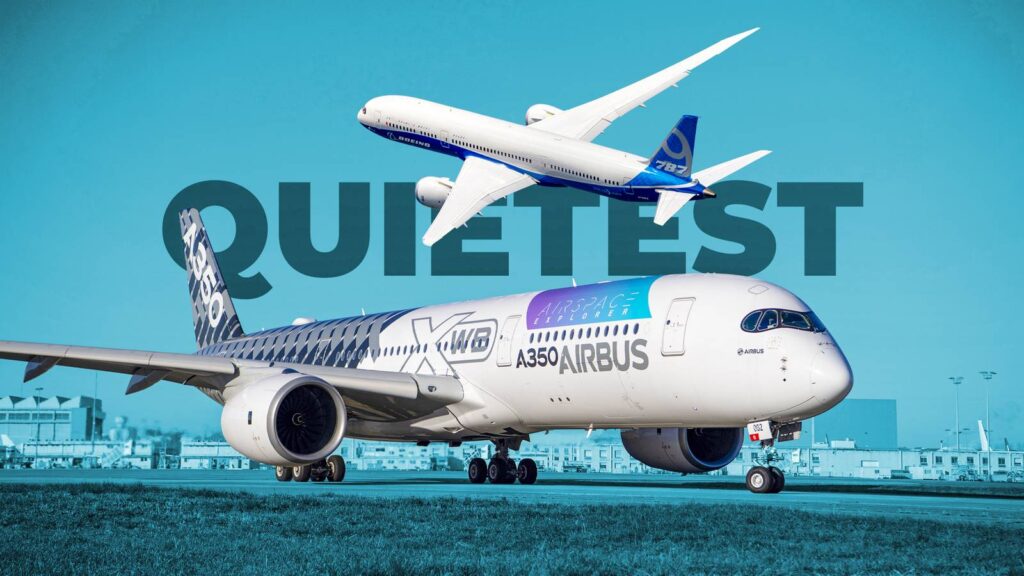
The Airbus A350 and Boeing 787 are among the most recognizable widebody aircraft of the modern aviation era. These aircraft, known for their advanced technology, passenger comfort, and economic efficiency, have become integral to the fleets of airlines worldwide. Primarily utilized on ultra-long-haul and long-haul routes, they also appear on some short- to medium-haul flights, setting benchmarks for efficiency, reliability, and quality in aviation.
While both aircraft prioritize passenger comfort through state-of-the-art cabin designs and technology-packed seating, there’s another crucial factor often overlooked: aircraft noise. The Airbus A350 is celebrated for its quietness, offering a distinct advantage over its rival, the Boeing 787.
The Battle of the Widebodies
Boeing launched the 787 program in April 2004, with the first delivery to All Nippon Airways in September 2011. The 787, built with 50% composite materials, comes in several variants, including the 787-8, 787-9, and 787-10, seating 250–340 passengers and offering a range of up to 7,565 nautical miles. By mid-2025, Boeing had delivered over 1,200 units to airlines like ANA, United Airlines, and American Airlines.
Airbus introduced the A350 program in October 2005, with its entry into service in January 2015 with Qatar Airways. The A350 offers variants such as the A350-900 and A350-1000, accommodating 300–400 passengers with a range exceeding the 787. The A350-900 ULR variant can cover up to 9,700 nautical miles, making it ideal for ultra-long-haul routes.
Both aircraft have earned reputations as reliable workhorses, cherished by crews, passengers, and airlines. They compete directly, intensifying the ongoing Airbus vs. Boeing rivalry as both seek marginal gains over the other.
Clever Cabin Design
Cabin design significantly influences passenger comfort and satisfaction. Every element, from seat ergonomics to air quality and lighting, shapes the travel experience. How do the Airbus A350 and Boeing 787 compare in cabin comfort and innovation?
The Boeing 787 boasts a low cabin altitude of around 6,000 feet and higher humidity levels, thanks to its composite structure. It features larger windows with electronic dimming, LED mood lighting, and a quieter engine, offering a modern and passenger-friendly atmosphere.
The Airbus A350, with its “Airspace” cabin, offers one of the quietest and most spacious twin-aisle environments. Its wider fuselage provides extra shoulder room and wider seats. Like the 787, it maintains low cabin altitude and good humidity, with advanced noise insulation and smooth airflow design, delivering a remarkably quiet and comfortable experience.
Noise Level Comparison
Beyond physical comfort features, aircraft noise plays a crucial role in passenger experience, especially on long flights. The Airbus A350 is regarded as one of the quietest twin-aisle aircraft, with cabin noise levels up to 5dB lower than previous-generation widebodies.
The A350’s quietness contributes to its premium reputation, often cited by airlines and travelers as a key factor in overall comfort.
The Boeing 787 is also quieter than older aircraft and even quieter than the A350 in certain conditions. Its cabin noise is roughly 20% lower than comparable previous-generation jets, offering a peaceful ride. However, the A350 is generally measured as quieter overall.
Coincidence or Clever Design?
Airbus emphasizes passenger experience, particularly in minimizing cabin noise. The A350’s design incorporates carbon-fiber-reinforced polymer, reducing weight and dampening noise more effectively than aluminum. The Rolls-Royce Trent XWB engines, with acoustic liners and advanced fan blade geometry, significantly reduce engine noise.
Inside the cabin, Airbus uses acoustic insulation in the floor, sidewalls, and ceiling, along with carefully designed air ducts to reduce airflow noise. The result is a consistently quiet interior, enhancing sleep quality and conversation.
Looking to the Future
Future developments in aircraft noise reduction will likely focus on smarter technologies. Advanced composite materials could actively absorb vibrations, preventing sound spread. Active noise control, similar to noise-canceling headsets, could maintain low noise levels throughout the cabin.
Engine innovations, such as ultra-high bypass turbofans and hybrid-electric propulsion, promise to cut noise dramatically. Combined with smarter ducting and AI-based acoustic monitoring, these technologies could make future aircraft cabins quieter and more comfortable.
The ongoing battle between the Boeing 787 and Airbus A350 represents the pinnacle of modern long-haul comfort and efficiency. Both aircraft have redefined passenger expectations, pushing manufacturers to refine every aspect of the flying experience. As the competition continues, the focus will remain on quieter, cleaner, and more efficient aircraft, driving innovation in aviation.