
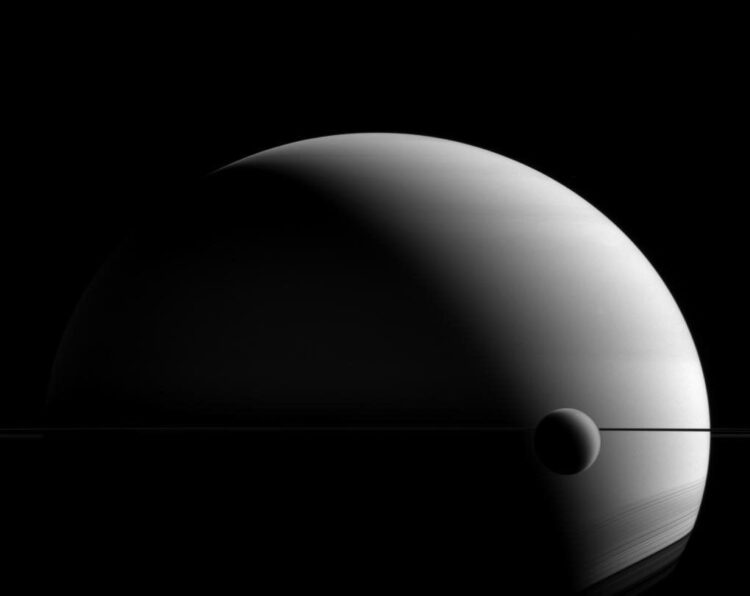
Careful reanalysis of data from more than a decade ago indicates that Saturn’s biggest moon, Titan, does not have a vast ocean beneath its icy surface, as previously suggested. Instead, a journey below the frozen exterior likely involves more ice giving way to slushy tunnels and pockets of meltwater near the rocky core.
Data from NASA’s Cassini mission to Saturn initially led researchers to suspect a large ocean composed of liquid water under the ice on Titan. However, when they modeled the moon with an ocean, the results didn’t match the physical properties described by the data. A fresh look yielded new – slushier – results. The findings could spark similar inquiries into other worlds in the solar system and help narrow the search for life on Titan.
Revisiting Cassini Data: A Slushier Reality
The Cassini mission, which began in 1997 and lasted nearly 20 years, produced volumes of data about Saturn and its 274 moons. Titan, shrouded by a hazy atmosphere, is the only world, apart from Earth, known to have liquid on its surface. Temperatures hover around -297 degrees Fahrenheit, where instead of water, liquid methane forms lakes and falls as rain.
As Titan circled Saturn in an elliptical orbit, researchers observed the moon stretching and smushing depending on its position relative to Saturn. In 2008, they proposed that Titan must possess a huge ocean beneath the surface to allow such significant deformation.
“The degree of deformation depends on Titan’s interior structure. A deep ocean would permit the crust to flex more under Saturn’s gravitational pull, but if Titan were entirely frozen, it wouldn’t deform as much,” said Baptiste Journaux, a University of Washington assistant professor of Earth and space sciences.
The study, published Dec. 17 in Nature, was led by NASA with collaboration from Journaux and Ula Jones, a UW graduate student of Earth and space sciences in his lab.
Understanding Titan’s Interior: The Role of Viscosity
In this study, the researchers introduce a new level of subtlety: timing. Titan’s shape shifting lags about 15 hours behind the peak of Saturn’s gravitational pull. Like a spoon stirring honey, it takes more energy to move a thick, viscous substance than liquid water. Measuring the delay told scientists how much energy it takes to change Titan’s shape, allowing them to make inferences about the viscosity of the interior.
“Nobody was expecting very strong energy dissipation inside Titan. That was the smoking gun indicating that Titan’s interior is different from what was inferred from previous analyses,” said Flavio Petricca, a postdoctoral fellow at NASA’s Jet Propulsion Laboratory, who led the study.
The model they propose instead features more slush and quite a bit less liquid water. Slush is thick enough to explain the lag but still contains water, enabling Titan to morph when tugged.
Implications for Extraterrestrial Life
The discovery of a slushy layer on Titan also has exciting implications for the search for life beyond our solar system. It expands the range of environments we might consider habitable.
“Instead of an open ocean like we have here on Earth, we’re probably looking at something more like Arctic sea ice or aquifers, which has implications for what type of life we might find, but also the availability of nutrients, energy and so on,” said Journaux.
Although the notion of an ocean on Titan invigorated the search for life there, the researchers believe the new findings might improve the odds of finding it. Analyses indicate that the pockets of freshwater on Titan could reach 68 degrees Fahrenheit. Any available nutrients would be more concentrated in a small volume of water, compared to an open ocean, which could facilitate the growth of simple organisms.
While it is unlikely that researchers will discover fish wriggling through slushy channels, if life is found on Titan, it may resemble polar ecosystems on Earth.
Future Missions and Research
Journaux is on the team for NASA’s upcoming Dragonfly mission to Titan, scheduled for launch in 2028. The data collected here will guide the mission and Journaux hopes to return with some evidence of life on the planet and a definitive answer about the ocean.
Co-authors include Steven D. Vance, Marzia Parisi, Dustin Buccino, Gael Cascioli, Julie Castillo-Rogez, Mark Panning and Jonathan I. Lunine from NASA; Brynna G. Downey at Southwest Research Institute; Francis Nimmo and Gabriel Tobie from the University of Nantes; Andrea Magnanini from the University of Bologna; Amirhossein Bagheri from the California Institute of Technology and Antonio Genova from Sapienza University of Rome.
This research was funded by NASA, the Swiss National Science Foundation and the Italian Space Agency.