



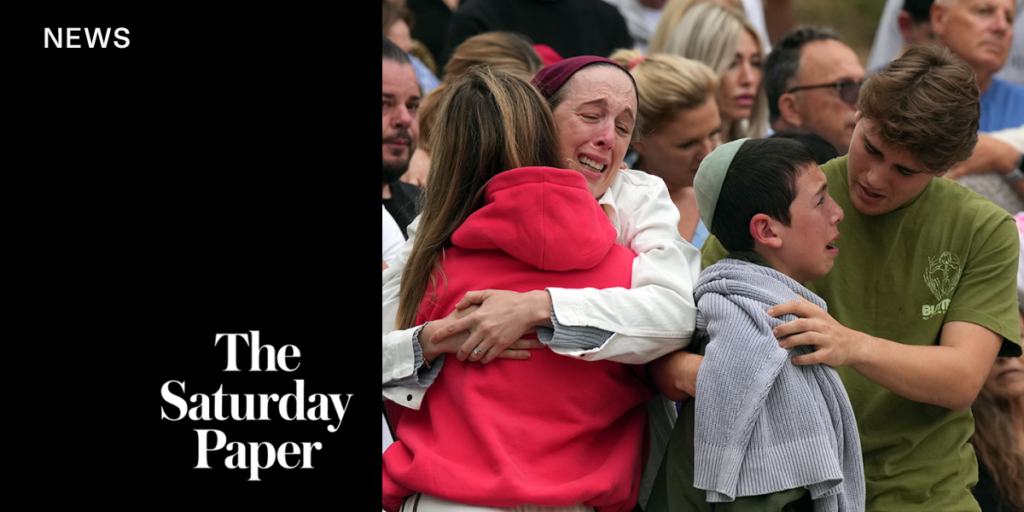
Every day since the tragic massacre at Bondi Beach, Rabbi Gabi Kaltmann has been inundated with calls. As the leader of the Ark Centre, a Jewish community hub in Hawthorn East, Melbourne, Kaltmann has become a pillar of support for a community grappling with loss and fear. The attack, which claimed the life of a dear friend, has left the Jewish community in shock.
“From the moment I get up in the morning, my phone starts ringing with elders of the community telling me that they’re on the verge of a breakdown,” Kaltmann shares. “It’s unimaginable what we as a community have just experienced. These are the daughters and sons of Holocaust survivors, and they are frankly struggling to comprehend, to come to terms with, what has just happened.”
The massacre has stirred profound anger, fear, and sorrow among Jewish Australians. Kaltmann notes the relentless calls he receives, filled with emotion and frustration towards political leadership. “It’s one call after another, with just the most unrelenting attack on [political] leadership, to which I just listen and acknowledge,” he says.
Community Struggles with Fear and Anger
Parents within the community face the daunting task of explaining the massacre to their children. Many attempt to distance the event geographically, portraying Sydney as a distant place. However, the older generation, particularly those over 60, are finding it hardest to cope. “It’s just one phone call after another, and when I meet people on the street they just want to hug you and weep on your shoulder,” Kaltmann explains.
Despite the anger directed at political leaders, Kaltmann remains diplomatic. “I don’t want to go to war with political leaders here,” he says. “But for the past two years, the Jewish community has been telling anyone that would listen that they don’t feel safe. There’s a sense of insecurity.”
He expresses disappointment over the federal government’s delayed response to Jillian Segal’s report on anti-Semitism, commissioned by the Albanese government in 2024. Although the report was delivered in July, it remained unaddressed until after the massacre.
Government Response and Criticism
On Thursday, Prime Minister Anthony Albanese formally responded to Segal’s report, proposing reforms including new hate speech offences and increased penalties for hate speech that incites violence. Former treasurer Josh Frydenberg, speaking at a memorial, criticized the government’s inaction. “This massacre at Bondi is the greatest stain on this nation,” he declared, urging for urgent and strong action to prevent future attacks.
Frydenberg highlighted the massacre’s grim distinctions: the worst terrorist attack on Australian soil and the severest loss of Jewish life outside Israel since October 2023. He attributed the tragedy to the ineffectiveness of the prime minister, calling for accountability and proposing eight actions, including outlawing radical preachers and designating Hizb ut-Tahrir as a terrorist organization.
“Our prime minister, our government, has allowed Australia to be radicalised on his watch,” Frydenberg stated.
Calls for Gun Reform and Public Safety
The massacre has reignited debates on gun reform. Both the prime minister and NSW Premier Chris Minns have pledged to tighten gun laws, with proposals to limit gun licenses to citizens and reduce the number of weapons an individual can own. Former Prime Minister John Howard, known for his gun reforms after the Port Arthur massacre, supports additional reforms but warns against using them as a distraction from addressing anti-Semitism.
For Carrick Ryan, a former officer with the Australian Federal Police, tightening gun controls is both obvious and necessary. “I think, unequivocally, the greatest defence this country has had against a mass casualty terrorism attack has been our firearms laws,” he says.
“If they had automatic weapons – if they had something like an AR-15 – we would be talking about hundreds dead,” Ryan emphasizes.
Ryan acknowledges the challenges in preventing such attacks, noting that while larger conspiracies are easier to detect, individuals can slip under the radar. He stresses the importance of removing weapons that enable mass casualties, advocating for mature responses over emotional reactions.
As the community mourns and seeks answers, the focus remains on ensuring safety and preventing future tragedies. The path forward involves addressing both immediate security concerns and the broader societal issues that contribute to such violence.