




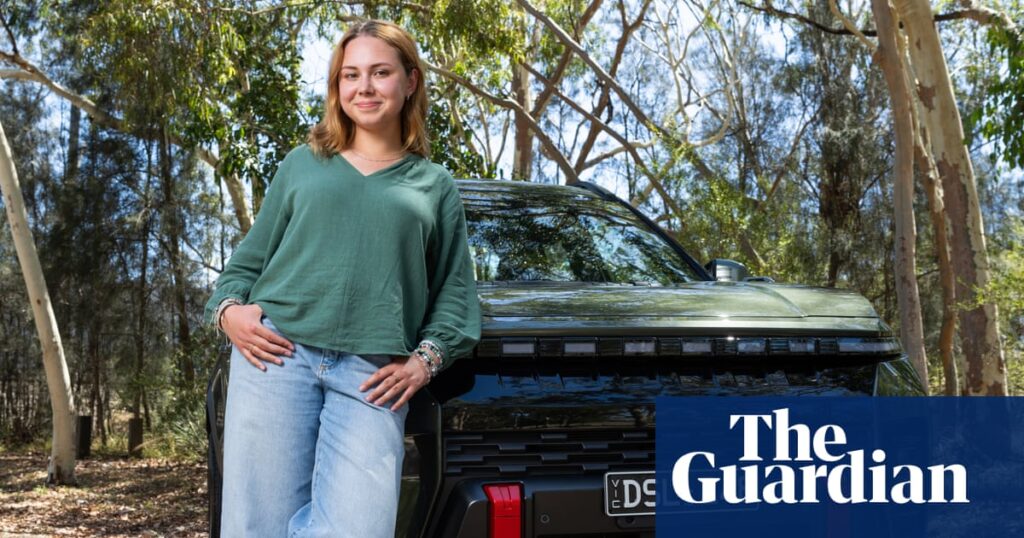
When I am handed the keys to Australia’s first affordable fully electric ute, the Musso EV, I feel a wave of nervousness wash over me. Having driven a 2014 Volkswagen Polo for the past four years, and before that, a Holden Astra older than myself, this transition to an electric ute is daunting. Sitting upright to peer over the wide bonnet, I am reminded of the unease I felt as a learner driver.
Australia’s affinity for large utes and SUVs is well-documented, with these vehicles dominating the top 10 most-purchased list last year. Despite safety and environmental concerns, their popularity continues to rise. Meanwhile, electric vehicle sales have also surged, accounting for 9.7% of new car sales in the three months leading to September, according to the Australian Automobile Association (AAA).
Introducing the Musso EV
The Musso EV, the first electric ute by South Korean brand KGM, claims to be the first affordable electric ute on the Australian market. The company highlights its combination of “refined SUV styling” with “rugged ute practicality.” However, the question remains: can it convert traditional gas-guzzling ute and SUV drivers, or even newcomers like myself?
My driving confidence restored after a few practice maneuvers, I venture onto the main road to test this vehicle’s capabilities. The Musso EV is equipped with modern technology that surpasses my Polo, including a wireless phone charger, a start button, and a 360° birds-eye view camera system, which proves invaluable for reverse parking.
Pricing and Market Position
The Musso EV is available in two-wheel and all-wheel drive models. The two-wheel drive starts at $60,000, significantly cheaper than competitors like Tembo’s Tusker at $74,000, LDV’s eT60 at $92,990, and Ford’s F-150 Lightning at $169,900.
Hussein Dia, professor of future urban mobility at Swinburne University, describes the Musso as the “first genuinely affordable” electric ute in Australia.
Dia notes its impressive range on a single charge and features typically found in “fancy SUVs.” However, he acknowledges that those using utes for heavy-duty work might find it lacking in robustness.
Stevan Dimitrovski, KGM’s Australian national marketing manager, describes the vehicle as “purpose-built for lifestyle,” suggesting it’s more suited for leisure activities than heavy towing.
Appeal to Mainstream Buyers
According to Dia, the Musso EV’s price point is likely to attract mainstream buyers rather than early adopters. However, Nathan Moore, a behavioral scientist at the University of Technology Sydney, argues that SUV and ute drivers typically seek vehicles for work or a rugged lifestyle, viewing EVs as neither capable nor rugged.
“The real motivations for people who’d want to buy an electric SUV are similar to those buying EVs anyway,” says Moore. “These tend to be early adopters with disposable income.”
The Ultimate Suburban Road Test
With its “lifestyle ute” design, I take the Musso EV for a suburban Sydney road test. It navigates a Bunnings car park, a Red Rooster drive-through, a Westfield shopping center, and a few laps around Parramatta Park with ease. Although I don’t need to charge it before returning, I attempt to find a public charger, a task that proves challenging.
Public chargers are crucial for Australians without off-street parking or those traveling long distances. Dia’s experiments into “charging deserts” revealed the need for careful planning on long drives, such as a 4,000km trip from Melbourne to Darwin. The Musso EV claims a range of 380km for the all-wheel drive and 420km for the two-wheel drive.
Dia warns that driving in rural areas could be challenging due to limited charging infrastructure.
Even in Sydney’s suburbs, finding a public charger is difficult. Three attempts in western Sydney yield occupied or non-existent stations.
Public Perception and Future Prospects
In a Bunnings car park, I gather opinions from ute drivers. Tully, an electrician, is intrigued by electric utes but prefers to wait until they become more established. Sue, a retiree, appreciates the Musso’s aesthetics but is concerned about its quietness. Jim, another retiree, worries about range and charging access, while Jack, an engineer, doubts Australia’s infrastructure readiness.
Only Steve, a handyman, is convinced, seeing the electric ute as ideal for city work without off-road demands.
Are Electric Utes the Answer?
Utes were three of the top five most-purchased vehicles in 2024, led by the Ford Ranger and Toyota HiLux. Dia hopes electric utes will soon join these ranks, noting the shift in the vehicle manufacturing landscape.
“For a long time, the market has been dominated by a few players, but the electric vehicle manufacturing game is different,” Dia explains.
The Musso EV’s environmental benefits are clear, yet KGM’s marketing barely mentions them. Belinda Noble from Comms Declare suggests this mirrors Elon Musk’s strategy with Tesla, focusing on the driving experience rather than environmental messaging.
Despite the Musso EV’s eco-friendliness, its size remains a concern. At 5.2 meters long, 1.9 meters wide, and 1.8 meters high, it’s only slightly smaller than conventional utes. While I felt secure driving it, the size could pose a safety risk to others.
Returning to my Polo, I appreciate the ease of maneuvering in tight spaces. The Musso EV’s test drive, while unpaid, offered valuable insights into the potential and challenges of electric utes in Australia.
As the market evolves, the Musso EV may pave the way for a new era of sustainable utility vehicles, but its success will depend on overcoming infrastructure and perception hurdles.