



The US President, Donald Trump, has spent much of his first year back in office reshaping the historic White House, a building he fervently fought to reclaim. His ambitious renovations have not only altered its physical appearance but also sparked discussions about legacy and leadership style.
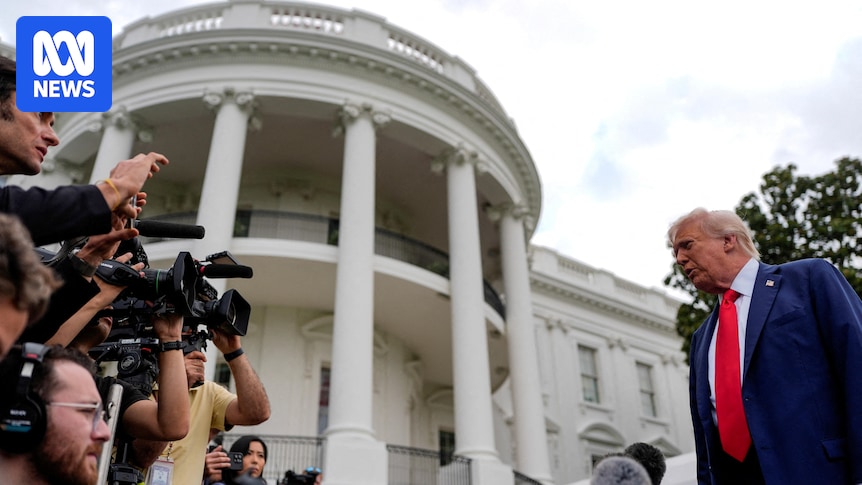
In a move that surprised many, President Trump was spotted on the roof of the White House, a place where sitting presidents are rarely seen. When questioned by the press, he casually replied, “Taking a little walk,” as if his presence there was routine. He gestured as if crafting something in the air, promising “something beautiful” and emphasizing, “It’s just another way to spend my money for the country.”
Renovations and Redesigns
Since re-entering the White House in January, Trump has embarked on a series of embellishments and renovations. The Oval Office now sports flashy gold accents, with even the ceiling’s crown molding receiving a luxurious touch. The President dismissed rumors that the appliqués were store-bought, stating, “This is not Home Depot,” during an interview with Fox News.
By mid-year, Trump fulfilled his promise to pave over the Rose Garden, a space traditionally used for press conferences and ceremonies. He justified the change by stating, “Every event you have, it’s soaking wet, and the women with the high heels — it’s too much.” While the roses remain, the grass has been replaced with “gorgeous stone.”
The Grand Ballroom Project
Perhaps the most ambitious of Trump’s projects is the construction of a grand ballroom. The earmarked site was the East Wing, which was originally built in 1902. However, it struggled to accommodate large gatherings, leading to the decision to replace it. Trump assured the public, “It won’t interfere with the current building. It will be near it, but not touching it.”
The planned ballroom, nearly double the size of the White House, is expected to host up to 999 people. Initially, architect James McCrery was chosen to oversee the project, but the White House recently announced a shift to Shalom Baranes Associates due to reported tensions over the project’s expanding scope.
The ballroom is estimated to cost $US300 million ($460 million), funded by Trump and “some friends of mine.”
Art historian Robert Wellington compares the ballroom’s design to Versailles’ Hall of Mirrors, noting, “Trump is well known for equating bigness with luxury and success.”
Motivations Behind the Makeover
Bruce Wolpe, a senior fellow at the United States Studies Centre, attributes Trump’s extensive renovations to “ego and legacy.” He explains, “His ego has no bounds as far as his skills as a builder and a developer. And his legacy: he wants to make something that’s going to live for generations after he is gone.”
Wolpe adds that Trump’s background in property development heavily influences his approach to the White House. Unlike previous presidents with military or political backgrounds, Trump’s identity is intertwined with his real estate ventures.
A Legacy-Defining Deadline
With US presidents limited to two terms, Trump’s urgency to leave a lasting mark on the White House is palpable. Wolpe suggests that Trump’s previous term, which ended in defeat, motivated him to use his time between presidencies to plan how he would reshape his legacy.
In a symbolic gesture, Trump announced plans to build a Paris-style arch near the Lincoln Memorial, reminiscent of the Arc de Triomphe. While no price tag or timeline is publicly known, the project further illustrates Trump’s penchant for grandiose designs.
According to Wellington, Trump’s inspirations are complex, drawing from a blend of 17th-century French aristocracy and 19th-century American Gilded Age aesthetics. “He’s taken this kind of aristocratic style and used it for his own corporate ends,” Wellington notes.
As Trump’s renovations continue, a sign outside the Oval Office reads “The Oval Office” in gold cursive, a nod to his Mar-a-Lago estate. Wolpe concludes, “He’s treating the White House like a hotel: ‘We’re going to show you the names of all the rooms.'”
With no one to challenge his vision, Trump’s transformation of the White House seems unstoppable, leaving future presidents to navigate the legacy he leaves behind.