




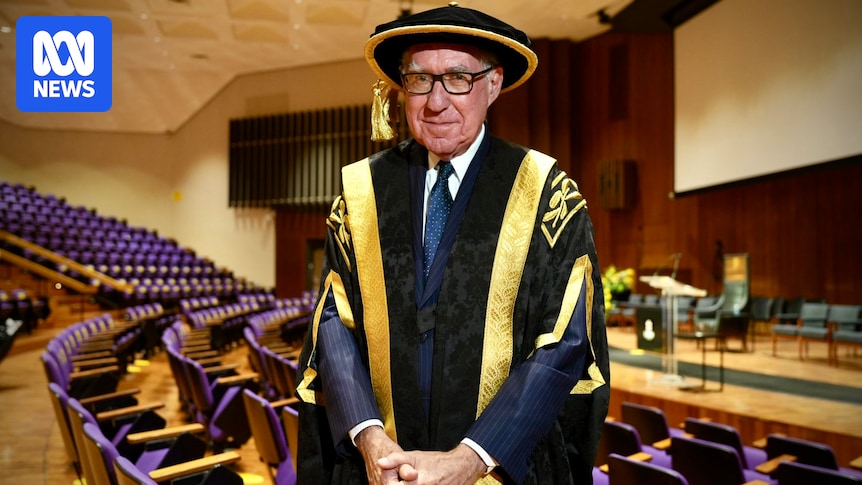
Businessman and education advocate David Gonski is stepping down as chancellor of the University of New South Wales (UNSW) after more than two decades, expressing optimism about the role of artificial intelligence (AI) in education. Gonski, who will officially leave his position on Thursday, has been a prominent figure in the sector, best known for his influential review into school funding.
Despite the challenges posed by AI and financial pressures on universities, Gonski remains hopeful about the future of education in Australia. In an interview with the ABC, he stated that AI will “improve” rather than “destroy” the education system, a perspective that highlights his forward-thinking approach.
From Supermarket Shelves to University Leadership
Gonski’s journey to becoming a household name in education and business began in the aisles of a suburban Sydney supermarket, where he stacked shelves as a student. Reflecting on those early days, he noted, “We were asked, do we want to stack shelves in women’s toiletries or tinned foods? All the men said tinned foods. But I realised very quickly that women’s toiletries were lighter, and you’ve got to carry the boxes down to the shelves. And I think that was the first time I really started to use my brain for a business purpose.”
His career trajectory took him through the legal and business worlds, eventually leading to his appointment as UNSW’s chancellor in 2005. At the time, the university faced financial difficulties, and Gonski’s corporate experience was seen as a valuable asset in turning its fortunes around. Under his leadership, UNSW has risen to become one of the top twenty universities globally.
“I think that it’s a great pride, from my point of view, to see us go into what is effectively the top twenty [university] in the world,” Gonski said. “It’s important for universities, particularly strong research universities like ours, to have that standing.”
AI: A Tool for Enhancement, Not Replacement
As Gonski prepares to exit his role, he remains upbeat about the integration of AI in education, despite concerns about its impact. He criticized the Job Ready Graduates scheme introduced by the Morrison government, which controversially adjusted the costs of various degrees. Gonski advocates for more young people to pursue humanities degrees, emphasizing the role AI can play in both education and business sectors.
“Many people ask me often, with AI coming, shouldn’t we just go to the beach? Which I disagree with that, absolutely,” Gonski remarked. “I think we’re going to be able to do our jobs much better. Some people will have different jobs to do, but I think that’s quite exciting.”
While many educational institutions are already embracing AI, Gonski insists that technology will not replace teachers. He believes that good teachers will leverage AI to enhance their teaching methods, making learning more effective for students.
“Personally, the good teachers will already know that AI will improve their lives, not ruin their lives. They will use the techniques and the machinery that comes with AI to make their students really see things that they can’t do without AI,” he said.
Valuing Vocational Education
In addition to his views on AI, Gonski encourages school-leavers to consider vocational training as a viable alternative to university education. In 2021, he co-led a major review in New South Wales, which highlighted the “negative perception” of vocational training pathways in high schools. As Australia faces a chronic skills shortage, Gonski urges young people to consider trades seriously.
“If, for example, you are a talented person who can be a great plumber, do it and be proud of it,” he advised. “And believe me, there have been many times in my life where the coming of a plumber is much more glorified than, for example, a urologist.”
The departure of David Gonski from UNSW marks the end of an era, but his influence on education and business in Australia is set to endure. His forward-looking perspective on AI and advocacy for diverse educational pathways continue to resonate as the nation navigates the challenges and opportunities of the future.