



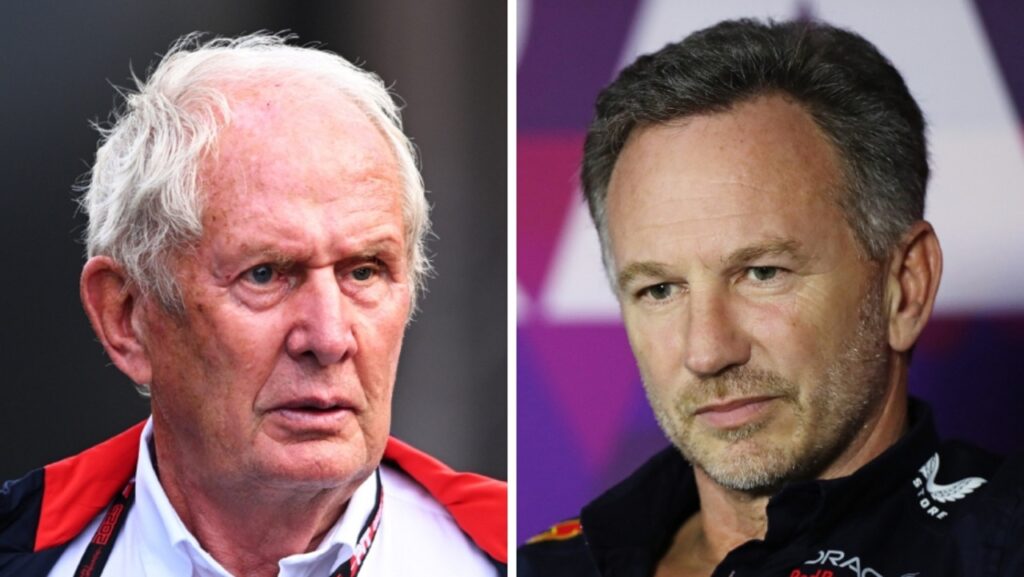
In a candid interview with Dutch publication De Limburger, former Red Bull adviser Helmut Marko has launched a scathing critique of ex-team principal Christian Horner, accusing him of engaging in “dirty games” to consolidate power within the team. Marko’s comments come on the heels of his recent departure from the racing giant, a move that has sent ripples through the Formula 1 community.
Marko’s exit was announced last week, following the dismissal of Horner as team principal just a few months prior. The 82-year-old Austrian has been a pivotal figure in Red Bull’s meteoric rise in Formula 1 since the team’s inception in 2005, contributing to six constructors’ championships and eight drivers’ titles. His role in nurturing young talent, including Sebastian Vettel and Max Verstappen, has been instrumental in Red Bull’s success.
Power Struggles and Accusations
Marko’s relationship with Horner dates back to their days in Formula 3000, and it was Marko who recommended Horner to Red Bull’s founder, Dietrich Mateschitz, as the youngest team principal in F1 history. However, following Mateschitz’s death in 2022, Marko alleges that Horner sought to seize control of the team, aligning himself with Red Bull’s Thai co-owner Chalerm Yoovidhya.
“Together with Didi (Mateschitz), I founded Red Bull Racing in 2005. We appointed Horner as team principal, and I was there as a supervisor,” Marko stated. “In principle, the power was always in Austria – we made the decisions.”
“Christian came up to me and said ‘he won’t make it to the end of the year’. From that moment on, Christian began cozying up to Chalerm Yoovidhya.”
Marko claims that Horner’s actions created an unpleasant working environment, alleging that Horner played “dirty games” to undermine him. He pointed to fabricated rumors and alleged attempts to discredit him within the team.
The Fallout and Official Statements
According to Marko, Horner’s dismissal in July was a result of accumulating evidence against him. “More and more often, we were able to prove that Horner lied about all sorts of things,” Marko said. “Once Chalerm realised that too, he changed his mind.”
Red Bull’s official statement regarding Marko’s departure suggested that he chose to leave the team. However, Marko dismissed the release as “full of nonsense,” hinting at deeper issues within the organization.
“Let’s just say that a lot has changed at the team in a short period of time. You think you know people well, but in the end that turns out not to be the case… I really won’t say more.”
Implications for Red Bull and Formula 1
The departure of two key figures from Red Bull raises questions about the team’s future direction. With Marko’s exit, the team loses a strategic mind behind its successful driver program. Meanwhile, Horner’s absence leaves a leadership vacuum that Red Bull must address to maintain its competitive edge.
Experts suggest that Red Bull’s internal dynamics could impact its performance in upcoming seasons. The team will need to navigate these changes carefully to sustain its dominance in Formula 1.
As the Formula 1 community watches closely, the developments at Red Bull could serve as a cautionary tale about the complexities of team management and the fragile nature of leadership alliances in high-stakes environments.
With the next racing season on the horizon, all eyes will be on Red Bull to see how it adapts to these significant changes and whether it can continue its legacy of success on the track.
