




In a groundbreaking international collaboration, researchers from the Snow Centre for Immune Health and Northeastern University in Boston are embarking on a mission to uncover how complex immune diseases are inherited across generations. This ambitious project aims to decode the genetic factors that control immune cell fate timers, potentially transforming our understanding of immune disorders.
The collaboration brings together the expertise of Professor Phil Hodgkin from the Snow Centre and Professor Ken Duffy from Northeastern University. Their goal is to scale an innovative mathematical model, known as ‘Cyton2’, to a population level for the first time. By integrating immune and genetic data, the team hopes to explain why some individuals inherit immune disorders despite having healthy parents and how genetic variations influence immune health.
Uniting Science and Mathematics
This new collaboration marks the first international partnership for the Snow Centre, building on over a decade of joint research by Professors Duffy and Hodgkin. Their combined efforts have previously reshaped the study of immune behavior by exploring how B and T cells are modified during division and multiplication.
Professor Duffy, who holds positions in Mathematics and Electrical and Computer Engineering at Northeastern University, brings a wealth of mathematical expertise to the project. His role is crucial in scaling up the ‘Cyton2’ model, which tracks immune cells with remarkable precision, revealing critical decisions made during their life cycle.
“This collaboration represents an exciting step toward transforming how we understand, diagnose, and ultimately prevent immune disease,” said Professor Hodgkin, Scientific Program Lead at the Snow Centre.
He emphasized the rarity of working with someone possessing such profound mathematical expertise to solve biological problems, acknowledging Professor Duffy’s contributions as integral to the team’s success.
Decoding Immune Cell Behavior
The ‘Cyton2’ model offers new insights into the immune system’s inner workings by measuring the strength of human cell responses under controlled conditions. Preliminary findings suggest that weaknesses in cell response strength may indicate immune deficiencies, while overly strong responses could signal a risk of autoimmune diseases.
These insights point to the possibility that immune disorders may be inherited, resulting from a combination of many small genetic effects that are harmless individually. The project aims to integrate immune data with genetic sequencing to better understand how genetic variation influences immune cell behavior, ultimately explaining the occurrence of immune disorders.
A Bold Vision for Immune Health
Professor Duffy expressed his enthusiasm for the collaboration, stating, “I’ve never passed up an opportunity to work with Prof Hodgkin. The Snow Centre has a bold vision, and I want to be part of it.” He aims to bring complementary mathematical expertise to support the team in achieving their goals.
The Snow Centre for Immune Health, co-led by WEHI and the Royal Melbourne Hospital in partnership with the Snow Medical Research Foundation, is committed to improving the lives of people with immune diseases. The centre’s unique approach to immune health involves uniting leading Australian and international researchers with a shared mission to transform immune system research and treatment.
The centre is supported by an initial commitment of up to $100 million over 10 years, making it one of the largest and longest-running philanthropic partnerships in Australian history.
For more information, visit snowimmunehealth.org.au.
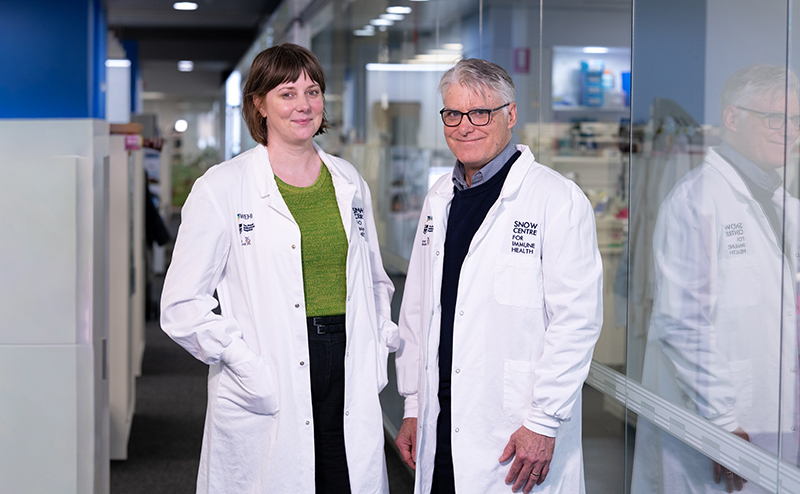
Header image: Professor Phil Hodgkin, Snow Centre for Immune Health, Scientific Program Lead and Dr Vanessa Bryant, Snow Centre for Immune Health, Deputy Scientific Director