



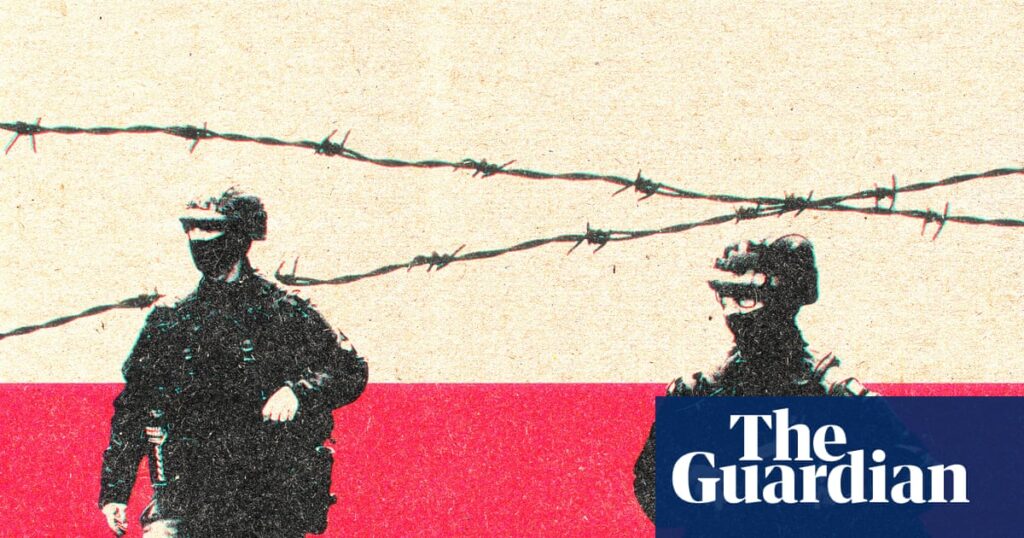
Cezary Pruszko vividly recalls the civil defense training from his school days during the Communist era in Poland, where map reading and survival skills were essential components of education. “My generation grew up with those threats. You didn’t have to explain why this mattered,” said the 60-year-old Pruszko, as he revisited those skills at an army base outside Warsaw on a frosty Saturday morning. Alongside dozens of other Polish civilians, he toured a bomb shelter, fitted gas masks, and practiced striking sparks from a flint to start a fire.
This training is part of a new initiative aimed at enhancing civilian resilience, with a goal to train 400,000 Polish citizens by 2027. The voluntary program is open to all, from schoolchildren to pensioners. “We are living in the most dangerous times since the end of the Second World War,” stated Poland’s defense minister, Władysław Kosiniak-Kamysz, at the program’s launch earlier this month. “Each of us must have the skills, knowledge, and practical knowhow to cope in a crisis.”
Historical Vulnerability and Recent Threats
Poland’s geographical position at the heart of Europe has historically left it vulnerable to invasions. The full-scale invasion of neighboring Ukraine in 2022 heightened these concerns, and recent incidents, including drone incursions into Polish airspace and sabotage attacks linked to Russian intelligence, have exacerbated fears. Most notably, a railway line was destroyed earlier this month, with authorities attributing the attack to Russia, allegedly intending to cause casualties.
In response, Poland is overhauling its national security strategy. The government has approved a draft budget for next year, increasing defense spending to 4.8% of GDP, a figure that surpasses most other NATO countries. New buildings must now include bomb shelters, and efforts are underway to refurbish older shelters. Additionally, construction has begun on an “eastern shield” along the country’s borders with Belarus and the Russian exclave of Kaliningrad.
Adjusting Military Strategies
At a forward operating base near Poland’s border with Belarus, Brigadier General Roman Brudło, commander of Poland’s 9th Armoured Cavalry Brigade, noted that Russia’s invasion of Ukraine has transformed Poland’s security landscape. “The quiet times have unfortunately passed, and we are living in a difficult time, in very dynamic times,” he remarked. Intelligence reports suggest the possibility of a full-scale invasion from Russia within the next few years, although Brudło hopes this scenario will not materialize.
Having joined the army in 1996, Brudło’s career has included service in Iraq and Afghanistan. He acknowledged that traditional warfare training must adapt to counter modern threats like drones and sabotage. “I’m not tied to the tank, I am not glued to it, and everybody here also went through training preparing us for new kinds of tasks,” he explained. He anticipates that Russia will exert pressure through hybrid tactics, aiming to exhaust Poland without provoking a full-scale conflict.
Captain Karol Frankowski, responsible for communications within the brigade, described his participation in NATO’s annual Saber Junction exercises in Germany. The scenario involved a hybrid attack resulting in martial law. “My job was to make contact with the locals during the crisis,” he said, emphasizing the importance of maintaining order and communication in such situations.
Migration and Security Concerns
One of Russia’s hybrid tactics, according to Brudło and Frankowski, involves encouraging “illegal migration” across Europe’s borders. The brigade assists border guards in detecting individuals attempting to cross from Belarus into Poland, and thus into the Schengen zone. Sensors along the border wall alert soldiers to crossing attempts. Recently, they apprehended an Afghan man, who was likely to be returned to Belarus.
“For the protection of our country, this is a necessity. We don’t know who this Afghan guy is. Maybe a spy or maybe some kind of person who wants to destroy our country from the inside,” said Frankowski. The narrative of weaponized migration has been used by Poland’s previous nationalist government to justify a harsh crackdown on migrants since the crisis began in 2020. Despite a change in government to Donald Tusk’s progressive coalition two years ago, policies have remained largely unchanged.
Aleksandra Chrzanowska, part of the Grupa Granica alliance of activists, criticized the focus on migrants as a threat, calling it a “far-right, racist narrative” not based on facts. “The drama and the tragedy of those who are coming here to seek protection is not interesting to people any more,” she lamented, noting that the debate on migration in Poland has shifted significantly to the right.
Preparing for the Future
Besides the border wall, the new “eastern shield” will include trenches and fortifications along the Belarus and Kaliningrad borders, designed to deter potential invasions. However, any future conflict is unlikely to resemble traditional warfare with tanks crossing borders. The shield will also feature GPS towers and other technology to counter drone threats.
In Gołdap, a town near the Kaliningrad border, residents are aware of the Russian threat but remain calm. “The threat does influence the way you think, but to be honest I’d be more worried if I were living in Warsaw,” said Piotr Bartoszuk, head of Gołdap’s vocational college. He recalled a time when locals regularly crossed the border for shopping and sightseeing, a practice now halted by closed borders.
“Russia is definitely a threat, but not a huge one, because we’re in NATO, we’re protected,” said Kornelia Brzezińska, a 15-year-old aspiring soldier studying in the military track at the college. If Poland were attacked, she expressed her readiness to fight. “I’d go to the front. I really do love Poland. It’s not something I say lightly. I wouldn’t abandon our nation – I’d defend it,” she declared.
As the training day at the military base concluded, Pruszko shared his plans to extend the survival course to his company’s employees. “Many younger employees have grown up in the EU, in a time of peace, with little sense of the dangers us older generations remember. I hope we never need these skills, but I want them to know what to do if the moment ever comes,” he said.