




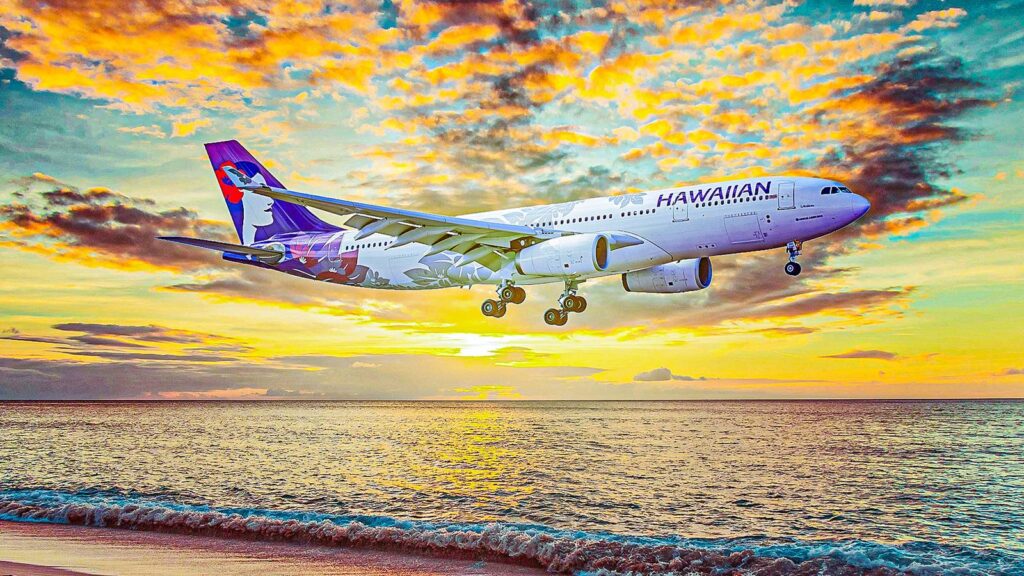
2025 has marked a pivotal year for Hawaiian Airlines as it undergoes significant changes following its merger with Alaska Airlines. This strategic integration is reshaping the carrier’s operations and fleet, offering a glimpse into its evolving future. With the merger in full swing, Hawaiian Airlines’ fleet is adapting to new demands and opportunities.
According to fleet data from ch-aviation, Hawaiian Airlines currently operates 75 passenger and cargo aircraft, with an additional six jets on order. This article delves into the current composition of Hawaiian’s fleet, the onboard experience, and the anticipated future developments.
Hawaiian Airlines’ Short-Lived Boeing 787 Fleet
The average age of Hawaiian Airlines’ fleet stands at 11.5 years, yet its Boeing 787-9 Dreamliner sub-fleet is notably younger. With four Dreamliners in service, averaging just 1.9 years old, and one more on order, these aircraft represent the cutting edge of Hawaiian’s fleet. The Dreamliners boast a total of 300 seats, divided into two classes.
The business class features 34 flatbed seats arranged in a 1-2-1 configuration, ensuring direct aisle access for all passengers. Meanwhile, the economy section comprises 266 seats in a 3-3-3 layout. As part of the merger, these Dreamliners will transition to Alaska Airlines, establishing a long-haul hub in Seattle. Alaska Airlines CEO Ben Minicucci remarked:
“With these bold moves, we are accelerating our vision to connect our guests to the world. We are seizing this moment to redefine the international experience and level up.”
Airbus Twinjets: A Key Component
Another significant aspect of the fleet is the Airbus A330, with Hawaiian operating 24 A330-200 models. These aircraft average 12.5 years old, with 23 currently active and one undergoing maintenance in Singapore. The A330-200s accommodate 278 passengers in a high-density configuration.
While the business class offers 18 flatbed seats, the 2-2-2 layout lacks direct aisle access for window seats. The economy section includes 260 seats, with plans to introduce a premium economy class in the future. Additionally, Hawaiian operates 10 A330-300P2F cargo jets for Amazon, highlighting its diversified operations.
Narrowbody Fleet: The Airbus A321neo
Hawaiian Airlines has revitalized its narrowbody fleet with 18 Airbus A321neo aircraft, averaging seven years old. These jets are configured with 189 seats, including 16 first-class recliners and 173 economy seats. At present, only one A321neo is inactive, stored in Oakland.
Island Hopping: The Boeing 717 Experience
The Boeing 717-200 plays a crucial role in Hawaiian Airlines’ operations, particularly for inter-island travel. With 19 aircraft in this category, they are the workhorses of the fleet, executing numerous short-haul flights daily. Currently, only one is inactive, undergoing maintenance in Honolulu.
The 717s feature 128 seats, split between eight in first class and 120 in economy, catering to the high-frequency demands of island hopping.
Looking Ahead: The Future of Hawaiian Airlines
The merger with Alaska Airlines presents Hawaiian Airlines with both challenges and opportunities. The integration of fleets and operations aims to enhance connectivity and expand international reach. As the airline adapts to these changes, it remains committed to maintaining its unique identity and service quality.
Industry experts suggest that this merger could set a precedent for future airline consolidations, especially in a post-pandemic world where efficiency and network expansion are paramount. The aviation landscape continues to evolve, and Hawaiian Airlines’ transformation is a testament to the dynamic nature of the industry.
As Hawaiian Airlines navigates this new chapter, its fleet transformation will be closely watched by industry analysts and passengers alike. The coming years promise to be transformative, with the potential to redefine air travel in the Pacific region and beyond.