



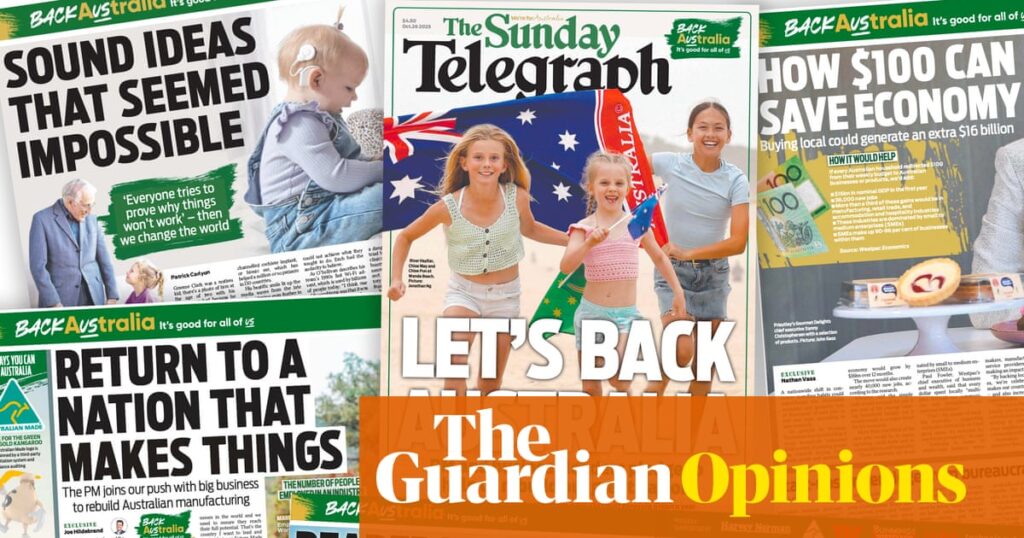
Joe Hildebrand has become the face of News Corp’s latest campaign, urging a return to the 1960s era when Australia was “self-reliant” and “made things here.” The campaign, titled Back Australia, was launched on Sunday across all of Rupert Murdoch’s media outlets, including major newspapers and digital platforms. Hildebrand’s call for national pride aims to bridge political divides, encouraging both the left and right to embrace a shared vision of economic independence.
This campaign follows Hildebrand’s previous involvement in News Corp’s Mission Zero series, which marked a significant shift in the company’s stance on climate change, advocating for reduced greenhouse gas emissions. Now, with Back Australia, News Corp is pushing for a revival of local manufacturing, a move that has left many observers puzzled given the company’s historical support for free-market policies.
The Campaign’s Economic Implications
The Back Australia campaign has raised eyebrows, particularly among those familiar with News Corp’s traditional editorial line. The strategy includes prominent figures like billionaire Dick Smith and has been met with skepticism due to its apparent contradiction with previous stances. Just last year, The Australian criticized Prime Minister Anthony Albanese’s Future Made in Australia initiative, warning it could harm existing industries by favoring less viable technologies.
Judith Sloan, an economist and columnist, has been a vocal critic of protectionist policies, recently condemning Andrew Hastie’s proposal to revive domestic car manufacturing as “bonkers.” She expressed concern over a growing trend among conservative politicians to abandon free-market principles.
Advertising and Economic Policy
The campaign’s dual role as both an editorial and sales initiative has sparked debate about the influence of advertising dollars on economic policy. News Corp’s managing director of sales, Louise Barrett, has openly acknowledged the campaign’s commercial aspect, noting that advertisers like Harvey Norman and Westpac are keen to align with the campaign’s values.
“What they’re paying for is to be associated with a campaign that aligns with their values and their approach to business,” said Ben English, editor of the Daily Telegraph.
Global marketer Toby Ralph suggests that the campaign taps into a broader trend of protectionism and local manufacturing revival in Western nations. He argues that advertisers find it more cost-effective to align with existing campaigns rather than creating new purposes.
ABC’s Editorial Standards and Complaints
In a separate media controversy, the ABC has faced a wave of complaints regarding its coverage of recent events in Gaza. Despite receiving over 100 complaints, the ABC ombudsman found no breach of editorial standards, emphasizing the importance of diverse perspectives in news coverage.
“We do not consider that the article minimizes or is misleading about Hamas’s actions,” the ombudsman concluded.
This decision comes in the wake of a federal court ruling against an orchestrated campaign by pro-Israel lobbyists, which had previously led to the unlawful termination of broadcaster Antoinette Lattouf’s contract.
Ita Buttrose’s Memoir and Media Reflections
Former ABC chair Ita Buttrose has released her memoir, Unapologetically Ita, which notably omits discussion of the Lattouf dismissal case. In media interviews, Buttrose has defended her handling of complaints during her tenure, emphasizing her commitment to procedural fairness.
Buttrose’s candid remarks about personal topics, such as her sex life, have also drawn attention, showcasing her characteristic openness and resilience.
Kerry Stokes and the Telethon Legacy
Meanwhile, media mogul Kerry Stokes has made headlines with his extensive interview about the annual Telethon event, which raised a record $21.4 million this year. Stokes used the opportunity to address his financial support for former SAS soldier Ben Roberts-Smith, defending his decision to assist in the defamation case.
“He served the country and won a VC. Doesn’t he deserve to have a defense?” Stokes stated, reaffirming his commitment to supporting Roberts-Smith.
Stokes also insisted on the independence of his media outlets, distancing himself from any editorial interference.
The Back Australia campaign and related media developments highlight the complex interplay between editorial content, economic policy, and advertising interests in Australia’s media landscape. As the nation grapples with its economic future, these discussions are likely to continue shaping public discourse.