



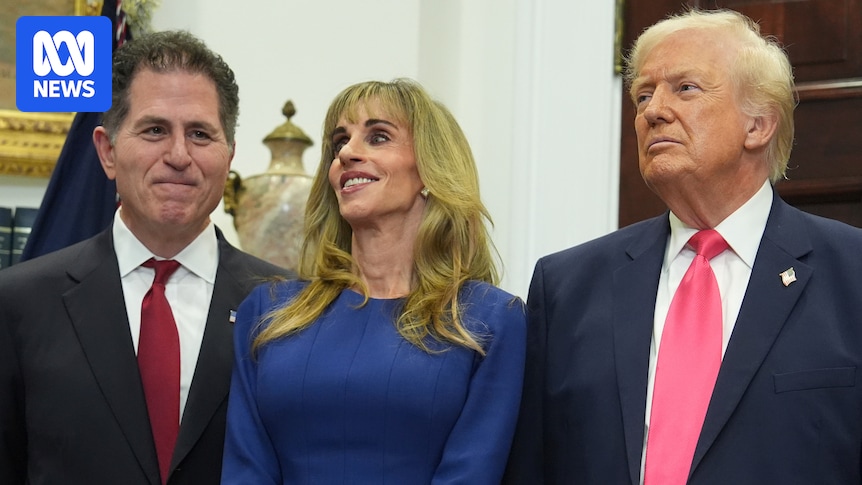
Tech billionaires Michael and Susan Dell have announced a monumental pledge of $9.5 billion to fund “Trump accounts” for children, marking one of the largest charitable commitments in recent history. The donation, equivalent to $6.25 billion USD, will be distributed as individual investments of $250 USD to 25 million children across the United States.
This unprecedented act of philanthropy arrives as part of a broader initiative under US President Donald Trump’s One Big Beautiful Bill Act, aimed at fostering financial literacy and wealth-building opportunities for young Americans.
Understanding the “Trump Accounts”
The “Trump accounts” are a novel financial instrument introduced under the One Big Beautiful Bill Act, which allows parents to establish tax-deferred investment accounts for their children under 18. Contributions to these accounts must be invested in an index fund that mirrors the overall stock market. Once account holders reach 18, they can withdraw funds for significant life expenses such as education, home purchases, or starting a business.
The US Department of Treasury is set to contribute $1,000 USD to accounts for children born between January 1, 2025, and December 31, 2028. With an assumed 7% annual return, this initial government seed could grow to approximately $3,750 USD by the time it becomes accessible.
The Trump Accounts became law in July, but the program will officially launch on July 4, 2026.
The Dells’ Vision for Their Donation
Michael and Susan Dell’s contribution is designed to complement the Trump accounts by targeting a different demographic. Their funds will be allocated to children aged 10 and under, living in areas where the median family income is $150,000 USD or less, and who fall outside the government’s eligibility window for the initial seed money.
In a statement, Susan Dell expressed their enthusiasm for this philanthropic venture, stating, “We’re thrilled to be spearheading this in the philanthropy sector and are so excited because we know that more people are going to jump on board because really, we can’t think of a better idea and better way to help America’s children.”
Reception and Criticism of the Trump Accounts
The introduction of Trump accounts has sparked a mixed response. Proponents argue that the initiative will democratize access to the stock market, offering even children from disadvantaged backgrounds a chance to build wealth. They view the government contribution as a counter to the growing appeal of socialism, promoting financial independence and opportunity.
However, critics warn that the accounts could exacerbate existing economic disparities. Wealthier families, able to maximize pre-tax contributions, are likely to benefit disproportionately, while those unable to afford additional deposits may see minimal gains.
Amy Matsui, Vice-President of Income Security and Childcare at the National Women’s Law Center, criticized the policy, stating, “In the end, this policy mirrors the rest of the law: another giveaway to the richest Americans that leaves everyone else further behind.”
Critics also highlight that the accounts do little to address immediate needs for children in poverty, nor do they compensate for cuts to essential programs like food assistance and Medicaid.
The Dells’ Philanthropic Legacy
Michael Dell, founder and CEO of Dell Technologies, ranks as the 11th richest person globally, with a net worth of $148 billion USD according to the Bloomberg Billionaires Index. Together with Susan, they have a long history of charitable giving, focusing primarily on children’s causes. As of 2024, the Dells had donated a lifetime total of $2.85 billion USD.
Comparisons with Other Tech Philanthropists
The Dells’ donation is significant, yet it stands alongside other major philanthropic efforts by tech billionaires. Bill Gates and Melinda French Gates have donated an estimated $47.7 billion USD, with $5.2 billion given away in 2024 alone. MacKenzie Scott has distributed $19.25 billion USD to various non-profits, emphasizing education and economic equity.
Meanwhile, Mark Zuckerberg and Priscilla Chan have redirected their focus from education and social justice to science and artificial intelligence, contributing a total of $5.1 billion USD over the years.
The Dells’ latest pledge not only reinforces their commitment to philanthropy but also ignites a broader conversation about the role of wealth in addressing social inequalities. As the Trump accounts roll out, their impact on American families and the broader socio-economic landscape will be closely watched.