

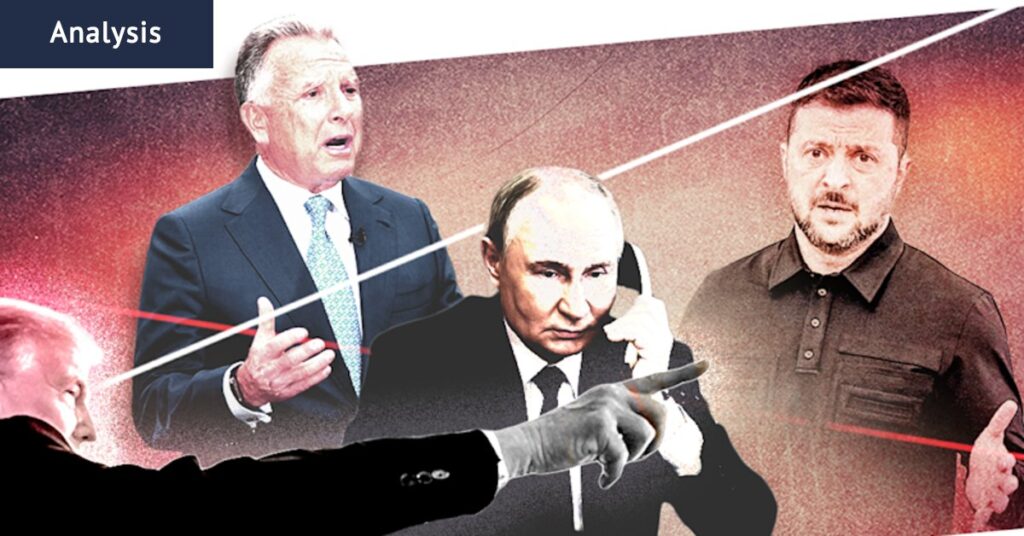
In a bid to broker peace in Europe, Donald Trump’s special envoy, Steve Witkoff, recently engaged in a candid dialogue with his Russian counterpart, Yuri Ushakov. The conversation, which took place last month, centered around potential solutions to cease the ongoing conflict between Russia and Ukraine. Witkoff, a property developer with an estimated fortune of $1.2 billion, approached the negotiations with the same straightforwardness he might employ in a Manhattan real estate deal.
Witkoff suggested that a peace deal might require concessions such as the relinquishment of Donetsk and possibly a land swap. However, he was quick to acknowledge that such terms could not be publicly endorsed by President Trump. “But I’m saying instead of talking like that, let’s talk more hopefully because I think we’re going to get to a deal here,” Witkoff reportedly told Ushakov, according to a leaked transcript published by Bloomberg.
The Leaked Conversation and Its Fallout
The leak of this confidential conversation has sparked significant controversy, particularly among U.S. Republicans who are calling for Witkoff’s dismissal due to his apparent admiration for Russian President Vladimir Putin. “You know I have the deepest respect for President Putin,” Witkoff was quoted as saying. This remark drew sharp criticism from Republican Congressman Don Bacon, who stated, “It is clear that Witkoff fully favours the Russians. He cannot be trusted to lead these negotiations.”
Speculation abounds regarding the source of the leak, with some suggesting it was an American insider aiming to undermine Witkoff. However, others believe a European intelligence service may have been eavesdropping on the Russians, using the leak to portray Witkoff as a Russian sympathizer.
Trump’s Defense and the Amended Peace Plan
Despite the backlash, President Trump has defended his envoy, asserting that Witkoff’s approach is typical of a dealmaker striving for a resolution. However, the original peace plan, which included significant concessions to Russia, is now being reconsidered. The revised plan, which Trump appears to support, includes a cap on the Ukrainian military at 800,000 troops, gradual easing of sanctions, and the possibility of Western troops entering Ukraine to maintain peace.
Crucially, the amended plan rejects the controversial “land swap” proposal and does not formally cede Ukrainian territories such as Crimea, Luhansk, and Donetsk. It also dismisses the recognition of Russian control in Kherson and Zaporizhzhia, leaving territorial claims for future discussions.
Expert Opinions and European Concerns
Olena Davlikanova, an associate senior fellow at the Sahaidachny Security Centre in Ukraine, emphasizes the importance of robust Western commitments for the peace deal to succeed. “What would really work is very clear back-up by the US so in the case of renewed aggression, the US will supply Ukraine with all necessary weapons and intelligence,” she asserts.
Keir Giles, a senior consulting fellow at Chatham House, warns of the dangers inherent in any agreement that appears to reward Putin for his aggression. “The decisions to be made in Europe and America today are shaped by a question that goes back decades: What causes Russia to stop?” Giles argues that only a substantial military presence and the resolve to use it can deter Russian advances.
The Fragility of Peace and the Road Ahead
The peace plan remains precarious, with Putin insisting on further territorial gains. “If Ukrainian forces leave the territories they hold, then we will stop combat operations,” Putin stated during a recent visit to Kyrgyzstan. This stance underscores the fragility of the current negotiations and the potential for continued conflict.
Witkoff is set to travel to Moscow for further discussions with Putin, possibly accompanied by Jared Kushner. Meanwhile, U.S. Army Secretary Dan Driscoll is engaging with Ukrainian counterparts. The lack of trust among the involved parties complicates the path to peace, with European leaders wary of Witkoff’s negotiations and the reliability of any Russian commitments.
Historical Context and Strategic Implications
The ongoing conflict and diplomatic efforts echo historical tensions between Russia and the West. Mark Brolin, a strategist with experience in both the Swedish Ministry of Foreign Affairs and American financial markets, points out the cognitive bias that has led some to overestimate Russia’s power. “Future historians will wonder how a regime of unelected thugs managed to intimidate NATO,” he writes.
Despite Russia’s economic vulnerabilities, its military capabilities remain formidable, bolstered by support from China and Iran. This dynamic poses significant challenges for Europe and the U.S. as they navigate the complex geopolitical landscape.
Conclusion: The Path to Resolution
The prospect of a peace deal remains uncertain, with significant hurdles to overcome. The involvement of Western powers, the strategic interests of Russia, and the resilience of Ukraine all play crucial roles in shaping the outcome. As the world watches, the stakes are high, and the path to resolution is fraught with complexity.
Ultimately, the success of any peace agreement will depend on the ability of all parties to navigate these challenges and commit to a sustainable and equitable solution.