



The future of Australia’s largest coal-fired power plant, Eraring, hangs in the balance as New South Wales (NSW) Premier Chris Minns signals openness to a potential deal to delay its closure. This move aims to avert potential blackouts, which experts warn could occur if the plant shuts down before the electricity grid is adequately prepared.
Energy experts have raised alarms, stating that the grid may not be ready for Eraring’s scheduled closure in mid-2027. The Australian Energy Market Operator (AEMO) has also highlighted a heightened risk of blackouts following the plant’s shutdown, underscoring the urgency of the situation.
Concerns Over Grid Stability
Officials are increasingly concerned that while the construction of renewable energy sources and power lines is underway, the infrastructure may not suffice to maintain a stable electricity flow, potentially leading to sudden blackouts. This has prompted the NSW government to consider negotiating with Origin Energy, the owner of Eraring, to delay the plant’s closure.
Premier Minns stated, “We are not necessarily opposed to a conversation with them about it,” indicating a willingness to explore options to keep the plant operational beyond its planned shutdown.
Previous Agreements and Current Options
In 2024, the state government offered to cover potential losses of up to $225 million annually to ensure Eraring remained operational past its original 2025 closure date. Although Origin Energy agreed to the deal, it was not activated due to favorable market conditions. However, there remains an option for the agreement to take effect from 2027 to 2029, though the terms are yet to be defined.
Energy expert Matt Rennie of Rennie Advisory emphasized the grid’s current dependency on Eraring, stating, “We need to pay proper regard to the reality that coal will come out of the system at some point, and therefore the preparation for the new energy system is absolutely critical.”
Market Expectations and Economic Implications
According to Ian Myles, an infrastructure analyst at Macquarie Equities, market watchers are already anticipating a deferral of Eraring’s closure. “My expectation is, and we’ve modelled this, that Eraring will be operational until 2029. That is probably a common expectation [across markets],” Myles noted.
Grattan Institute senior fellow Tony Wood suggested that while Eraring might need to remain operational beyond 2027, the financial burden would likely fall on bill-payers. He remarked, “Even if the grid limps along without Eraring, there’ll be costs, and what would annoy me if I lived in NSW is the question: who’s going to pay for all this?”
Infrastructure Challenges
AEMO has warned that the loss of inertia and system strength from Eraring’s closure would increase blackout risks. The NSW grid owner, Transgrid, is racing to install new equipment to stabilize the grid, but this is not expected to be ready until “at least 2028.”
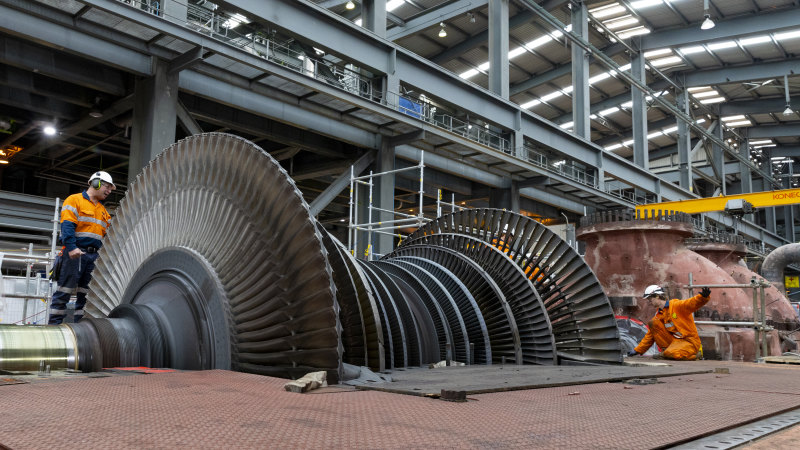
To run smoothly, power grids must not only match supply and demand but also maintain “system security,” including inertia, which comes from the steady frequency traditionally provided by the spinning turbines of gas, coal, and pumped hydro plants.
Most of Australia’s coal plants are slated for retirement by 2035, with rising maintenance costs and competition from renewables accelerating closure plans. If Eraring shuts in 2027, alternative solutions like securing extra gas or hydropower supply may be necessary, with costs ultimately passed to consumers.
Government Initiatives and Renewable Energy Goals
The NSW government is working to expedite the installation of synchronous condensers, machines that stabilize the grid without burning fuel. Minns highlighted new laws passed to fast-track this critical infrastructure, despite concerns that extending Eraring’s operation might slow renewable energy deployment.
Nevertheless, Minns affirmed that NSW leads the nation in renewable energy investment, underscoring the state’s commitment to a sustainable energy future.
As the debate over Eraring’s future continues, the NSW government faces the challenge of balancing immediate energy needs with long-term sustainability goals. The outcome of these discussions will have significant implications for the state’s energy landscape and economic stability.