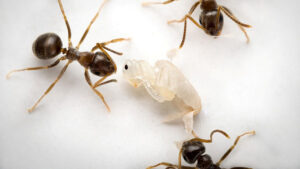


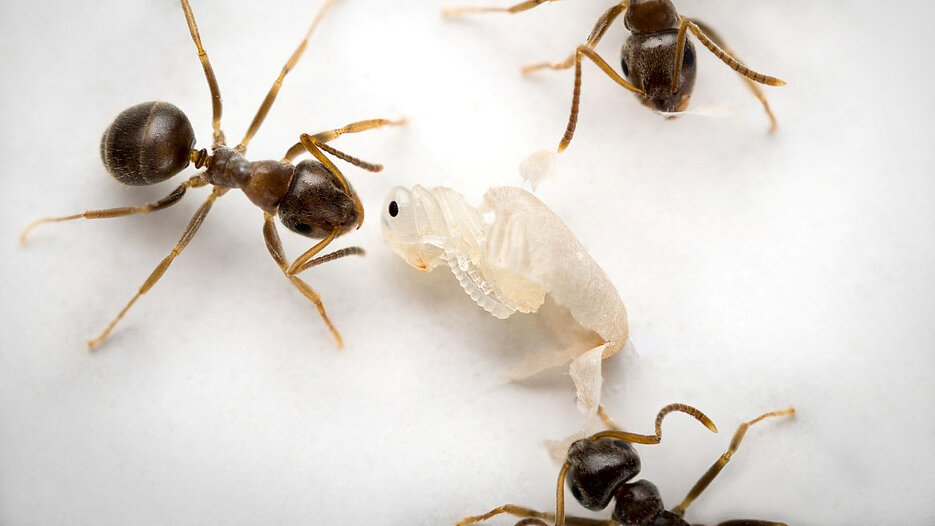
In a striking display of self-sacrifice, fatally ill ant pupae of the species Lasius neglectus send an alarm signal to their colony, alerting them to an incurable infection. This behavior, recently uncovered by researchers, ensures the protection of the colony by prompting workers to eliminate the threat, even at the cost of the infected pupae’s lives.
The discovery, published in the journal Nature Communications, reveals a unique survival strategy where the colony’s workers respond by extracting the diseased pupae from their cocoons. They then bite small openings in the pupae’s skin and apply formic acid, an antimicrobial poison, effectively disinfecting the area but also killing the pupae in the process.
Research Findings and Implications
This research was conducted by the Institute of Science and Technology Austria (ISTA) in collaboration with Professor Thomas Schmitt, a chemical ecologist from the University of Würzburg’s Biocentre. Erika Dawson, the study’s first author, explains that this seemingly self-destructive behavior indirectly benefits the sick ants by safeguarding their relatives and ensuring the colony’s continued survival.
“What initially appears to be self-sacrifice also indirectly benefits the animal sending the signal, as it protects its relatives,” said Erika Dawson. “By sending a warning signal, an ant suffering from a fatal infection ensures the health of the entire colony and the production of new daughter colonies.”
Ants undergo a four-stage development process. The larvae, which are legless and maggot-like, are fed by workers until they pupate in a cocoon. During this largely immobile stage, they metamorphose into adult ants. The inability of pupae to move on their own necessitates this unique signaling system.
The “Find-me And Eat-me” Signal
While adult ants can leave the nest to die, infected pupae rely on the colony’s intervention. This parallels the behavior of infected cells in a body, which also signal for removal to prevent further infection. Sylvia Cremer, a researcher at ISTA, notes that this system requires a precise signal to ensure only incurably diseased pupae are targeted.
“It is important that such a signal is both sensitive and specific,” Cremer stated. “This means that all incurably diseased ant pupae should be tracked down, but no healthy pupae or those that can overcome the infection with their own immune system should be unpacked.”
Olfactory Communication in Ants
Professor Thomas Schmitt’s research highlights that the signal is not airborne but rather a non-volatile odor on the pupae’s surface. The team found that two components of the natural body odor profile of terminally ill pupae are intensified, serving as the trigger for the workers’ hygienic behavior.
To test this, researchers transferred the odor from diseased to healthy pupae, observing that the workers responded with the same destructive treatment, confirming the odor’s role in the alarm system.
Selective Signaling and Colony Health
Interestingly, not all infections result in signaling. Erika Dawson notes that queen pupae, with their stronger immune systems, can often contain infections without alerting the colony. In contrast, worker pupae, overwhelmed by infection, signal their incurable disease to protect the colony.
“This fine-tuning between the individual and colony levels makes the altruistic disease signaling so efficient,” Dawson remarked.
The study, titled “Altruistic Disease Signalling in Ant Colonies,” was published on December 2, 2025, in Nature Communications. It was funded by the European Research Council under the Horizon 2020 research and innovation program.
This research not only sheds light on the complex social structures of ants but also offers insights into potential applications in understanding immune responses and disease management in other species.