

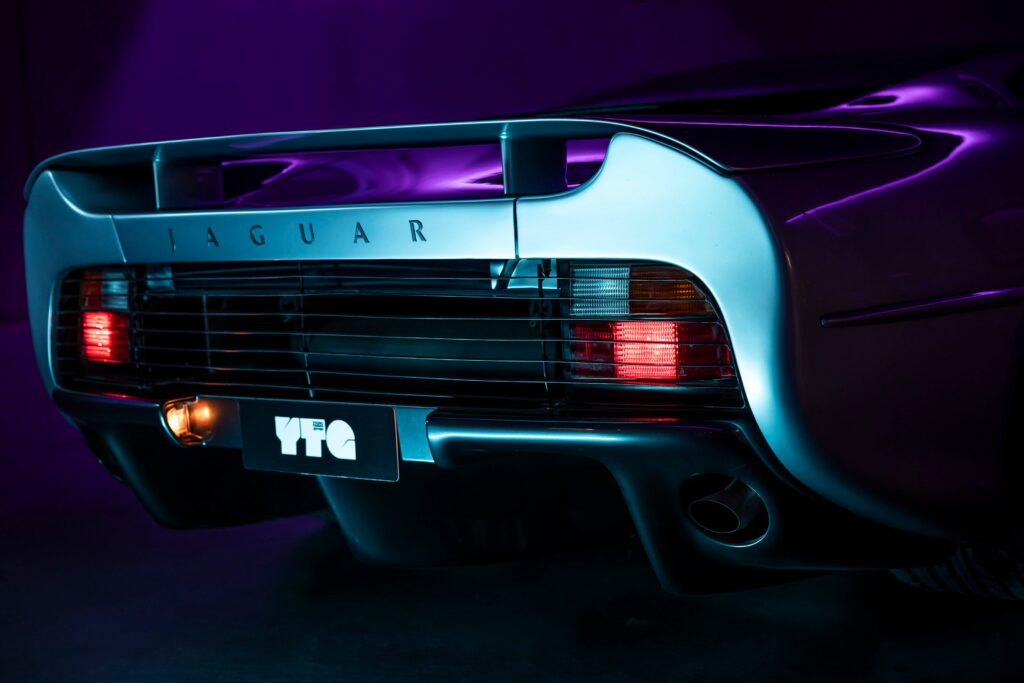
The global reveal of the Jaguar XJ220 at the British Motor Show on October 18, 1988, was fraught with challenges. The prototype’s V12 engine seized just hours before the event, forcing the car to be pushed onto the stand. Despite this setback, the XJ220 captured the audience’s attention, overshadowing even Ferrari’s new F40. The sleek design and ambitious engineering of the XJ220 drew crowds, but the path from concept to production was anything but smooth.
The XJ220 was initially conceived as a concept car, designed to explore Jaguar’s potential in FIA Group B racing. However, the overwhelming public interest led Jaguar to consider a production run. The show car featured a mid-mounted 48-valve V12 engine, four-wheel steering, and all-wheel drive, with a targeted top speed of 220 mph. Yet, this ambitious setup would never see production.
The Transition from Concept to Production
As Jaguar explored the feasibility of producing the XJ220, it became clear that changes were necessary. The original V12 engine was replaced with a turbocharged V6 to reduce weight and complexity, aligning with the trends set by competitors like the Porsche 959 and Ferrari F40. The decision was not without controversy, as many prospective buyers had been drawn to the promise of a V12 engine.
Mike Moreton, appointed to lead the project, faced the challenge of balancing performance with production viability. The V6 engine, derived from the Austin Rover V64V, was modified to meet the XJ220’s performance targets. The resulting JRV-6 engine, paired with a rear-wheel-drive system, offered a different driving experience than initially envisioned.
Performance and Legacy
Despite the changes, the XJ220 achieved remarkable feats. In 1992, it set a record as the world’s fastest production car, reaching a top speed of 217.1 mph at the Nardo ring in Italy. This record stood until the McLaren F1 surpassed it in 1998. The XJ220 also excelled on the Nürburgring, setting a production car lap record that remained unbeaten for eight years.
However, the economic climate of the early 1990s posed significant challenges. The collapse of the Soviet Union, rising oil prices, and a global recession dampened the supercar market. Many deposit holders faced financial difficulties, leading to legal battles over contract cancellations. Ultimately, Jaguar produced only 281 of the planned 350 units.
Market Reception and Collector Interest
The XJ220’s market reception was mixed. While it was praised for its performance and design, some criticized the departure from the original V12 concept. Over time, the XJ220 has gained appreciation among collectors, with values steadily rising. Recent sales have seen prices climb above $600,000, reflecting its rarity and historical significance.
In comparison, the Ferrari F40, with over 1,300 units produced, commands higher prices despite being more common. The XJ220’s unique blend of qualities and its status as a misunderstood marvel of automotive history contribute to its growing allure among enthusiasts.
The Even Rarer XJ220S
Adding to the XJ220’s mystique is the XJ220S, a road-legal version of the XJ220-C racer. Jaguar built only six of these models, featuring a composite body, fixed headlights, and a stripped-out cabin. With power increased to 507 kW and weight reduced to 1,151 kg, the XJ220S represents a pinnacle of Jaguar’s engineering prowess.
Despite its troubled genesis, the Jaguar XJ220 remains a fascinating chapter in automotive history. Its blend of cutting-edge technology, striking design, and complex legacy continues to captivate enthusiasts and collectors alike. As time passes, the XJ220’s place in the pantheon of great supercars becomes ever more secure.