

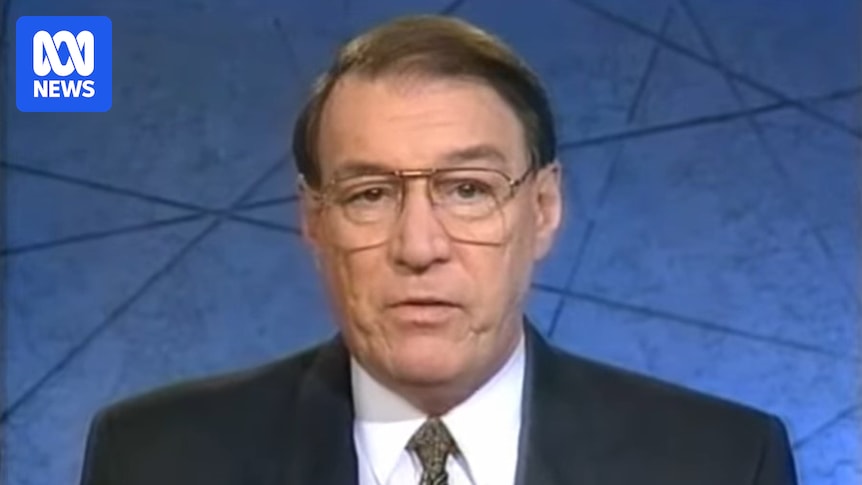
Veteran broadcaster Arthur Higgins, whose illustrious career spanned six decades and included coverage of landmark events such as the Moon landing and the September 11 attacks, has passed away at the age of 85. The English-born presenter, affectionately known as “Big Daddy” for his distinctive baritone voice, was celebrated for his vast sporting knowledge and his enduring passion for broadcasting.
Higgins’s death was confirmed by his daughter Gemma on social media, who expressed that her father was “very loved and missed.” His passing marks the end of an era for many who grew up listening to his authoritative yet warm broadcasts.
From Wartime England to Australian Airwaves
Born in England during World War II, Higgins’s early memories were punctuated by the sounds of air raid sirens as German planes flew overhead. These formative experiences, coupled with a fascination for pirate radio stations, ignited a lifelong interest in broadcasting. This passion followed him to Australia when his family relocated, setting the stage for a remarkable career.
Higgins began his broadcasting journey in Brisbane, working at radio stations 4BH and 4BC before transitioning to television with Channel Nine. His career took a significant turn in 1969 when he was called upon to narrate the Apollo 11 Moon landing for viewers after a temporary failure in the station’s live feed. This moment cemented his reputation as a reliable and engaging broadcaster.
A Career of Historic Coverage
Throughout his career, Higgins demonstrated an extraordinary ability to connect with audiences during pivotal moments in history. After stints in radio across Canberra and Sydney, including at the popular station 2GB, he returned to Channel Nine in Melbourne. There, he became a household name, working alongside notable figures like Peter Hitchener and Mickie de Stoop.
Higgins’s expertise extended beyond news into sports broadcasting, where he covered four Olympic Games, six Sydney to Hobart yacht races, and the America’s Cup. His contributions to television concluded with a tenure at ABC before he returned to his radio roots in the 1990s, notably calling Melbourne Storm games on 3AK.
Reporting on September 11
In 2001, while working at 3UZ, Higgins was at home when the September 11 attacks unfolded. Demonstrating his commitment to journalism, he rushed to the studio to cover the unfolding tragedy. His coverage was marked by immediacy and empathy, as he relayed updates from American cable stations and even held a microphone to the TV speakers to broadcast CNN interviews live.
“There is a lot of warmth missing; the presenters don’t connect with their audience like they used to,” Higgins reflected on the evolution of media in a later interview with Peninsula Essence. “A pet hate of mine is social media. I won’t go near it.”
Legacy and Reflections
After retiring in Melbourne, Higgins remained a respected voice in media circles, often reflecting on the changes within the industry. He lamented the shift towards 24-hour news cycles, which he felt had diluted the personal connection between presenters and their audiences.
Arthur Higgins leaves behind a legacy of dedication and integrity in journalism. He is survived by his two brothers, daughters Gemma and Genine, six grandchildren, and two great-grandchildren. As the media world continues to evolve, Higgins’s contributions and the warmth he brought to broadcasting will be fondly remembered by colleagues and listeners alike.