



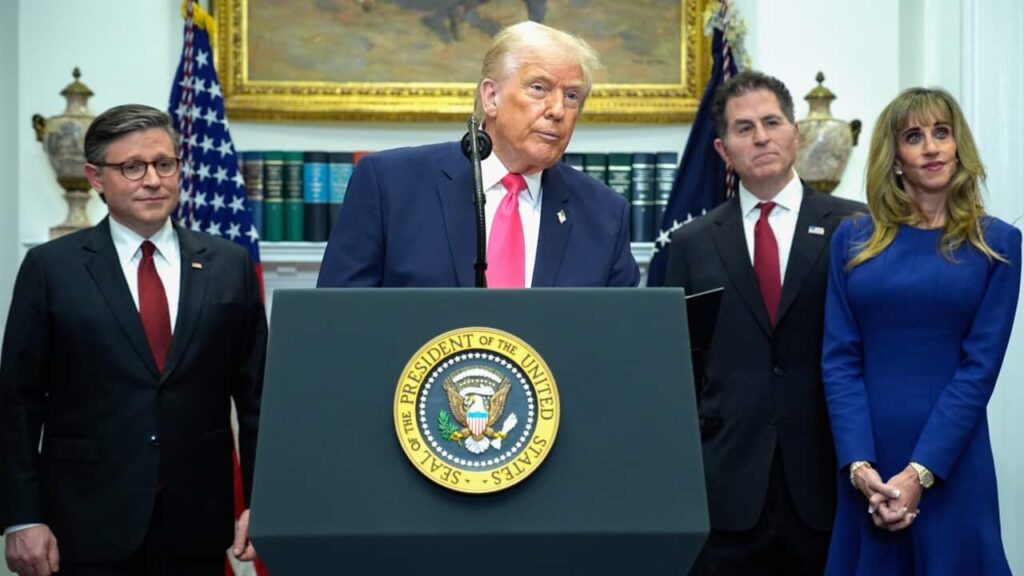
United States President Donald Trump has expressed admiration for Australia’s superannuation system, describing it as “a good plan” that has “worked out very well.” He revealed plans to explore a similar model in the U.S. as a strategy to address the nation’s declining birth rate. This announcement was made on Wednesday AEDT during the unveiling of a record US$6.25 billion donation from Michael and Susan Dell of the Dell technology company to children’s investment accounts.
“There’s a certain Australian plan that people are liking and they’re talking about … not for children, necessarily, but it’s for people, working people,” Trump stated. “We’re looking at it very seriously. It has worked out very well; it’s a good plan.”
Understanding the Superannuation System
Australia’s superannuation scheme is a compulsory retirement savings system, which mandates employer contributions to employees’ retirement funds. This system has grown to become the world’s fourth-largest pension pool. In contrast, the U.S. has the 401(k) retirement savings plan, where contributions are largely voluntary, leading to significant differences in retirement savings outcomes between the two countries.
When asked if he was specifically referring to the superannuation scheme, Trump confirmed, “That’s what they’re talking about, yep.” The interest in Australia’s model comes as the U.S. grapples with demographic challenges, including a shrinking birth rate.
The Dell Donation and ‘Trump Accounts’
The US$6.25 billion donation by Michael and Susan Dell aims to establish investment accounts for 25 million American children under the age of 11, living in households with a median income below US$150,000 per year. This initiative builds on the ‘Trump Accounts’ program, which provides US$1,000 in investment accounts for children born between January 1, 2025, and December 31, 2028, accessible when they turn 18.
Michael and Susan Dell are committing to one of the largest private donations in American history, which will directly benefit the next generation of American children through the new ‘Trump Accounts’ program.
Trump Accounts are available to American children under 18 who have a Social Security number. The broader aim of this trust fund-style policy is to encourage family growth, echoing efforts seen in other developed nations facing similar demographic challenges.
International Comparisons and Economic Implications
Australia’s superannuation system has not only bolstered retirement savings but also contributed to economic stability. With a pension pool that attracts international investment, Australia has positioned itself as a model for sustainable retirement planning. The potential adoption of a similar system in the U.S. could signify a shift towards more robust retirement savings mechanisms, potentially impacting both domestic and global financial markets.
In February, Australian Treasurer Jim Chalmers visited the U.S. to promote the superannuation scheme, which was widely interpreted as a strategic move to negotiate with Trump over trade tariffs. This visit underscores the international interest in Australia’s approach to retirement savings.
Looking Ahead: Potential Policy Shifts
While Trump has not provided specific details on how a U.S. version of the superannuation system would be implemented, his remarks suggest a growing interest in adopting policies that encourage long-term savings and address demographic challenges. Experts suggest that any such policy would need to consider the unique economic and social landscape of the U.S., including existing retirement savings mechanisms and the diverse needs of the American workforce.
The discussion around adopting Australia’s superannuation model highlights the ongoing global conversation about sustainable retirement planning and demographic resilience. As nations grapple with aging populations and declining birth rates, innovative solutions like the superannuation system may offer valuable insights and potential pathways forward.
For the latest updates and in-depth analysis, download our app and subscribe to our newsletter.