



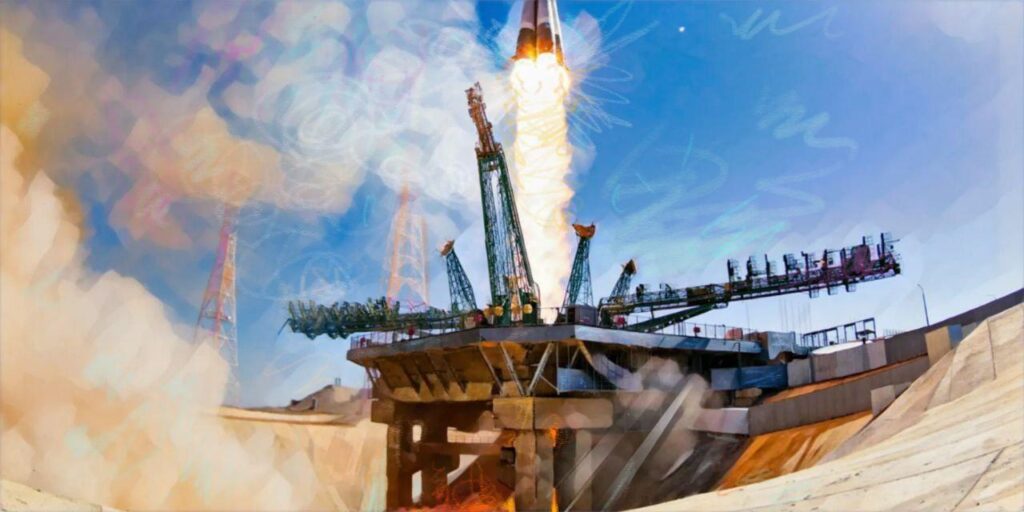
Russia’s space agency, Roscosmos, has confirmed that a launch pad at the Baikonur Cosmodrome in Kazakhstan sustained damage during the liftoff of a Soyuz spacecraft. The incident, which occurred on November 26, raises questions about the near-term launch schedule at a site that has been pivotal for Russian space missions for over six decades.
The Soyuz MS-28 mission successfully lifted off from Baikonur, carrying Russian cosmonauts Sergey Kud-Sverchkov and Sergey Mikayev, along with NASA astronaut Christopher Williams, to the International Space Station (ISS). The crew docked with the ISS approximately three hours later, with Roscosmos affirming that the spacecraft functioned as planned and the crew was in good health.
Damage Assessment and Repair Plans
Following the launch, engineers inspected Launch Pad 31/6, which was used for the flight. Roscosmos reported damage to several structural elements of the pad, with repair work slated to begin soon. The agency assured that all necessary parts for restoration were available, although it did not specify the exact components affected.
Both The Moscow Times and Russian state media, including RIA Novosti, have reported on the damage without detailing specific elements. Independent analysts, however, suggest that the damage might be more severe than indicated by Roscosmos. Anatoly Zak, a noted expert on Russian space activities, reported that a mobile service platform might have collapsed into the flame trench during or shortly after liftoff.
“A collapse of a mobile service platform would be unusual, since such structures are normally retracted before ignition,” noted Anatoly Zak.
Implications for Future Launches
Roscosmos has not confirmed the collapse of the platform and maintains that the MS-28 mission proceeded nominally. However, the incident is significant as Russia continues to rely on Baikonur for its Soyuz crew launches. The site, leased from Kazakhstan through 2050, remains essential because the Vostochny Cosmodrome in Russia’s Far East is not yet certified for crew flights.
While Russian outlets have hinted at potential adjustments to future launch schedules, no confirmed delays have been reported for upcoming missions. NASA has not issued a public statement regarding the status of joint operations following the incident.
Historical Context and Current Challenges
Baikonur has been a cornerstone of Russian space exploration since 1955, witnessing historic launches such as Sputnik and Yuri Gagarin’s first human spaceflight. However, the site’s infrastructure has aged, with limited modernization efforts. In 2019, Site 1 was retired from crew flights due to heavy wear, leaving Site 31/6 as the sole pad for Soyuz crew missions.
The new damage at Baikonur comes amidst tighter budgets and reduced access to imported components for Roscosmos, exacerbated by Western sanctions. The agency has scaled back some science missions, focusing instead on low-cost hardware that can be domestically produced.
Future Prospects and Strategic Shifts
The incident underscores the urgency for Russia to develop alternative launch sites. Vostochny Cosmodrome, envisioned as a future hub for crewed missions, still lacks the necessary systems for human spaceflights. Although Russia had planned its first crewed launch from Vostochny in the early 2020s, delays have pushed the target date back.
Until Vostochny is operational, Baikonur remains critical for Russia’s space endeavors. Any prolonged outage at the site could strain international partnerships, as NASA and Roscosmos rely on a steady flow of missions to maintain the ISS. Progress spacecraft, which supply vital resources to the Russian segment of the ISS, are also launched from Baikonur.
Roscosmos has pledged to release more information once a full review of the damage is completed. Meanwhile, the next Soyuz and Progress spacecraft are being prepared at Baikonur, as the MS-28 crew continues their mission aboard the ISS.
“The MS-28 crew is expected to stay aboard the station for about six months,” Roscosmos stated, “as ground teams assess the situation at Baikonur and decide how soon the damaged pad can return to service.”
The situation at Baikonur remains fluid, with potential implications for Russia’s space strategy and international collaborations. As Roscosmos navigates these challenges, the global space community watches closely, aware of the critical role Baikonur plays in sustaining human presence in space.